O wert thou in the cauld blast,
On yonder lea, on yonder lea,
My plaidie to the angry airt,
I'd shelter thee, I'd shelter thee;
Or did misfortune's bitter storms
Around thee blaw, around thee blaw,
They bield should be my bosom.
To share it a', to share it a'.
Robert Burns
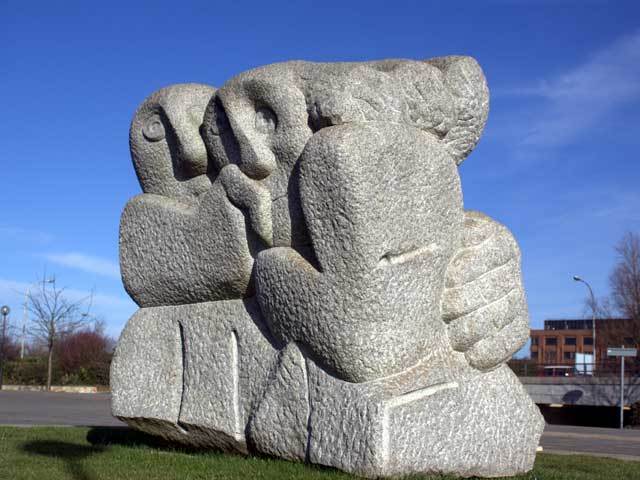
The published coordinates will take you to a sculpture that was created in 1984 by Ronald Rae. The above poem, one of the last poems written by Robert Burns, is inscribed on a plaque that is attached to the granite plinth on which the sculpture stands in Station Square in Central Milton Keynes.
As this is an EarthCache there is no physical cache to find or log to sign. Instead, read the description on the cache page and send the answers to the questions at the bottom of the page to me using my profile link in order to claim a find. You may claim a find before I have responded to your message, however any logs without a corresponding email may be deleted without notice.
Granite
Granite is a common type of felsic intrusive igneous rock that is crystalline and phaneritic (coarse grained) in texture. Granite's colours are predominantly white, pink, or grey in colour. Granite is a rock that is composed of an amalgamation of different minerals that are fused together under the intense heat and pressure of earth tectonics. The granite that was used for the sculpture in front of you is Creetown Granite, from the hill of Kirkmabreck in Galloway, Scotland.
The minerals most commonly found in granite are feldspar, quartz and mica, though other amphibole minerals are usually also present in smaller quantities. The minerals in granite are usually visible without the need for magnification because the rock cools underground. The size of the crystals depends on the rate at which the rock cooled - smaller crystals means the rock cooled quickly because the crystals did not have time to form. The crystallography of granite can usually be determined by estimating the percentage of different colours in the rock - pink or red for feldspar, dark brown or dark grey for mica, white or lightly coloured for quartz and black for amphibole.
Weathering
While granite is prized for use in buildings and sculptures for its resistance to erosion, it is still subject to weathering as are all rocks at the earth's surface. There are three types of weathering: physical, chemical and biological.
Physical weathering on a rock is caused by the effects of changing temperature, causing the rock to break apart. The process is sometimes assisted by water. For example - freeze-thaw occurs when water continually seeps into cracks in rock, freezes and expands, eventually breaking the rock apart.
Chemical weathering on a rock is caused by rain water reacting with the mineral grains within the rocks to form new minerals and soluble salts, which will then wash away. These reactions occur particularly when the water is slightly acidic. There are different types of chemical weathering, the most important being solution (removal of rock in solution by acidic rainwater. In particular, limestone is weathered by rainwater containing dissolved CO2), hydrolysis (the breakdown of rock by acidic water to produce clay and soluble salts) and oxidation (the breakdown of rock by oxygen and water, often giving iron-rich rocks a rusty-coloured weathered surface).
Biological weathering involves living organisms contributing to the weathering process. For example trees grow down roots through joints or cracks in the rock in order to find moisture. As the tree grows, the roots gradually prize the rock apart. The tiniest bacteria, algae and lichens produce chemicals that help break down the rock on which they live, so they can get the nutrients they need. Many animals, such as piddock shells, bore into rocks for protection either by scraping away the grains or secreting acid to dissolve the rock. One ends up with a rock on the beach looking like Swiss cheese.
EarthCache Questions
- Describe the granite that the sculpture is made from in terms of colour, texture and crystals. Which colour is more predominant in the rock? What percentage of the main minerals found in granite do you think it is made from?
- If you look closely you can find evidence of weathering on the sculpture. What type is it from the list above? Is it equally present on all sides of the sculpture, or is there one side that is more or less weathered than the others? Why?
- Compare the granite of the sculpture with the granite conglomerate of the paving slabs in the station square (not the pedestal the sculpture sits on). Does it have the same mineral make-up? Can you see any differences between the two stone types?
- What evidence is there of weathering in the paving slabs? What type is it from the list above?
- Some of the paving slabs in the square have been removed and have been replaced with a different type of stone. Why do you think this is? Why do you think they weren't replaced with granite conglomerate?
- (Optional but desirable) Please take a photo of yourself with the sculpture in the background.