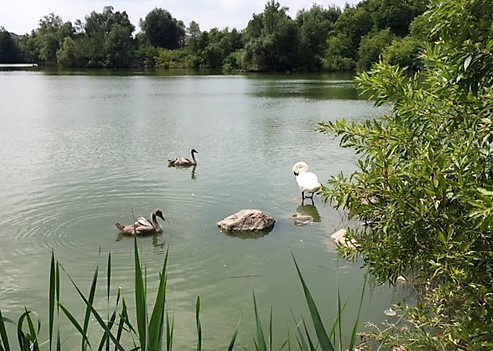
From the viewing areas you might get a good view of the swans on the lake.
Swan Lake was formerly a gravel pit in the 1960’s and 1970’s and is now a valued community feature, surrounded by parks, trails and urban development near the heart of Historic Markham Village.
In late 2010, residents of Swan Lake Community raised concerns about the water quality in Swan Lake. In response, the City initiated a monitoring program of the lake as well as upstream stormwater management ponds. High levels of phosphorus in the lake water and sediment were found to be contributing to low oxygen levels in the water, degraded fish habitat and the growth of blue-green algae.
Nitrogen and phosphorus are nutrients that are natural parts of aquatic ecosystems. Nitrogen is also the most abundant element in the air we breathe. Nitrogen and phosphorus support the growth of algae and aquatic plants, which provide food and habitat for fish, shellfish and smaller organisms that live in water.
But when too much nitrogen and phosphorus enter the environment - usually from a wide range of human activities - the air and water can become polluted. Nutrient pollution has impacted many streams, rivers, lakes, bays and coastal waters for the past several decades, resulting in serious environmental and human health issues, and impacting the economy.
Too much nitrogen and phosphorus in the water causes algae to grow faster than ecosystems can handle. Significant increases in algae harm water quality, food resources and habitats, and decrease the oxygen that fish and other aquatic life need to survive. Large growths of algae are called algal blooms and they can severely reduce or eliminate oxygen in the water, leading to illnesses in fish and the death of large numbers of fish. Some algal blooms are harmful to humans because they produce elevated toxins and bacterial growth that can make people sick if they come into contact with polluted water, consume tainted fish or shellfish, or drink contaminated water.
The Markham council authorized an innovative treatment to help improve the lake water quality in 2013, adopting the same technology used in Glasgow’s Strathclyde Lochfor the 2014 Commonwealth Games.
In the summer of 2013, 25 tonnes of Phoslock – a non-toxic clay product capable of removing phosphorus from the water and capping phosphorus in the bottom sediment - was applied across the lake.
Phoslock is the commercial name for a bentonite clay in which the sodium and/or calcium ions are exchanged for lanthanum. The addition of this element allows it to bind with phosphates to form rhabdophane and thereby remove them from the water column. It is used in lake restoration projects as a tool to manage eutrophication and manage algal blooms (specifically cyanobacteria or blue green algae) by reducing phosphorus, one of the major contributing factors to algal growth.
When Phoslock is applied during the spring or summer, some phosphorus removal may not take place until winter or spring the following year as the algae die, sink to the sediment and release phosphate as they decompose. This “second year” reduction is consistent with results observed in other lakes treated with Phoslock where phosphorus bound in algal cells during an application has only been removed from the total phosphorus pool once algae have completed their life cycle.
Continued monitoring of the lake water quality has indicated a 60% reduction in total phosphorus in surface and mid layers of the lake and increased water clarity in 2014. While phosphorus levels remain relatively high in the system, the risk of algae blooms and the severity of impacts have been reduced through the adoption of this innovative treatment technology.
One issue that emerged from the intensive study made of the lake in recent years is that the numbers of water fowl present on the lake, particularly in the late summer and autumn, are considerably higher than were originally estimated. As a result, measures aimed at proactively managing the number of Canada Geese on the lake were recommended, along with more regular monitoring of the outlets from the adjacent storm water management ponds.
Geese are major contributors of Phosphorus and Nitrogen in ponds and lakes. These nutrients come directly from goose excrement and cause eutrophication. Eutrophication is a natural process that all bodies of water experience. It is the gradual enrichment of nutrients over time. Goose excrement speeds up this process. Leaving extra nutrients for algae and weeds to grow rapidly. A rapid increase in algae can deplete the water of oxygen, damaging the aquatic environment and causing fish kills.
To log this earthcache you must answer the following questions (you may need to do some internet research):
1 - Based on growing season averages what were the total phosphorus levels (mg/L) in 2011 and 2013?
2 - Based on growing season averages what were the total nitrogen levels (mg/L) in 2011 and 2013?
3 - From the above description what does too much nitrogen and phosphorus in the water cause?
4 - From the sign at the viewing area provide one of the four items that are prohibited and could result in a $5,000 fine.
5 - From the viewing areas are there any indications of excessive algae growth, and do you believe the City of Markham achieved its goal of improving the health of the lake by lowering the phosphorus level?
6 - Optional - A photo of you or your GPS somewhere at Swan Lake.