Glaciers are slowly moving masses of accumulated ice. They form when more snow falls in a particular winter then melts in the following summer. Over extended periods of time, the snow that accumulates on the surface becomes ice beneath the surface.
During the Pleistocene Epoch, beginning 1.6 million years ago, global temperatures were lower than they are today. Although the reason for this worldwide decrease in temperature is unclear, it is evident that one of the results of this cooling climate was the formation of a series of large continental ice sheets. These ice sheets advanced and retreated several times, and during the last of these advances, the Wisconsinan Stage, glaciers reached their maximum distance south and covered most of New York State.
Glaciers in New York State reached a thickness of between 1 and 2 km. We know this because of scratches left by glaciers in the bedrock of the highest peaks of the Adirondacks 1.6 km high. The effect of the landscape on the area was extremely dramatic, as it caused erosion by scraping away the bedrock and loose sediments. It also gashed river valleys into deep troughs and deposited rock debris into a variety of different landforms. (1)
Perhaps one of the best evidences of past glaciation are long, parallel scratches in smoothed bedrock called striations. By trapping and carrying cobbles and pebbles in the bottom of the glacier over moderately hard bedrock like granite or limestone, glaciers indicate the direction over which they moved. A set of striations pointing in a north -south orientation will indicate a that glacier moved due south in the past. Additionally, the cobbles and pebbles trapped in the glacier can rotate and become scratched themselves. (2)
The ice sheet that covered New York is called the Laurentide Ice Sheet. Named after the location of its origin, the Laurentian Mountains of Quebec it covered nearly 13 million square kilometers, a large portion of the North American continent. The glacier flowed across New York State in a connected series of ice rivers or lobes. These lobes flowed in various directions as evidenced by striations and other evidence left behind by the glaciers. (1)
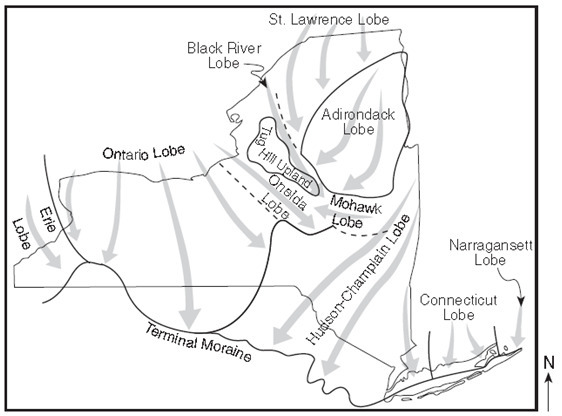
Figure 1: Lobes of the Laurentide Ice sheet in New York State (3)
There are several good examples of striations in the limestone bedrock along this stretch of trails in Green Lakes State Park. This Earthcache takes you to two of my favorites. Located just a short distance apart and directly on the Overlook and Farmer's Hill trails, these are very good examples of striations. In order to claim this Earth Cache as found you will need a ruler (metric or US standard system) and a compass.
Please accomplish the following and email me the answers. Do not include them in your log:
1) How long is the longest of the striations at either location?
2) What direction are these striations pointing?
3) Which lobe most likely formed them?
4) Assuming that the bedrock is of similar compositions and hardness at both locations which locations likely had the greater force? How do you know?
Sources:
(1) Isachsen, Y. W., Landing, E., Lauber, J. M., Rickard, L. V., & Rogers, W. B. (2000). Geology of New York: A simplified account(2nd ed.). Albany, NY: New York State Museum/Geological Survey, State Education Dept., University of the State of New York. Pages 161-167
(2) David, Roberts and W. Grant Hodson. Geology Eastern North America. Boston, New York: Houghton Mifflin Company, 1996. Page 40.
(3) New York State Science Regents Examinations: Physical Setting/Earth Science, June 2006. (n.d.). Retrieved August 18, 2018, from http://www.nysedregents.org/earthscience/archive2.html. page 19
New York State Parks Geocache Permit #GL-18-067