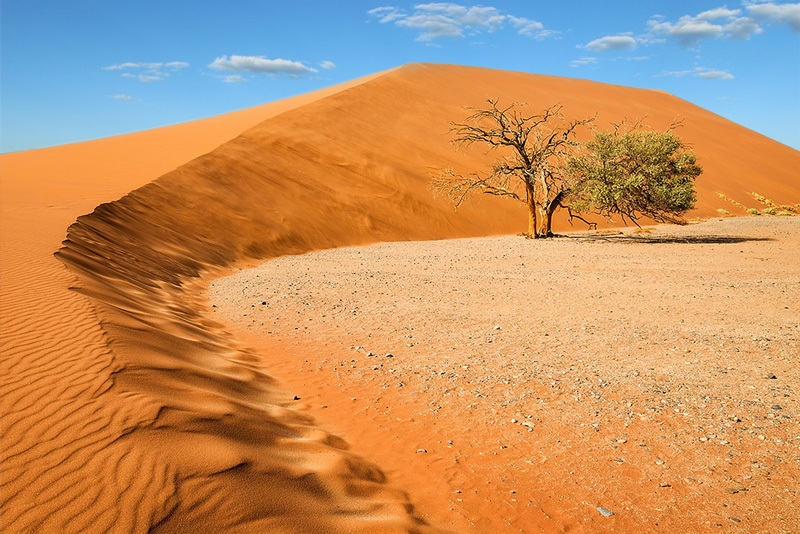
The color of the sand dunes, ranging from pale apricot to tangerine and deep red, originates from high iron content and is the result of ‘rusting’ or oxidation of those particles.
On your tour to Sossusvlei, you probably have noticed darker areas within the mainly orange-coloured dunes. Even from a distance, those dark stripes or streaks at the dune flanks are clearly visible. These are neither shadows of ripples nor humus soil of rotten trees nor other organic material. Instead, these are also sedimants like the predominant quartz sand that have been weathered over millions of years, eroded and washed over the rivers into the sea.
In order to discover this phenomenon, you do not need a metal detector, a simple hand magnet is sufficient. Nowadays, almost every geocacher even holds various neodymium magnets within his extended caching equipment.
If you take a closer look, you can locate spots on or near the listed coordinates with dark streaks in the orange sand. Many dark and also iron-bearing minerals are contained in these spots.
You will realize that the (heavier) darker minerals are always accumulated at certain places. The reason for this sorting phenomenon is the different size and density of the sediment particles.
It is very likely that these dark sediment particles consist of ironsand or heavy sand. This sand contains the mineral magnetite that we are going to examine more closely.
Composition and Properties
Magnetite is a ferrimagnetic mineral and because of its high amount of iron of up to 72%, it is besides Hamatit one of the main iron ores. With the chemical formula Fe3O4, more precisely (Fe3+2Fe2+O4), it is the most stable compound between iron and oxygen. High iron content gives the heavy mineral its opaqueness and distinct color luster. The appropriate color and shape you will need to find out yourself while solving the associated task.
Magnetite is a dense (specific gravity 5.2 g/cm3) mineral. This is considerably above common silicate minerals. Hardness is about 6 on the Mohs’scale. It has no cleavage but parting may be distinct. Crystals are brittle and fracture is uneven.
In case of natural genesis, magnetite develops mostly centimeter-sized, octahedron-shaped crystals, less often rhombic dodecahedron. Granular or massive aggregates occur mostly in large quantities as coarse ore.
As the name already tells, magnetite has admirable magnetic properties, meaning it is attracted by a magnet and can be magnetized to become a permanent magnet itself. This makes the mineral easily identifiable. Magnetite is the most magnetic of all the naturally-occurring minerals on Earth.
Because its magnetic property is the most striking feature, you will find more details on the self-magnetism of this mineral here.
In common sense, most of the rock forming minerals are not magnetic. But on an atomic scale, all substances are magnetic since each atom has a permanent magnetic moment resulting from the spin of its electrons and the orbital motion of the electrons around the atomic nucleus. However, the individual fields neutralize each other, so that no magnetic moment takes an effect outwards.
Minerals are the only ones that have a magnetic dipole field without external action. This field arises from oppositely polarized magnetic domains, where the number of dipoles in one orientation is higher than in the other. Magnetite is an oxide of both trivalent and divalent iron. The oxygen ions are present in a dense packing of spheres, while the iron (II) and iron (III) ions have their place in two antiparallel magnetized crystal lattices in the form of octahedron gaps and tetrahedron gaps. This arrangement causes the transfer of electrons to happen between the iron ions in certain directions only. The magnetic moments of the gaps are antiparallel to one another which results in a residual moment that causes the external magnetic effect.
Origin and Deposits
It is believed that the Dunes of Sossusvlei were formed around five million years ago. Once weathered, the rocks of the Lesotho highlands were eroded away and transported by the Orange River towards the Atlantic Ocean. The Benguela Current drove the grains north by longshore drift. Blowing inland, winds caused the distribution of the sand and the formation of the Namib Sand Sea.
Since the earth's core largely consists of iron, volcanic activity outcrops iron-bearing material to the surface for millions of years. Therefore, many igneous or metamorphic rocks contain iron in form of the mineral magnetite. Although, it is a very common mineral, it is rarely the main component of a rock. Magnetite crystallizes as a magmatic mineral at about 600 °C, when liquid lava penetrates the adjacent rocks. Small grains of this mineral occur in Basalt, Granit, Diabas und Gabbro. Magnetite is also formed by contact metamorphism, when rocks containing sulfide, silicate or limestone are overprinted by magmatic gases.
Magnetite is among the most common minerals in heavy mineral fraction of alluvial, marine and aeolian deposits because it is abundant in many rock types. Particularly worthy of note is the durability (resistance against weathering) of the basaltic rock fragments, which do not only endure more than 2000 km of transport from Drakensberg mountain range along the Orange River, but survive in nearly unchanged proportions multistep transport in high-energy coastal and arid environments for another 1000 km, prolonged over a long period of time.
Aeolian transport of sand grains causes not only the formation of ripples and dunes but also the origination of placer deposits. In geology, a placer is a location where heavy minerals were gathered by gravitiy. In order to accumulate in placers, mineral particles must be significantly denser than quartz (whose specific gravity is about 2.5 – 3.5 g/cm3), as quartz is usually the largest component of sand. Depending on the direction and strength of the wind, placers were found mostly at a distinct side of the dune.
Placer environments typically contain black sand, a conspicuous shiny black mixture of iron oxides like magnetite, maghemite, hematite and ilmenite.
Tasks
The listed coordinates guide you to a nice viewpoint at Deadvlei. On your way, look for the aforementioned spots with dark streaks in the orange-colored sand. Then engage yourself in the following tasks.
- After you get a bit of an overview of the Dunes of Sossusvlei, describe the typical locations of the dark spots, their distribution and shape. At what side of a dune (stoss or lee) are the deposits usually? What could be the cause? Justify your observation.
- Choose one spot with dark and dry sediments and take a sand sample. Now perform the separation of the magnetite minerals by means of a magnet. Make sure you observe the notes below for a successful experiment.
Document the experiment with an illustrated proof – either by a freehand sketch or a picture.
Estimate the percentage of the magnetic minerals compared to your sample.
Describe the minerals extracted by magnetic separation (size, shape, color, hardness, shine, transparency).
- Using a common magnifying glass or a folding magnifier, look closely at the minerals and describe your observation. Can you determine differences in grain size and roundness between magnetite and quartz sand? Provide a presumption of the cause of the similarity or dissimilarity.
Once you have sent your answers to the e-mail address of our profile, you can log your visit online. We will only contact you if something is missing or incorrect.
Have fun outdoors.
Notes on the successful completion of the experiment:
- Find a location with dark sand, since the number of heavy minerals is significantly higher than at locations with red sand.
- Take only samples from dry areas or make sure your samples are thoroughly dried.
- Use strong magnets like neodyms.
- Cover the magnet by paper or plastic sheet in order to better strip off the magnetic minerals into an appropriate container.
- Repeat the process of magnetic separation, if necessary.
Sources:
- wikipedia.org/wiki/Sossusvlei
- wikipedia.org/wiki/Magnetite
- wikipedia.org/wiki/Roundness_(geology)
- sandatlas.org
- kristallin.de
- Paläomagnetismus und Archäomagnetismus, Heinrich C. Soffel, Springer, 1991
- From Lesotho basaltic highlands to the Namib Sand Sea: long-distance transport and compositional variability in the wind-displaced Orange Delta, Garzanti et al., 2012