First off: Oaro M Settlement is private land. Driving through town is not permitted. Park at the parking coordinates and walk through town. Be very careful when crossing the tracks - look both ways. There are no lights or barrier arms, but there ARE trains!
The Mystery of Oaro
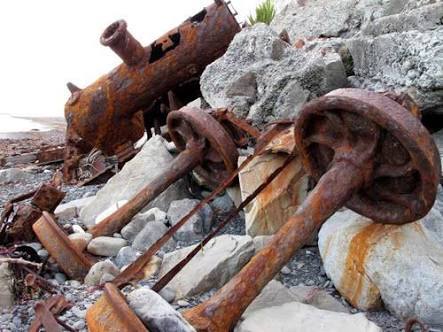
In 1943 a mixed goods steam train came up from Christchurch to Oaro. Shortly before it was expected to arrive the entire train had left the rails and now lies rusting on the shore here. But there are strange facts to be gleaned from the site and online research. Facts that do not add up...
1. The engine is small for its day. I was unable to determine the type of engine, but this rail line as laid in 1943 - diesel locomotives where in common use then, so why use a older, low power steam engine? And not a more modern steam engine? A KA class engine is about 3 times the size.
2. There are cars in front of the engine, as well as the cars behind. And not just one or two, that might have continued on as the engine jumped the rails before succuming themselves. An engine is normally placed at the front of the train, or very rarely, at the back. In the middle is very unusual.
3. The cars are old flatbeds, note the curved spokes on the wheels. They appear to have no superstructure, or even a flat bed. Of course these may have eroded or rotted away in the intervening years.
4. There are no significant rocks on top of the wreckage, suggesting that the train was not pushed off the rails by a landslide or rockfall.
5. And, perhaps most importantly, the accident has not been reported in any of the journals of railway accidents.
To me two things really stand out. Firstly, that the train is old - and old engine and old cars, possibly from the log hauling days of early New Zealand rail, maybe around 1910. Perhaps a delivery to a museum? (or from a museum to a restoration facility?) And secondly, the lack of accident reporting. This was 1943 - during the Second World War. Was this a New Zealand Rail or Government coverup? What were they transporting? No evidence of the cargo remains. A secret wartime project? Was New Zealand building parts for the Manhatten Project? Or something else? Was the train sabotaged?
I invite you come and have a look for yourselves. Please post in your logs your theories of what may have happened here.
Remember, Tracks are for Trains. Be VERY careful near the rail line.