Welcome To The Mon River Rails To Trails
Everyday, dozens of people run, walk, hike, bike, and of course, geocache right past this magnificent shale formation but don't think anything about the rock present in the area. To complete this earthcache, you will need to return to the trail, make some observations, and use your new found knowledge to draw conclusions about the world around you. Below is some information about shale, the formation, and what happens to the rock over time. I hope you enjoy this area as much as I do!

Shale in Architecture
Shale is a fine-grained, clastic sedimentary rock composed of mud that is a mix of flakes of clay minerals and tiny fragments (silt-sized particles) of other minerals, especially quartz and calcite. Shale is characterized by breaks along thin laminae or parallel layering or bedding less than one centimeter in thickness, called fissility. It is the most common sedimentary rock.
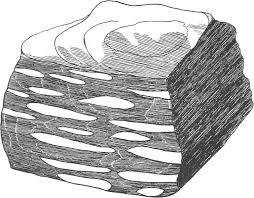
Fissility
In geology, fissility is the ability or tendency of a rock to split along flat planes of weakness (“parting surfaces”). These planes of weakness are oriented parallel to stratification in sedimentary rocks. Fissility is differentiated from scaly fabric in hand sample by the parting surfaces’ continuously parallel orientations to each other and to stratification. Fissility is distinguished from scaly fabric in thin section by the well-developed orientation of platy minerals such as mica. Fissility is the result of sedimentary or metamorphic processes.
Facies
In geology, a facies is a body of rock with specified characteristics, which can be any observable attribute of rocks such as their overall appearance, composition, or condition of formation, and the changes that may occur in those attributes over a geographic area. It is the sum total characteristics of a rock including its chemical, physical, and biological features that distinguishes it from adjacent rock.
Talus
Talus is a term that refers to the accumulative rockfall at the base of a rock face or cliff. The degree of sameness in size, layering, and homogeny of the talus is referred to as sorting. Contributing rock that is irregularly fractured does not weather evenly and because it breaks off in large irregular pieces, contributes to a poorly sorted talus slope. The recognition and characterization of talus slopes is often important in determining the potential for mass movements (landslides, etc.). Movements occur whenever the talus slope exceeds the critical angle.

Chemical weathering decomposes or decays rocks and minerals. An example of chemical weathering is water dissolving limestone. Water and many chemical compounds found in water is the main agent of chemical weathering. Feldspar, one of the most abundant rock-forming minerals, chemically reacts with water and water-soluble compounds to form clay. Water contains many weak acids such as carbonic acid. This weak, but abundant, acid is formed when carbon dioxide gas from the atmosphere mixes with rainwater. Sulfur dioxide and nitrogen gases create other types of acid rain that act as chemical weathering agents. Some sources of sulfur dioxide are power plants that burn coal; as well as volcanoes and coastal marshes. Sulfur gases react with oxygen and rainwater to form sulfuric acid. Although relatively weak, acid’s abundance and long-term effects produce noticeable damage to vegetation, fabrics, paints, and rocks. There are different types of chemical weathering, the most important are:
--Solution: removal of rock in solution by acidic rainwater. In particular, limestone is weathered by rainwater containing dissolved CO2, (this process is sometimes called carbonation).
--Hydrolysis: the breakdown of rock by acidic water to produce clay and soluble salts.
--Oxidation: the breakdown of rock by oxygen and water, often giving iron-rich rocks a rusty-colored weathered surface. Oxidation is another kind of chemical weathering that occurs when oxygen combines with another substance and creates compounds called oxides. Rust, for example, is iron oxide. When rocks, particularly those with iron in them, are exposed to air and water, the iron undergoes oxidation, which can weaken the rocks and make them crumble.
QUESTIONS!
At the coordinates provided you will find a fully exposed shale formation with visible breaks in the rock. The formation is visible from the trail, but you may need to move closer to answer the question about talus; please be careful of the loose rock. Answer each of the questions and email your findings to me via geocaching.com.
1) Estimate the length and height of the exposed formation.
2) Is there any fissility? If so, describe it.
3) Identify the talus at the base of the formation. What caused this?
4) What type of weathering is present at GZ?
5) Why is this rock formation different than the ones before and after it along the trail?
Extra Credit: Take a photo of yourself at your favorite of the three locations. Be sure to avoid revealing the answers.