This is earthcache 1 of 4, on Cumbria Wildlife Trust’s Eycott Hill Nature Reserve. Other than the free car park there are no facilities here. The terrain is uneven and can be very wet underfoot. Sturdy footwear will be required, and wellington boots are recommended in autumn and winter, or after prolonged periods of heavy rain.
Eycott Hill: millions of years in the making
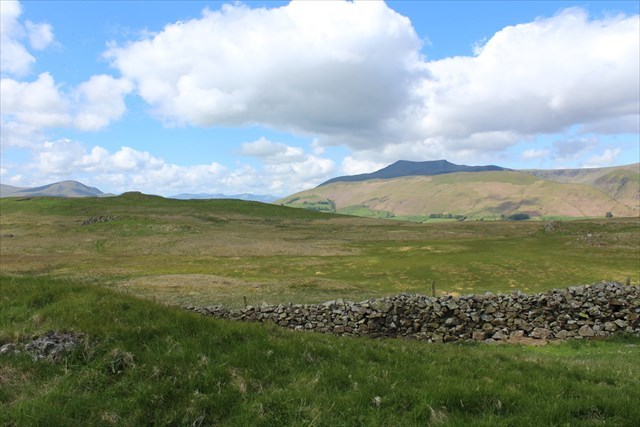
Eycott Hill’s geological story goes back almost 500 million years. Ancient lava flows, sandwiched between older siltstones and mudstones and younger limestones, give an insight into the origins and evolution of the Lake District and make this nature reserve a nationally important Site of Special Scientific Interest (SSSI) for geology.
It all began approx. 480 million years ago, when sediment washed into the ancient Iapetus Ocean. Layers of mud and silt built up, hardening to form the siltstones and mudstones known as the Skiddaw Group. These slate rocks are amongst the oldest in the Lake District.
Around 450-460 million years ago, the Iapetus Ocean began to close as the surrounding continents moved together, and volcanic eruptions were triggered. Lava flowed and solidified to form a hard, dark igneous rock called andesite. At Eycott Hill Nature Reserve there are over 20 separate lava flows that erupted millions of years apart. The oldest lava flows, to the west of the nature reserve, contain large feldspar crystals.
Almost 100 million years later, the eroded lava landscape was covered by a warm, shallow sea. The remains of sea creatures accumulated on the sea bed as a limey mud which, over time, hardened to form limestone. Today, hollows in the ground, known as sinkholes are a clue to the limestone rock that lies below the glacial deposits. Limestone reacts with rainwater and dissolves to form the hollows. During the last ice age, around 20,000 years ago, a thick ice cap covered the Lake District. Ice flowed from the fells carving out the softer material and weaker rocks from between the lava flows and leaving behind ‘erratic’ rocks.
Please note: you leave the main path to reach this Earthcache. The ground is uneven and the vegetation contains nettles and thistles so trousers and sturdy boots are recommended.
Questions:
1. What is the geological feature in the ground here?
2. Standing on the large stone, facing NW, how many of these features can you see directly in front of you? How many are behind you?
3. How was this geological feature formed?
4. OPTIONAL: We would love to see your photos. Please post one of the nature reserve but don’t show the geological feature!
To claim this Earthcache, please send your answers in a message, either by e-mail or through the Message Centre. Do not put them in your log. You do not have to wait for a reply before logging, if there is a problem with your answers we will let you know. Logs without a supporting answer message may be deleted.
Look out for information panels at the nature reserve to learn more about Eycott Hill’s earth history. You can also download a geology leaflet before you visit or order a printed copy by calling Cumbria Wildlife Trust on 01539 816300. Lots of events take place each year at Eycott Hill Nature Reserve, visit https://www.cumbriawildlifetrust.org.uk/events to see what is happening in advance of a visit. For children Cumbria Wildlife Trust have a “Tale Trail” leaflet called “The Raven of Eycott Hill”, these can be picked up in the car park, or can be ordered in advance of a visit by calling 01539 816300. There is also a Nature Reserve leaflet with lots of interesting information about the wildlife you may see here.
All the information above has been sourced from Cumbria Wildlife Trust & Cumbria GeoConservation. Thanks also to Elizabeth Pickett for her assistance and illustrations.