The Pennsylvanian Period lasted from 320 to 286 million years ago. During the Pennsylvanian Period, widespread swamps laid down the thick beds of dead plant material that today constitute most of the world's coal . The term Pennsylvanian is a U.S. coinage based on the frequency of rocks of this period in the state of Pennsylvania; internationally, the terms late Carboniferous Period or Silesian Period are preferred.
The Southern Hemisphere, which was dominated by the huge continent Gondwana (see figure 1 below), underwent a series of ice ages during this period. These ice ages sequestered water in times of ice growth and released it in times of melting , causing the ocean to cyclically regress (uncover coastal lands) and transgress (cover coastal lands) around the world. Repeating sequences of sedimentary rock layers record these changes in sea level.
From the bottom up, a typical sequence is sandstone , shale, coal, limestone , and sandstone again. Each such unit is termed a cyclothem and was formed as follows: (1) As ice melted in Gondwana, seas rose globally. Rivers and streams deposited sand and gravel in the coastal lowlands as they sought new equilibrium profiles (i.e., stable altitude-vs.-distance cross-sections). This sand layer eventually became sandstone. Although the coastal zones where sandstone deposition was taking place at any one time were narrow, larges areas were blanketed by these sediments as the seas rose and coastlines swept slowly inland. (2) As the rising sea neared a given location, a lush coastal swamp developed. This deposited a thick layer of dead leaves, tree trunks, and other organic material rich in carbon that would eventually form coal. (3) When the sea finally submerged the swamp, a shallow marine environment appeared. The remains of shelly marine animals built up on the sea floor and eventually became limestone. (4) Ice began to build again in Gondwana, and sea levels began to drop in a new phase of regression. (5) Erosion of re-exposed coastal lands scraped off the topmost sediments left by the last transgression, including some of the limestone layer. (6) Ice began to melt again in Gondwana, triggering a fresh cycle of transgression.
As many as 90 cyclothems have been found in one place, one on top of the other. Each such cylothem records a complete climatic cycle like the one described above.
"Pennsylvanian Period." World of Earth Science. . Encyclopedia.com. 7 Oct. 2018 <http://www.encyclopedia.com>.
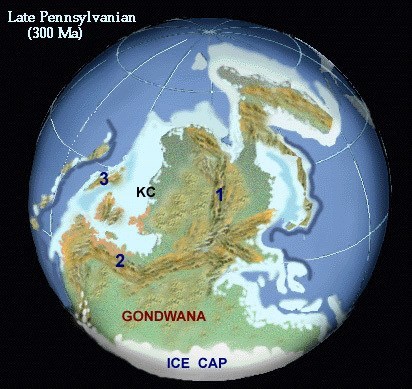
KC = Location of Kansas City; 1 = Appalachian Mountains; 2 = Ouachitas Mountains; 3 = Ancestral Rocky Mountains
Once you arrive at the posted coordinates look to the Northeast and you will see an example of these rock layers. There are three distinct limestone layers. Each is separated by layers of shale which are covered in greenery. Each of the three thick layers are limestone. In descending order, from the top down, these are Winterset Limestone, Bethany Falls Limestone and Hertha Limestone.
To claim credit for this Earthcache, please do the following:
Email or message your answers with the GC code and name of the cache.
1 - What is a typical sequence for a cyclothem?
2 - What remains built up on the sea floor and eventually became the limestone layers you see before you?
3 - If the Bethany Falls limestone layer is twenty feet thick, estimate the height from the level you are standing to the top.