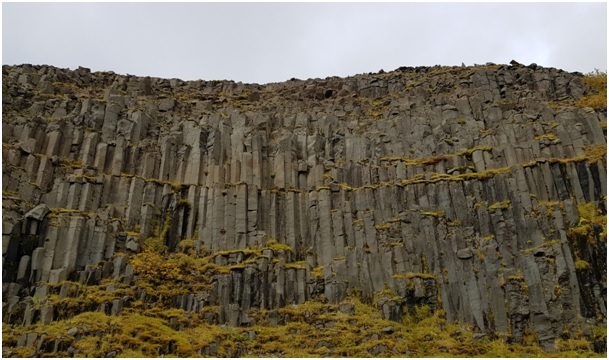
The learning point of this earthcache is to get to know the basalt rock, and its formation of the columns better.
The coordinates lead you to the valley of Seljavellir, a hidden gem in Iceland.
Up at the mountain side here you will find some fine samples of basalt columns that`s displayed.
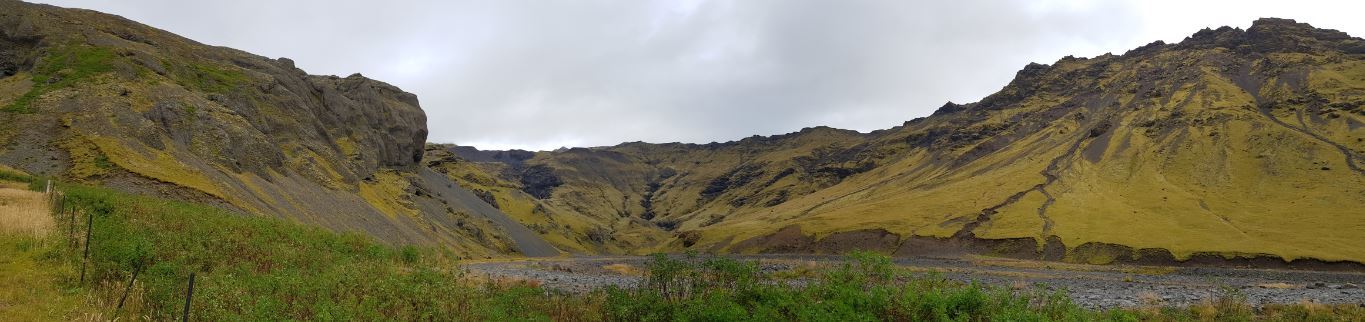
(Valley of Seljavellir)
. . . . . . . . . . . . . . . . . . . . . . . . . . . .
The basic way to explain the geology of Iceland is that the island is placed over a hot spot.
Iceland has formed by the coincidence of the spreading boundary of the North American and Eurasian plates and a hotspot or mantle plume – an upsurge of abnormally hot rock in the Earth´s mantle. As the plates moved apart, excessive eruptions of lava constructed volcanoes and filled rift valleys. And that is how this part of Iceland and this Valley has formed. With the volcanic act this beautiful landscape has been built up.
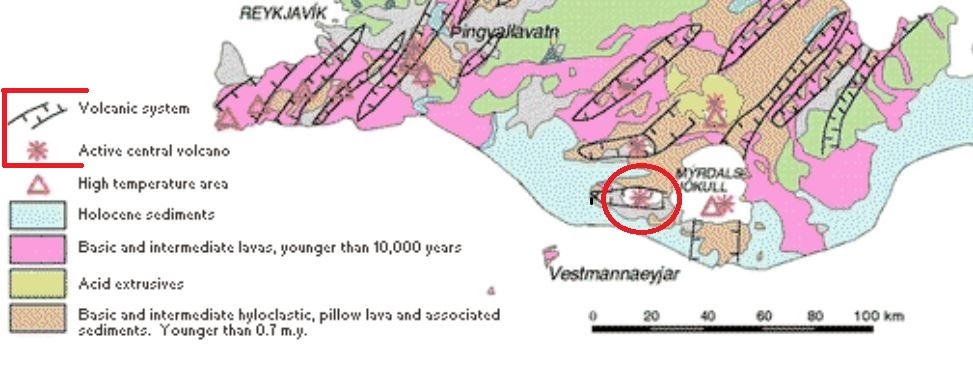
This area consists of the columns made up by basalt that comes from a micro-crystalline basaltic lava. The lava origin from the Volcano Eyjafjallajökull and is found at the base and foot of the volcano. The lava has flowed down in the shallow valley, coming from above at the north part where the Eyjafjallajökull is to be found. The basalt here in this valley consists of plagioclase, olivine, occasional pyroxenes and iron oxide crystals, set in a micro-crystalline groundmass of the same mineralogy, which hosts no interstitial glass. The colonnades exhibit quasi-hexagonal fracture patterns, jointed into columns ranging between 30 and 130 cm across.
. . . . . . . . . . . . . . . . . . . . . . . . . . . .
Basalt is an extrusive igneous rock that is very dark in color. It is actually the most common type of rock in the earth's crust, and it also makes up most of the ocean floor.
The basalt rock is made of different dark colored minerals such as pyroxene and olivine. The volcanic rock is low in silica content and comparatively rich in iron and magnesium. Basalt also contains some light colored minerals such as feldspar and quartz, but the amounts are very small, and by that don’t “shine” through the stone. Typically, you can't see most of the mineral crystals without using a microscope in the basalt stone because the quick cooling that prevents large crystals from forming. This makes the crystals tiny and unseen by the human eye.
Basalt forms when lava reaches the earth's surface at a volcano or a mid ocean ridge. The lava is between 1100 to 1250° C when it gets to the surface. It cools quickly, within a few days or a couple weeks, forming solid rock. While very thick lava flows may take many years to become completely solid.
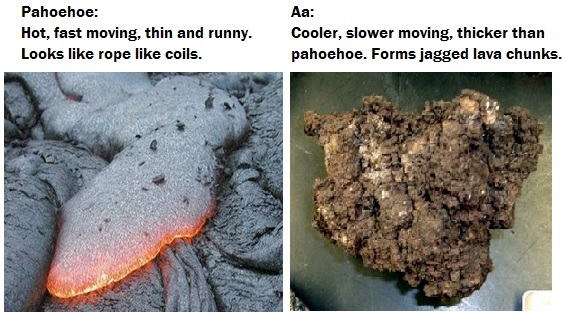
There are two types of volcanic basalt, described under in words to easier understand and remember the two different types:
Two Hawaiian words are used to describe the two types of volcanic basalt: 'A'a and pahoehoe. 'A'a basalts have rough surfaces (that make barefoot people cry, "Ah! Ah!" as they walk across it). This type of lava surface is rough with pointing and sharp edges. 'A'a is cooler, slower-moving basaltic lava. Pahoehoe basalts have a smooth glassy surface that looks like many ropes. The "ropes" form when the surface cools, becoming solid rock while lava flows beneath it. Pahoehoe is a hotter, faster-moving basaltic lava.
Columnar Jointing:
The wording columnar jointing is defined as: parallel, prismatic columns in basaltic flows and sometimes other rocks, and this specific pattern is a result of cooling. The columns are normally found in shallow intrusive or extrusive igneous rock bodies, generally, basaltic, sills, dikes and lava flows.
Columnar jointing is always a joy to observe in rocks out in the field. Viewing perfectly immaculate geometric columns of rock can only be described as magical and mind gaping. However, that majestic columnar jointing can easily be explained with a little bit of physics.
Let me try to explain how columnar jointing forms in basalt.
Basalt is an igneous, volcanic rock. Igneou means that the rock formed from a melt and volcanic substance. The melt erupted at the Earth’s surface as lava before it cooled to form the rock.

Columnar jointing is a product of differential cooling in a volcanic deposit. Remember, they are hot and when they are deposited as lava flows or tephra deposits, they encounter the Earth’s surface that, comparatively speaking, is cold. The top of the lava flow will be cooler than the bottom of the lava flow, as the picture above shows. The tops and bottoms of the deposits are especially exposed to the cold surface of the Earth. When most lavas or tephra cool, they tend to contract. Easy example to understand this can be explained by: Hot steam, when you open the lid of a simmering pot or a tea kettle, that hot steam wants to escape and expand into the air. When objects contract, they often crack or fracture, that respond to the change in volume, hot things generally take up more space than cold things. When contraction occurs at centers (marked with red in the picture above.) which are equally, then a hexagonal fracture pattern will develop, and can produce 4, 5, 6, 7 or 8-sided shapes that terminate with convex/concave surfaces. These shapes then propagate through the deposit to form long columns that keep (roughly) the shape of the fracture formed at the cooling surfaces (e.g., the top or bottom of the deposit).
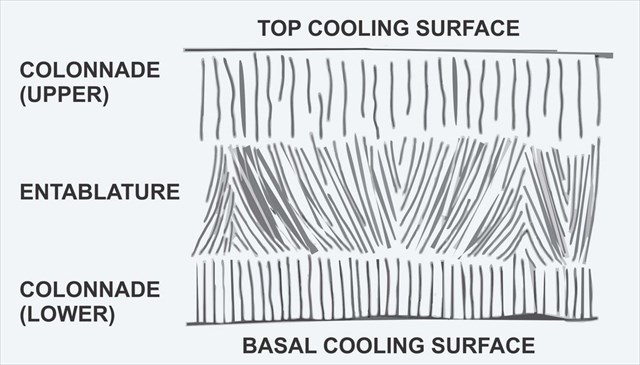
These columns can be tall – extending throughout thick flow units. The section of the cooling unit that has columns is called the colonnade, while irregularly fractured areas between the columns is called the entablature.
Water can play a big role in the formation of columnar jointing in lava flows.
The sequences of colonnades and entablatures can also be geographically extensive, sometimes laterally continuous for tens of kilometers. Some of the best examples of columnar jointing are in large basaltic lava flows thanks to their high thermal gradient.
To log this cache.
To get to log this cache you will have to visit and answer the questions which are related to the coordinates given the earthcache.
When answers are collected, send them to CO for verification.
You can log immediately after answers are sent CO. If there are any questions about your answers CO will contact you.
Logs without answers to CO or with pending questions from CO will be deleted without any further notice.
Please do not include pictures in your log that may answer the questions.
Questions
1. Answer the questions under by visiting the coordinates, and study the valley of Seljavellir.
A. Describe the basalt, and the columns that you stand in front off! Color, texture, crystals, minerals, formation and shape!
B. The formation of columns is particular enhanced by water. Where water cooling has played a significant role a predominantly two-tiered set of columns can develop, known as entablature and colonnade. By studying ground zero, would you say that water cooling have played a significant role here at this location? Why/why not?
C. Have a look at the geometries of the fracture found at ground zero. Can more shapes than the Hexagonal fracture type be found here? (Square 4, Pentagon 5, Hexagon 6, Heptagon 7, Octagon 8, Nonagon 9, Decagon 10). No need to climb, there is enough to study and pick from at your own length of height.
D. Is this basalt lava the Pahoehoe type or not? Describe how you conclude?
2. (It’s voluntary to post a photo in your online log of your visit)
Without revealing any answers!
