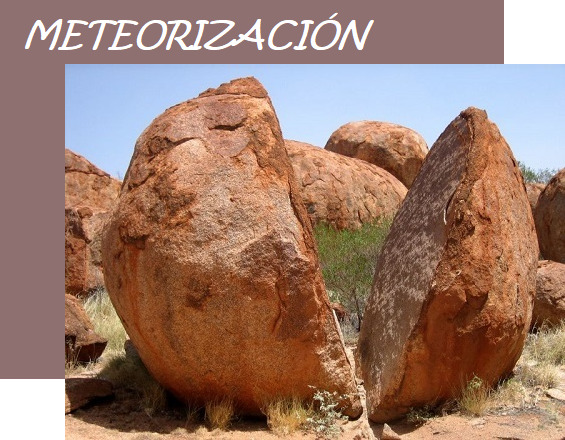

Se llama meteorización a la descomposición de minerales, rocas y suelo así como de madera y materiales artificiales que ocurre sobre o cerca de la superficie terrestre cuando estos materiales entran en contacto con la atmósfera, hidrosfera y la biosfera.
La meteorización ocurre in situ (en el sitio), es decir, en el mismo lugar, con poco o ningún movimiento, y por lo tanto no debe confundirse con la erosión, que implicaría el movimiento de rocas y minerales por agentes como el agua, hielo, nieve, viento, olas y gravedad y luego ser transportados y depositados en otros lugares.
Existen dos clasificaciones importantes de los procesos de meteorización: la meteorización física y química; a veces también está involucrado un componente biológico. Sin embargo algunos cientientíficos consideran la meteorización biológica como un tercer tipo.
- El desgaste mecánico o físico implica la descomposición de rocas y suelos a través del contacto directo con las condiciones atmosféricas, como el calor, el agua, el hielo y la presión.
- La segunda clasificación, la meteorización química, implica el efecto directo de los químicos atmosféricos o químicos producidos biológicamente, también conocidos como meteorización biológica en la descomposición de rocas, suelos y minerales.
Mientras que la intemperie física se acentúa en ambientes muy fríos o muy secos, las reacciones químicas son más intensas cuando el clima es húmedo y caluroso. Sin embargo, ambos tipos de desgaste ocurren juntos, y cada uno tiende a acelerar el otro. Por ejemplo, la abrasión física (frotando entre sí) disminuye el tamaño de las partículas y, por lo tanto, aumenta su área de superficie, haciéndolas más susceptibles a las reacciones químicas. Los diversos agentes actúan en concierto para convertir los minerales primarios (feldespatos y micas) en minerales secundarios (arcillas y carbonatos) y liberan elementos nutrientes de las plantas en formas solubles.
|

Weathering is the breaking down of rocks, soil, and minerals as well as wood and artificial materials through contact with the Earth's atmosphere, water, and biological organisms.
Weathering occurs in situ (on site), that is, in the same place, with little or no movement, and thus should not be confused with erosion, which involves the movement of rocks and minerals by agents such as water, ice, snow, wind, waves and gravity and then being transported and deposited in other locations.
Two important classifications of weathering processes exist – physical and chemical weathering; each sometimes involves a biological component. However, some scientists consider biological weathering as a third type.
- Mechanical or physical weathering involves the breakdown of rocks and soils through direct contact with atmospheric conditions, such as heat, water, ice and pressure.
- The second classification, chemical weathering, involves the direct effect of atmospheric chemicals or biologically produced chemicals also known as biological weathering in the breakdown of rocks, soils and minerals.
While physical weathering is accentuated in very cold or very dry environments, chemical reactions are most intense where the climate is wet and hot. However, both types of weathering occur together, and each tends to accelerate the other. For example, physical abrasion (rubbing together) decreases the size of particles and therefore increases their surface area, making them more susceptible to chemical reactions. The various agents act in concert to convert primary minerals (feldspars and micas) to secondary minerals (clays and carbonates) and release plant nutrient elements in soluble forms. |


|
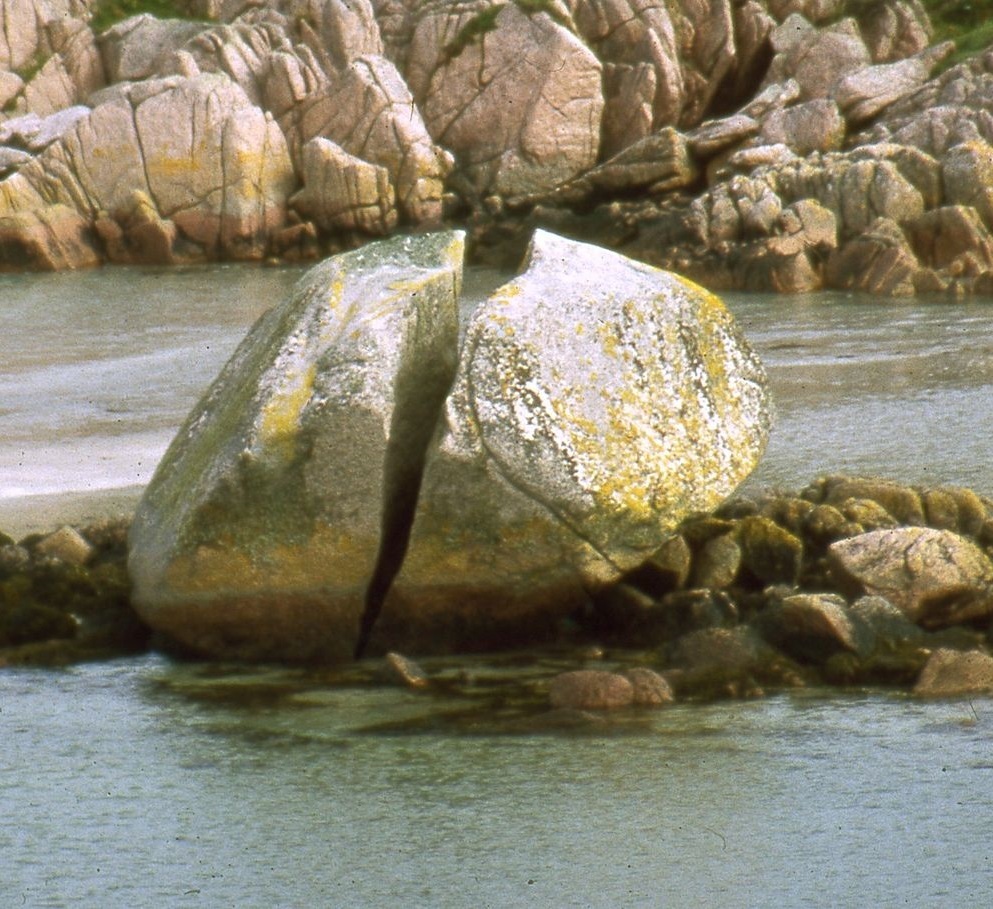
Meteorización física / Physical weathering
Gran bloque de granito fracturado, probablemente por gelifracción, en Escocia.
Large fractured granite block, probably by gelifraction, in Scotland. |
La meteorización física está causada por las condiciones ambientales (agua, calor, sal, etc.). Los agentes que la provocan son:
- Descompresión: La reducción de la presión litostática produce la expansión y el agrietamiento en rocas que se han formado a gran profundidad. A causa de esta dilatación experimentan el desarrollo de diaclasas subhorizontales, que en rocas compactas y homogéneas, como los batolitos graníticos, inducen la formación de grandes losas horizontales (lanchares).
- Termoclastia: es la fisura de las rocas aflorantes como consecuencia de la diferencia de temperatura entre el interior y la superficie. La diferencia térmica día-noche es la causa: durante el día, al calentarse, la roca se dilata; sin embargo, por la noche, al enfriarse, se contrae. Al cabo de un tiempo acaba rompiéndose. Este tipo de meteorización es importante en climas extremados con gran oscilación térmica entre el día y la noche (como en el desierto). La termoclastia da origen a una forma típica de meteorización mecánica en rocas graníticas que se denomina exfoliación en bolas, en inglés onion weathering (meteorización en capas de cebolla) debido a que la radiación solar penetra muy superficialmente en el granito, calentando apenas uno o varios centímetros a partir de la superficie, que es la zona que se dilata, mientras que al enfriarse, se va separando del núcleo interno que conserva la misma temperatura más tiempo.
- Gelifracción: es la rotura de las rocas aflorantes a causa de la presión que ejercen sobre ellas los cristales de hielo. El agua, al congelarse, aumenta su volumen en un 9 %. Si se encuentra en el interior de las rocas, ejerce una gran presión sobre las paredes internas que acaba, tras la repetición, por fragmentarlas. Este tipo de meteorización es importante en climas húmedos y con repetidas alternancias hielo-deshielo (+0 °C/-0 °C), como los montañosos.
- Haloclastia: es la rotura de las rocas por la acción de la sal. En determinados ambientes hay una gran presencia de sal. Esto es en los ambientes áridos, ya que las lluvias lavan el suelo llevándose consigo la sal, la cual se precipita sobre el suelo al evaporarse el agua. La sal se incrusta en los poros y fisuras de las rocas y, al recristalizar y aumentar de volumen, aumenta la presión que ejercen sobre las paredes internas (similar a la gelifracción) con lo que se puede ocasionar la ruptura. El resultado son rocas muy angulosas y de menor tamaño, lo que generalmente da lugar a los procesos de erosión.
|
Physical weathering is caused by environmental conditions (water, heat, salt, etc.). The agents that provoke it are:
- Decompression: The reduction of the lithostatic pressure produces the expansion and the cracking in rocks that have been formed at great depth. Because of this dilatation, they undergo the development of subhorizontal diaclases, which in compact and homogeneous rocks, such as granitic batholiths, induce the formation of large horizontal slabs (lanchars).
- Thermoclasty: it is the fissure of the rocks outcropping as a consequence of the temperature difference between the interior and the surface. The day-night thermal difference is the cause: during the day, when heated, the rock dilates; however, at night, when it cools, it contracts. After a while it ends up breaking. This type of weathering is important in extreme climates with large thermal oscillation between day and night (as in the desert). Thermoclastia gives rise to a typical form of mechanical weathering in granite rocks called inion weathering (weathering in layers of onion) because solar radiation penetrates very superficially into the granite, heating up just one or several centimeters from the surface, which is the area that dilates, while cooling, it is separated from the inner core that retains the same temperature longer.
- Gelifraction: it is the breakage of the rocks outcropping because of the pressure exerted on them by the ice crystals. Water, when frozen, increases its volume by 9%. If it is inside the rocks, it exerts a great pressure on the internal walls that end, after the repetition, by fragmenting them. This type of weathering is important in humid climates and with repeated ice-thaw alternations (+0 ° C / -0 ° C), like mountainous ones.
- Haloclasty: it is the breaking of rocks by the action of salt. In certain environments there is a great presence of salt. This is in the arid environments, since the rains wash the soil taking salt with it, which falls on the ground when the water evaporates. The salt is embedded in the pores and fissures of the rocks and, when recrystallizing and increasing in volume, the pressure they exert on the internal walls increases (similar to gelification), which can cause rupture. The result is very angular and smaller rocks, which generally leads to erosion processes.
|
|
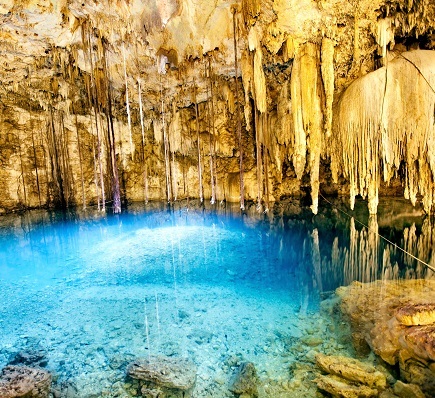
Meteorización química / Quimical weathering
Cenote Dzitnup (México)
Cenote Dzitnup (Mexico) |
La meteorización química produce una transformación química de la roca provocando la pérdida de cohesión y alteración de la roca. Los procesos más importantes son los atmosféricos, el vapor de agua, el oxígeno y el dióxido de carbono que están implicados en:
- Oxidación: Se produce al reaccionar algunos minerales con el oxígeno atmosférico. Se forman nuevos minerales con elementos en uno o más estados oxidados (mayor carga positiva).
- Disolución: Es muy importante en minerales solubles como cloruros, nitratos, en rocas calcáreas y en el modelado kárstico.
- Carbonatación: Se produce al combinarse el dióxido de carbono con el agua formando ácido carbónico, el cual se combina con ciertos minerales como el carbonato de calcio que se transforma en bicarbonato: el primero es insoluble en el agua pero el segundo no lo es, por lo que es arrastrado por ella. Es un proceso muy importante y perjudicial para los suelos, especialmente, en el riego por goteo.
- Hidratación: En esta reacción, el agua es incorporada a la estructura de algunos minerales aumentando de volumen como sucede con el yeso o sulfato de calcio hidratado. Este proceso es fácil de ver, por ejemplo, mezclando anhidrita con agua, lo que produce una reacción exotérmica (desprende calor) al transformarse en yeso (sulfato de calcio hidratado).
- Hidrólisis: Es la rotura en la estructura de algunos minerales por la acción de los iones de H+ y OH- de agua, fundamentalmente en la meteorización del feldespato, que se transforma en arcillas y del granito que puede llegar a la caolinización (transformación en arcillas, especialmente en caolín).
- Bioquímica: La acción de los ácidos orgánicos procedentes de la descomposición de materiales biológicos en el suelo o por la acción físico - química de los propios vegetales vivos.
|
Chemical weathering produces a chemical transformation of the rock causing the loss of cohesion and alteration of the rock. The most important processes are atmospheric, water vapor, oxygen and carbon dioxide that are involved in:
- Oxidation: It is produced by reacting some minerals with atmospheric oxygen. New minerals are formed with elements in one or more oxidized states (higher positive charge).
- Dissolution: It is very important in soluble minerals such as chlorides, nitrates, in calcareous rocks and in karstic modeling.
- Carbonation: It is produced when carbon dioxide is combined with water to form carbonic acid, which is combined with certain minerals such as calcium carbonate which is transformed into bicarbonate: the former is insoluble in water but the latter is not, so is dragged by it. It is a very important and damaging process for soils, especially in drip irrigation.
- Hydration: In this reaction, water is incorporated into the structure of some minerals, increasing in volume as is the case with gypsum or hydrated calcium sulfate. This process is easy to see, for example, mixing anhydrite with water, which produces an exothermic reaction (releases heat) when transformed into gypsum (hydrated calcium sulfate).
- Hydrolysis: It is the break in the structure of some minerals by the action of the H + and OH- ions of water, mainly in the weathering of feldspar, which turns into clays and granite that can reach kaolinization (transformation into clays, especially in kaolin).
- Biochemistry: The action of organic acids from the decomposition of biological materials in the soil or by the physical - chemical action of the living plants themselves.
|
|
Meteorización biológica / Biological weathering
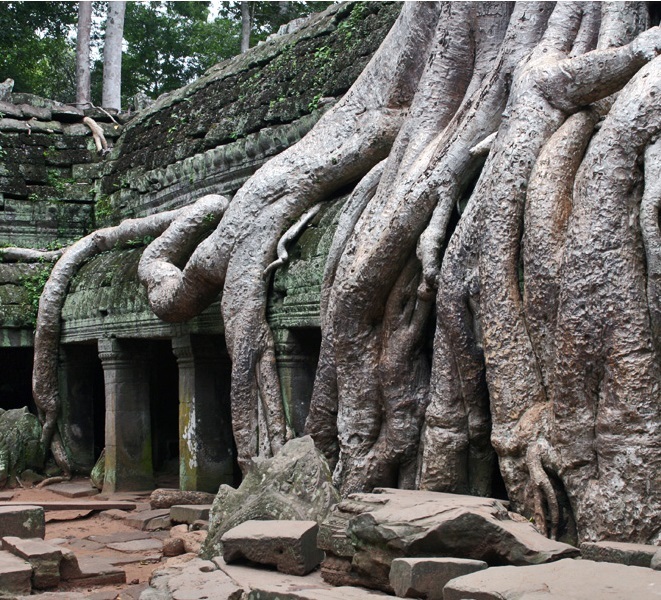
Acción de los árboles sobre el templo perdido de Ta Prohm (Camboya)
Action of the trees on the lost temple of Ta Prohm (Cambodia) |
La meteorización biológica u orgánica consiste en la ruptura de las rocas por la actividad de animales y plantas. La construcción de madrigueras y la acción de las raíces de los árboles pueden provocar una acción mecánica, mientras que los efectos de la presencia de agua y diversos ácidos orgánicos, así como el aumento del dióxido de carbono, pueden complementar la meteorización alterando la roca. Así pues, los efectos de la meteorización biológica combinan los procesos de disgregación y los de alteración.
La vegetación desempeña un papel decisivo en los procesos de meteorización química, ya que aportan iones y ácidos de disolución al agua. La descomposición orgánica genera humus más o menos ácido que provoca fenómenos de podsolización.
|
The biological or organic weathering consists of the breaking of rocks by the activity of animals and plants. The construction of burrows and the action of the roots of trees can cause a mechanical action, while the effects of the presence of water and various organic acids, as well as the increase of carbon dioxide, can complement the weathering by altering the rock. Thus, the effects of biological weathering combine the processes of disintegration and alteration.
Vegetation plays a decisive role in chemical weathering processes, since they provide ions and dissolving acids to water. Organic decomposition generates more or less acidic humus that causes phenomena of podsolization. |

Para loguear este Earthcaché
1-Envíanos las respuestas a las 4 cuestiones que se plantean a continuación a través del Centro de Mensajes de geocaching.com
2-Loguea el Earthcaché como encontrado. No se responderá salvo que exista algún problema con las respuestas enviadas.
3-IMPORTANTE: No publicar fotos que revelen las respuestas.
Los registros que incumplan las reglas anteriores serán borrados sin previo aviso
PREGUNTAS:
1) En las coordenadas publicadas, hallarás una gran roca, ¿qué tipo de meteorización crees que ha afectado más a la roca?
2) Hallarás una grieta en la roca, ¿cúal es su grosor?
3) Si te desplazas unos 20 metros hacia el norte puedes observar otro tipo de meteorización, la biológica. ¿Qué crees que está produciendola?
4) Ahora, desde ese punto y mirando hacia la derecha, podrás observar un ejemplo de meteorización química. ¿Qué colores presenta la roca?
5) La diferencia térmica día-noche es la causa de un tipo de meteorización. ¿Cómo se llama el agente en concreto?
6) Durante la carbonatación, ¿qué elementos se combinan para generar el ácido carbónico?
7) Opcionalmente, nos gustaría que subiérais una fotografía tomada por vosotros de algun ejemplo de meteorización. Por favor, no subir fotografías que pudieran desvelar las respuestas de las anteriores preguntas.
|
To log this Earthcaché
1-Send to us the answers to the following 4 questions using the Message Center at geocaching.com
2-Log the Earthcache as found. No reply will be given unless there is a problem with the answers sent.
3-IMPORTANT: Do not publish photos that may reveal the answers.
Logs that do not comply with these rules will be deleted without warning.
QUESTIONS:
1) In the published coordinates, you will find a large rock. What type of weathering do you think has most affected the rock?
2) You will find a crack in the rock. What is its thickness?
3) If you move about 20 meters to the north you will observe another type of weathering, the biological one. What do you think is producing it?
4) Now, from that point and looking to the right, you will see an example of chemical weathering. What colors does the rock present?
5) The day-night thermal difference is the cause of a type of weathering. What is the name of the agent in particular?
6) During carbonation, what elements combine to generate carbonic acid?
7) Optionally, we would like you to upload a photograph taken by you of some example of weathering. Please do not upload photographs that might reveal the answers to the previous questions.
|

|
|