ENRICO BERNARDI
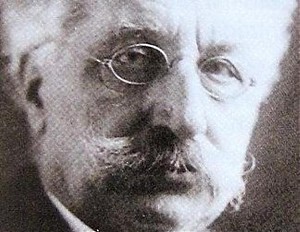

Alla domanda: chi ha inventato il primo motore a scoppio alimentato a benzina ? Quanti saprebbero rispondere: il veronese Enrico Bernardi ?! Molti probabilmente direbbero: chi è Enrico Bernardi ?
Enrico Zeno Bernardi nasce a Verona il 20 maggio 1841. La sua creatività lo porta a progettare a quindici anni un modello di locomotiva ed un modello di macchina a vapore fissa. Nel 1863, dopo la laurea in matematica diventa assistente alle cattedre di geodesia, idrometria, meccanica razionale e fisica all’Università di Padova. Nel 1876 e per i tre anni successivi è preside dell’istituto tecnico professionale industriale di Vicenza. Studia il motore a scoppio inventato da Eugenio Barsanti e Felice Matteucci, la cui caratteristica è quella di essere assai pesante ed essere più adatto al funzionamento “statico” in fabbrica o come propulsore navale.
Ma è nel 1882 che inventa un motore a scoppio a benzina soprannominato “motrice Pia” del nome della figlia. Il suo brevetto è datato 5 agosto 1882.
Karl Benz brevetta una soluzione simile il 25 ottobre 1882, mentre Gottlieb Daimler registra il suo brevetto di motore a scoppio il 16 dicembre 1883.
Ma sia Daimler che Benz riuscirono a brevettare l’auto prima di lui. E divennero famosi.
E’ per le strade di Quinzano, dove risiede con la famiglia, che nel 1882 gira il triciclo di legno del figlio spinto dal motore a scoppio.
Nel 1893 monta un motore a scoppio a benzina su una ruota di una bicicletta realizzando la prima motocicletta.
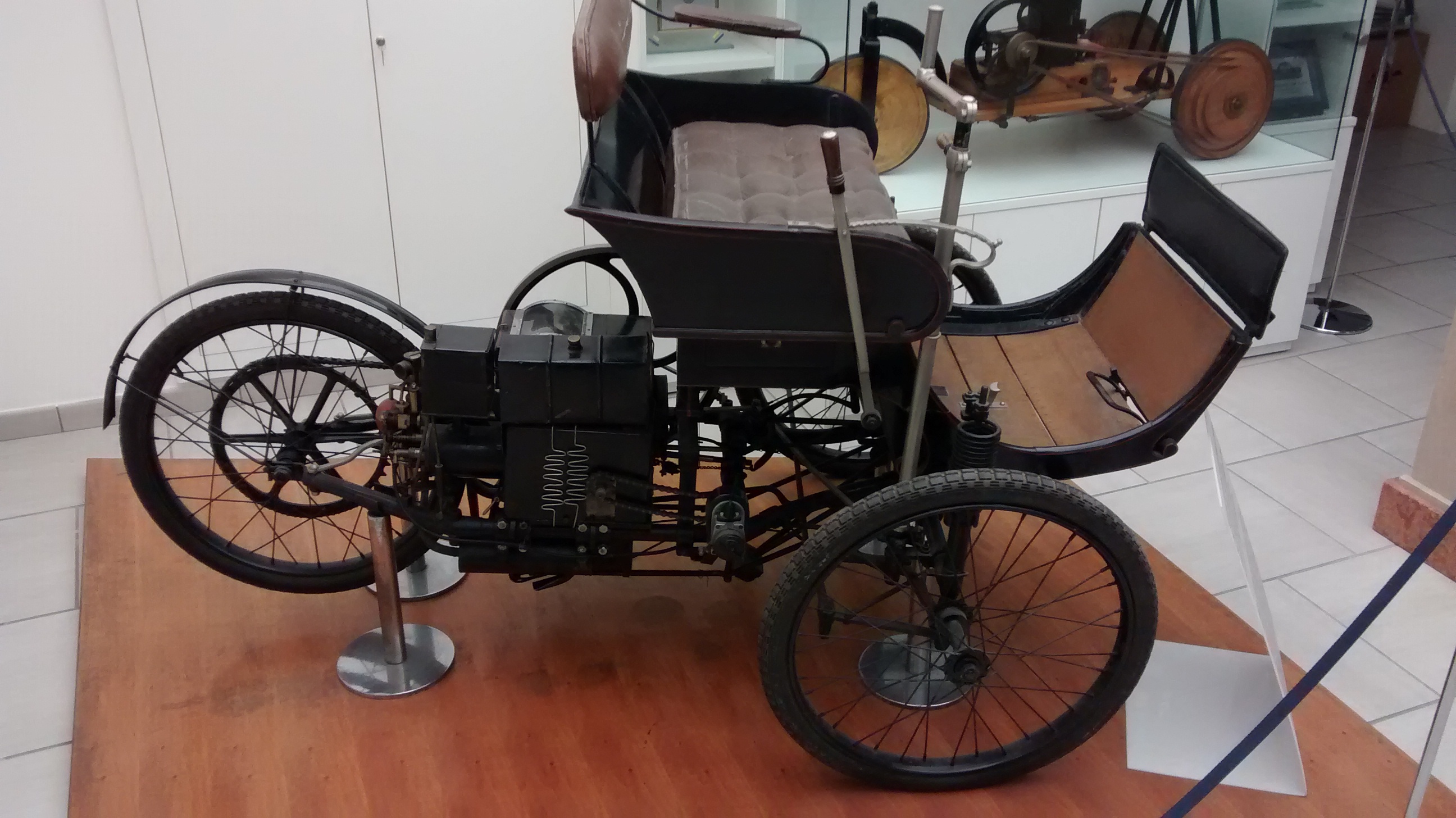
Nel 1894 presenta a Padova la sua vetturetta a tre ruote, prima automobile italiana ed inizia una piccola produzione in serie. E’ riconosciuto come colui che brevettò, non solo in Italia ma anche in Germania, Svizzera, Belgio ed Inghilterra, molte delle parti che compongono l’automobile come il filtro a benzina, la camera di compressione, la frizione, il cambio. Ma come molti degli inventori dell’epoca, senza adeguati fondi, non riuscì a portare ai massimi livelli le sue invenzioni.
Muore a Torino il 21 febbraio 1919. La salma viene tumulata e trasferita a Padova nel 1920. Qui, ironia della sorte, nessuno pagò i diritti comunali ed i suoi resti finirono nell’ossario comune. Un altro dei geni destinati all’oblio, nonostante l’enorme importanza delle sue invenzioni.

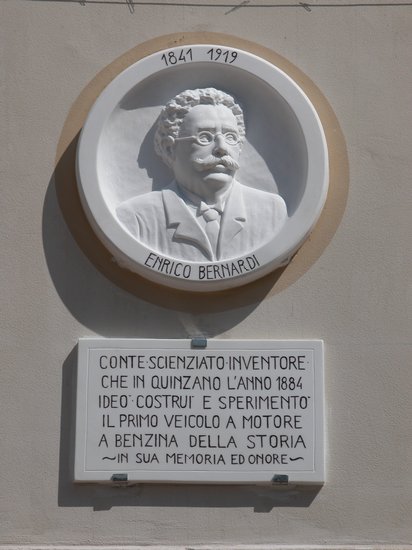
Nella sua città gli sono stati dedicati una targa sulla sua casa natale in via San Paolo, una scultura sul palazzo comunale di Quinzano, un monumento ai giardini dell’Arsenale ed un bassorilievo ai giardini delle Colombare. Un riconoscimento postumo, un quasi volersi far perdonare per non ospitare i suoi resti nel pantheon ”Ingenio Claris”.

Nel museo di macchine “Enrico Bernardi” di Padova sono conservati i principali esemplari di motore oltre a numerosi scritti ed appunti autografi.
un video del museo
La cache
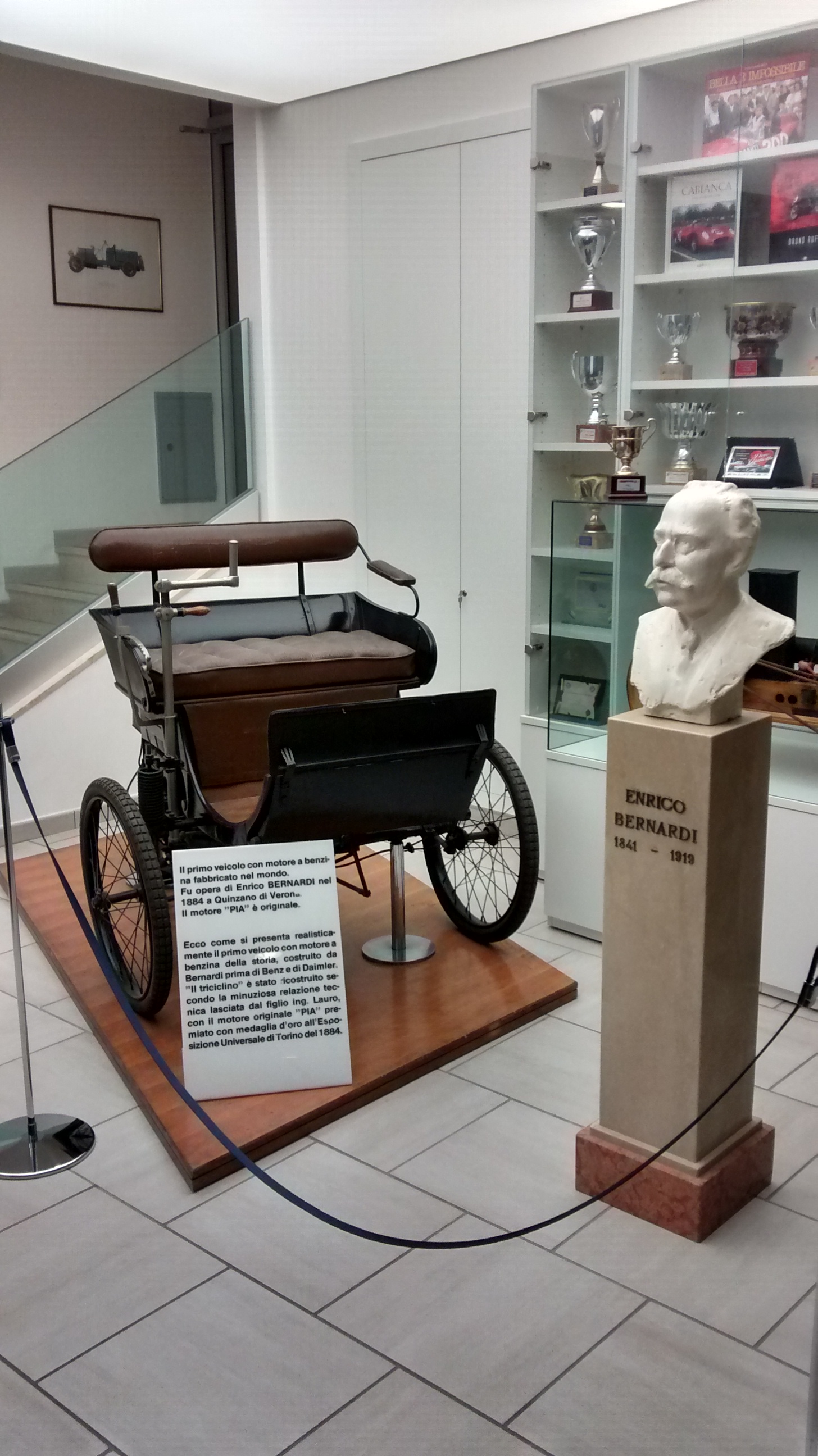
E’ posizionata a queste coordinate perché se passate dal lunedì al venerdì dalle 7.00 alle 19.00 potete entrare alla sede dell’ACI ed ammirare una ricostruzione, con motore originale Pia, del triciclo progettato da Bernardi e del triciclo giocattolo costruito per il figlio Lauro.
La cache è sempre disponibile e non è necessario entrare nei locali per trovarla.
E’ una tradi, facile per chi ha già incontrato simili nascondigli, un po’ più difficile per chi è la prima volta che ne cerca uno. Ricordatevi solo che non dovete aprire o smontare nulla !!!
Se non riuscite a trovare la cache e volete un aiuto supplementare dovete per forza entrare e, stando di fronte al triciclo, guardare alla vostra sinistra la stampa appesa al muro di un’auto …. modello 12/24 hp (1905). Scrivete il nome del modello (prima riga) in maiuscolo su certitude ed avrete un hint supplementare ma i più bravi non avranno bisogno di questa spintarella.
Ricordatevi di portare una penna e buon divertimento !
Questa cache è stata pubblicata il 15 dicembre 2018 in occasione dell’event “Gli Auguri di Natale”

To the question: who invented the first petrol engine? Do you know that the answer is: the Veronese Enrico Bernardi?! Many people would probably say: who is Enrico Bernardi?
Enrico Zeno Bernardi was born in Verona on May 20, 1841. His creativity led him to design a model of a locomotive and a model of a fixed steam engine at fifteen. In 1863, after graduating in mathematics, he became assistant professor of geodesy, hydrometry, rational mechanics and physics at the University of Padua. In 1876 and for the next three years he was dean of the industrial professional technical institute of Vicenza. He studies the combustion engine invented by Eugenio Barsanti and Felice Matteucci, whose characteristic is that of being very heavy and more suited to the "static" operation in the factory or as a naval propeller.
But it was in 1882 that he invented a petrol engine nicknamed the "Pia motrice" of his daughter's name. His patent is dated 5 August 1882.
Karl Benz patents a similar solution on October 25, 1882, while Gottlieb Daimler registers his petrol engine patent on December 16, 1883.
But both Daimler and Benz managed to patent the car before him. And they became famous.
It is on the streets of Quinzano, where he lives with his family, who in 1882 turns the wooden tricycle of his son driven by the internal petrol engine.
In 1893 he mounted a petrol engine on a wheel of a bicycle making the first motorcycle.
In 1894 he presented his three-wheeled car in Padua, the first Italian automobile and began a small series production. He is recognized as the one who patented, not only in Italy but also in Germany, Switzerland, Belgium and England, many of the parts that make up the car like the petrol filter, the compression chamber, the clutch, the gearbox. But like many of the inventors of the time, without adequate funds, he failed to bring his inventions to the highest level.
He died in Turin on 21 February 1919. His body was buried and moved to Padua in 1920. Here, ironically, no one paid the municipal rights and his remains ended up in the common ossuary. Another of the genes destined to oblivion, despite the enormous importance of its inventions.
In his hometown he was given a plaque on his birthplace in via San Paolo, a sculpture on the town hall of Quinzano, a monument to the Arsenal gardens and a bas-relief in Colombare’s gardens. A posthumous recognition, almost to be forgiven for not hosting his remains in the pantheon "Ingenio Claris".
In the museum of machines "Enrico Bernardi" of Padua are preserved the main examples of engine as well as numerous autographed writings and notes.
a video of the museum
The cache
It is positioned at these coordinates because if you go from Monday to Friday from 7.00 to 19.00 you can enter the headquarters of the ACI and admire a reconstruction, with original Pia engine, of the tricycle designed by Bernardi and the toy tricycle built for his son Lauro.
The cache is always available and it is not necessary to enter the ACI headquarter to find it.
It's a tradi, easy for those who have already encountered similar hiding places, a little more difficult for those who are looking for the first time. Just remember that you do not open or disassemble anything !!!
If you can not find the cache and you want extra help, you have to go in and, standing in front of the tricycle, look to your left the print hanging on the wall of a car .... 12/24 hp model (1905). Write the model name (first line) in uppercase on certitude and you will have an extra hint but the best will not need this help.
Remember to bring a pen and have fun!
This cache was published on December 15, 2018 on the occasion of the "Gli Auguri di Natale" event

You can validate your puzzle solution with certitude.
