
 English
Current coast of North-west Africa was predominantly created in Cretaceous period (145 - 66 million years ago). North America had just begun pulling away from Eurasia during the Jurassic, and South America had started to split off from Africa, from which India, Australia, and Antarctica were also separating. Sea level was higher during most of the Cretaceous than at any other time in Earth history, and it was a major factor influencing the paleogeography of the period. When the Cretaceous Period ended, most of the present-day continents were separated from each other by expanses of water such as the North and South Atlantic Ocean. During these processes coast of Africa consisting mostly of limestone emerged. Limestone contains more than 50% calcium carbonate (CaCO3). It consists of the cemented remains of marine organisms, including corals, brachiopods, stromatoporoids and crinoids.
Geomorphological processes - movement of continents, tectonics or sedimentation - influenece large areas in long periods of time. On the other hand local changes on rocks - their decay and transformation - are faster and we call these weathering. There are three basic types.
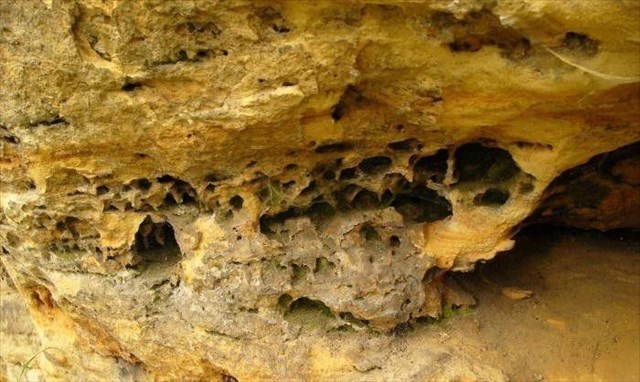
Chemical Weathering
Chemical weathering causes an alteration to the chemical composition of rock due to a chemical reaction. Water that is slightly acidic can dissolve rock. An example of this would be slightly acidic rain changing the chemical composition of limestone to form a limestone pavement. This occurs on the surface and along the joints and bedding planes of limestone. You can also see evidence of this on buildings made from limestone.
CO2 + H2O + CaCO3 → Ca(HCO3)2
chemical weathering / altération chimique / chemické zvětrávání
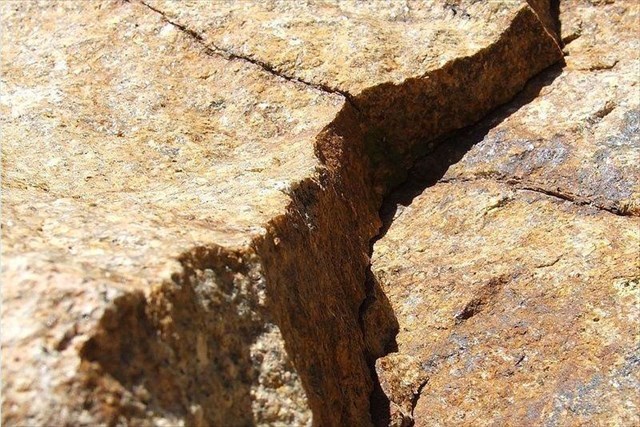
Mechanical Weathering
Freeze-Thaw - Most rocks are very hard. However, a very small amount of water can cause them to break. When water seeps into cracks and freezes it then expands. This powerful force can increase the size of cracks. Over time the repeated freeze-thaw action of water can break rocks apart. Eventually, pieces of rock break off creating scree.
Exfoliation or Onion Skin Weathering - This type of erosion is common in warm areas. As the sun shines on rocks during the day it causes them to expand. During the night the rock contracts due to the colder temperature. Over time this continued process causes small pieces of surface rock to flake off.
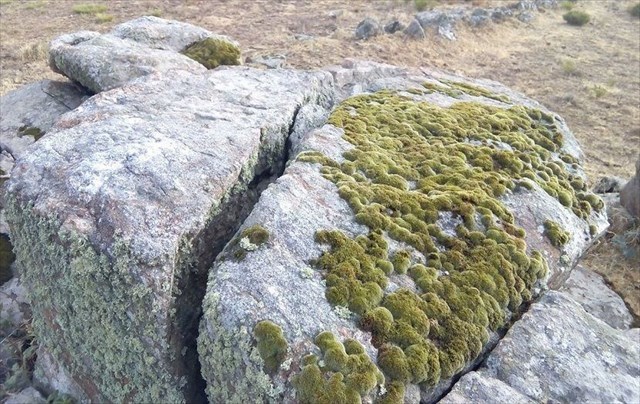
Biological Weathering
Biological weathering is the effect of living things. For example as the roots of a tree extend into the ground they can break rocks apart. Ivy growing up a building can cause bricks to loosen. It also occurs on a much smaller scale through lichen and moss.
To log this earthcache please send me the answers to the following questions via email or message centre.
1) What type of weathering created Trou de Diable? Discuss.
2) How wide and and deep is the sinkhole and what is the size of connecting tunnel? Approximate on site.
3) How many lines of blue Arabic text is on information table on site?
4) Photos are optional, but always welcome.
 Français (google translator)
La côte actuelle du nord-ouest de l’Afrique a été principalement créée au Crétacé (il ya 145 à 66 millions d’années). L'Amérique du Nord venait tout juste de commencer à se séparer de l'Eurasie pendant le Jurassique et l'Amérique du Sud commençait à se séparer de l'Afrique, à laquelle se séparaient l'Inde, l'Australie et l'Antarctique. Le niveau de la mer était plus élevé pendant la plus grande partie du Crétacé qu’à tout autre moment de l’histoire de la Terre et constituait un facteur majeur influant sur la paléogéographie de cette période. À la fin du Crétacé, la plupart des continents actuels étaient séparés les uns des autres par des étendues d'eau telles que l'océan Atlantique nord et sud. Au cours de ces processus, des côtes africaines composées principalement de calcaire sont apparues. Le calcaire contient plus de 50% de carbonate de calcium (CaCO3). Il est constitué des restes cimentés d'organismes marins, notamment de coraux, de brachiopodes, de stromatoporoïdes et de crinoïdes.
Les processus géomorphologiques - mouvement des continents, tectonique ou sédimentation - influent sur de vastes zones pendant de longues périodes. D'autre part, les changements locaux sur les roches - leur dégradation et leur transformation - sont plus rapides et nous les appelons altération. Il existe trois types de base.
Altération chimique
L'altération chimique provoque une modification de la composition chimique de la roche due à une réaction chimique. Une eau légèrement acide peut dissoudre la roche. Un exemple de ceci serait les pluies légèrement acides modifiant la composition chimique du calcaire pour former une chaussée de calcaire. Cela se produit à la surface, le long des joints et des couches de calcaire. Vous pouvez également en voir des preuves sur des bâtiments en calcaire.
CO2 + H2O + CaCO3 → Ca(HCO3)2
Altération mécanique
Gel-dégel - La plupart des rochers sont très durs. Cependant, une très petite quantité d'eau peut provoquer leur rupture. Lorsque l'eau s'infiltre dans les fissures et gèle, elle se dilate. Cette force puissante peut augmenter la taille des fissures. Au fil du temps, l'action répétée de l'eau sous l'effet du gel-dégel peut briser les roches. Finalement, des morceaux de roche se détachent pour créer des éboulis.
Exfoliation ou altération de la peau d'un oignon - Ce type d'érosion est courant dans les zones chaudes. Comme le soleil brille sur les rochers pendant la journée, il se développe. Pendant la nuit, la roche se contracte en raison de la température plus froide. Au fil du temps, ce processus continu entraîne la formation de petits morceaux de roche en surface.
mechanical weathering / altération mécanique / mechanické zvětrávání
Altération biologique
L'altération biologique est l'effet des êtres vivants. Par exemple, lorsque les racines d'un arbre s'étendent dans le sol, elles peuvent briser les roches. Ivy qui grandit dans un bâtiment peut provoquer le décollement des briques. Il se produit également à une échelle beaucoup plus petite à travers le lichen et la mousse.
Pour vous connecter à cette Earthcache, envoyez-moi les réponses aux questions suivantes par courrier électronique ou par courrier:
1) Quel type de vieillissement créé Trou de Diable? Discuter.
2) Quelle est la largeur et la profondeur du gouffre et quelle est la taille du tunnel de connexion? Approximatif sur le site.
3) Combien de lignes de texte arabe bleu se trouvent sur le tableau d’information sur place?
4) Les photos sont facultatives, mais toujours les bienvenues.
 Česky
Česky
Současné pobřeží severozápadní Afriky (Maroka) vznikalo v období křídy (66 – 145 Ma), kdy se africká deska srážela s evropskou (alpinsko-himalájské vrásnění, vznik pohoří Atlas) a zároveň se již vzdalovala od americké (rozevírání Atlantiku, začátek v juře 200 Ma).
Při těchto geomorfologických procesech, kdy částečně klesla hladina Atlantiku a současně bylo vyzdviženo dno, vzniklo dnešní pobřeží, které tvoří převážně vápenec - usazená hornina obsahující 50 – 80% uhličitanu vápenatého (CaCO3) a různé příměsi minerálů a zkamenělin.
Geomorfologické procesy (transport a posun desek, tektonika, sedimentace) ovlivňují v dlouhém časovém úseku velké celky. Lokální změny na horninách – jejich rozpad, které bývají rychlejší, nazýváme zvětráváním a rozlišujeme 3 základní způsoby.
Chemické zvětrávání, kdy dochází k rozkladu horniny prostřednictvím působících chemických procesů, mění se chemické složení horniny.
U vápence se jedná o krasovou činnost, kdy působí vzdušný oxid uhličitý rozpuštěný ve vodě na vápenec a vzniká krystalický, ve vodě rozpustný hydrogenuhličitan vápenatý – CO2 + H2O + CaCO3 → Ca(HCO3)2
Mechanické zvětrávání působení fyzikálních sil dochází k rozpadu horniny na menší části nebo až na minerální složky. Chemické složení se však nemění.
Působení tektonických sil a tlaků v zemské kůře a tím spojených změn teploty má za následek smršťování a pukání velkých celků. Působení větru či vody, které nesou drobné abrazivo, lokálně rozrušuje rozdílně tvrdé vrstvy horniny. Na horniny působí i teplota. Pravidelné zamrzání a rozmrzání vody, která při tom mění svůj objem, až o 10 % se nazývá mrazové zvětrávání. V pouštních oblastech s velkým rozdílem teplot ve dne a v noci, kdy se rychle střídá roztahování a smršťování působí erozi pouhý sluneční svit.
Biologické zvětrávání vzniká působením živých organismů, které reagují s minerály v horninách a vyvolávají tak jejich biochemický rozklad.
Například lišejníky uvolňují kyselinu, která rozrušuje horninu a tím vzniká půda - nejsvrchnější vrstva zemské kůry. Kořenový systém rostlin (stromů) je schopen rozrušit přes drobné pukliny skalní bloky.
biological weathering / altération biologique / biologické zvětrávání
Pro zalogování je potřeba odpovědět, přes email či messenger, na následující otázky:
1) Jaký typ zvětrávání vytvořil Trou du Diable? Proč si to myslíte.
2) Jaký je průměr a hloubka závrtu + velikost propojovacího tunelu
3) Počet modrých řádků arabského textu na tabuli na zděném soklu
4) Nepovinné, ale potěší, foto z místa
překlad do angličtiny: Ištván - köszönöm Magyarországnak