Fossils of Southern Ontario
The Paleozoic Era, which ran from about 540 million years ago to 251 million years ago, was a time of great change for the earth. During this era, the breakup of one supercontinent took place with new land masses forming. Plants became more widespread both on land and in the oceans, and the first vertebrate animals colonized land.
The Paleozoic Era can be further broken down into seven more periods including Cambrian, Ordovician, Silurian, Devonian, Mississippian, Pennsylvanian and Permian
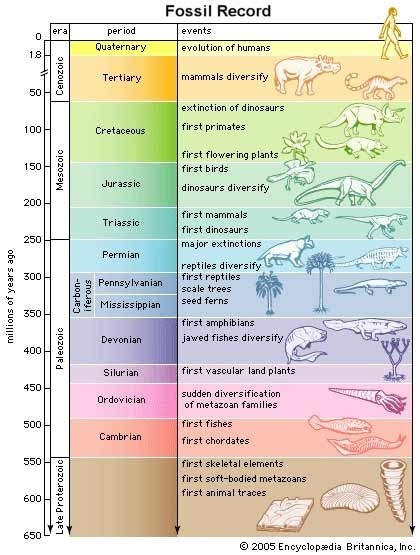
During the Cambrian to late Devonian times, approximately 540 to 340 million years ago, present day Ontario was flooded by shallow, tropical seas when the continent was situated close to the equator. Sediments including calcareous skeletons of marine creatures were deposited on the ocean floor and over time, were compressed into sandstones, shales and what is commonly referred to as limestone.
In many instances, a combination of sea water as well as burial can cause magnesium-rich fluids from calcareous sediments to change the limestone to dolostone. This process of converting limestone to dolostone often causes cavities or pores to form and these pores are frequently filled with new crystals of different minerals such as calcite. Calcite is a common constituent of sedimentary rocks, limestone in particular, much of which is formed from the shells of dead marine organisms.
Another carbonate mineral commonly found in fossils is Aragonite, one of the three most common naturally occurring crystal forms of calcium carbonate.
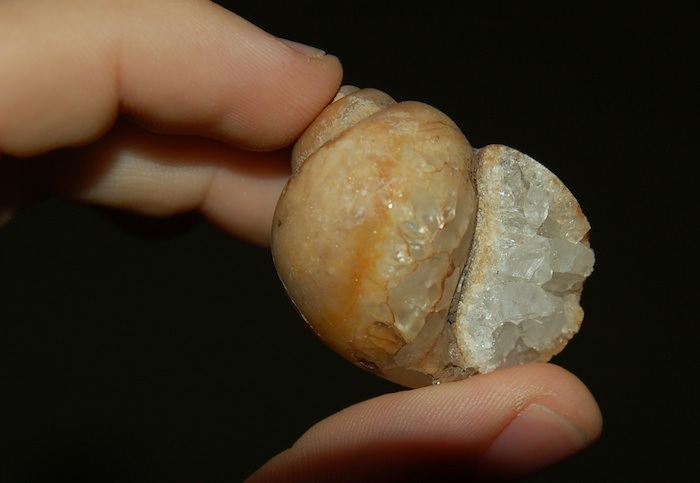
Calcite filled Sea Urchin
Formation of calcite crystals can happen rapidly when the shells and bones lie on the ground surface or on the sea bottom. If the shell or bone is buried in sediment, it dissolves more slowly. Shells are preserved without being dissolved only when they are buried in sediments that consist of calcium carbonate minerals, like limestones. If the calcite or aragonite is dissolved away the result is a fossil being preserved as a mold or cast.
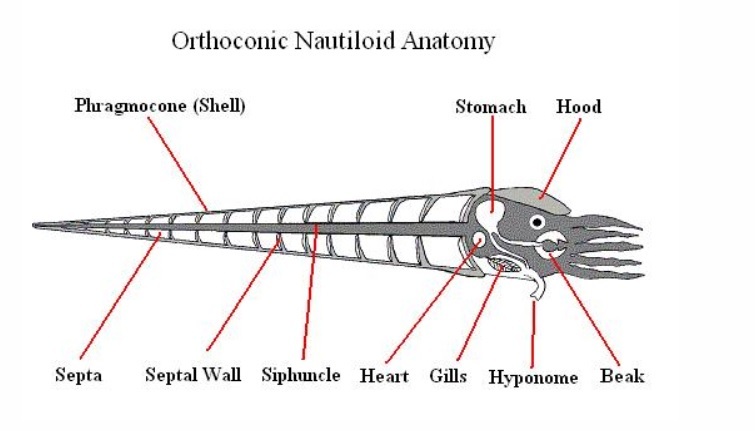
Look at the rock wall in front of you. You will see examples of a number of fossils from the Ordovician period of the Paleozoic era. One of the larger fossils found in these dolostone blocks include an Ordovician orthoconic nautiloid. Nautiloids are among the group of animals known as cephalopods, an advanced class of mollusks which also includes ammonoids, belemnites and modern coleoids such as octopus and squid. Other mollusks include gastropods, scaphopods and bivalves.
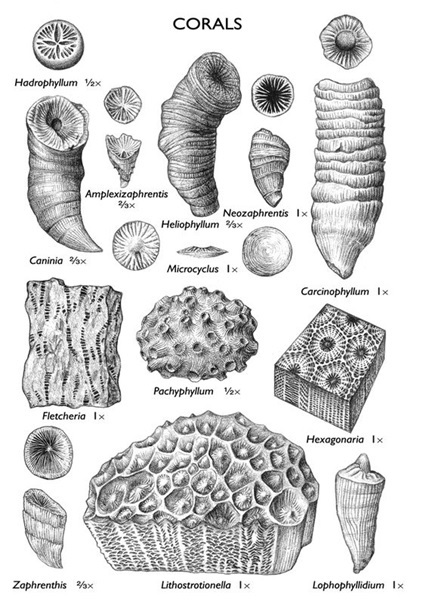
Other common fossils in these blocks include a variety of corals like the ones in the image below.
Logging Requirements
This earthcache is accessible by standing on the sidewalk along Simcoe St looking at the dolostone rock wall in front of you
To Log this earthcache
Please send me your answers within 4 days of posting your found log. If there is more than one cacher in your party, include the names in your group. Only one person needs to send me the group answers. No spoiler photo's please. Found logs posted without proof you visited the site will be deleted.
Questions
Visit the posted coordinates and look at the stones. You can look at the entire length of the rock wall for fossils to answer the following questions.
1. Find an example of orthoconic nautiloid in one of the blocks. You are looking for a long narrow fossil that shows separation of individual chambers.
a) What is the length and width of the example you found?
b) Do you see evidence of calcite deposits in or around the fossil? If yes, does the calcite deposit fill the entire chamber of the siphuncle or are their gaps exposing the chamber?
c) What colour is the body of the fossil? Does this stand out against the natural colour of the stones or does it blend in?
2. Find one other type of fossil other than a nautiloid. What type is this fossil, and is it larger or smaller than the nautiloid?
3. Do you see evidence of calcite deposits on the stones that do not have fossils in them?
4. Step back and look at the blocks in the rock wall
a) Estimate the average length, width and height of the larger stone blocks in metres?
b) Estimate the average length, width and height of the smaller stone blocks in metres?
c) The known density of Dolomite is 2899 Kg per cubic metre. Using your estimates from a) and b), estimate the weight of the larger vs the smaller blocks?
5) Do you believe these blocks were quarried from the same location? Explain your reason!
6. Do you see any evidence of other mineral deposits that give the stone a different colour? What colour do you see, and what mineral do you think is present to cause it?
References:
https://www.fossils-facts-and-finds.com/ordovician_period.html