Sunshine Header-Harvester, c.1935
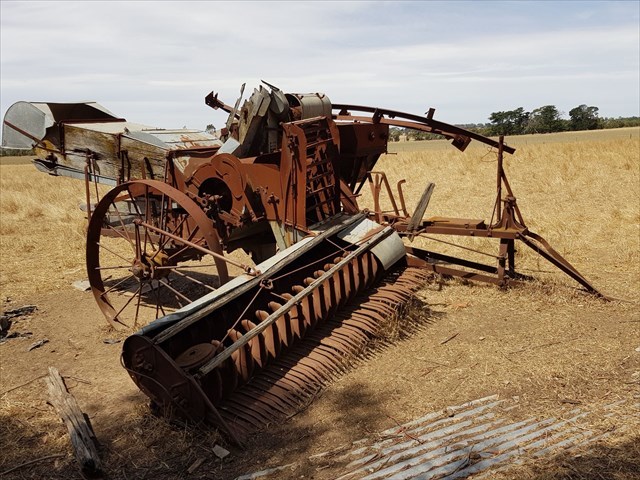
HEADER-HARVESTER
This Australian cereal harvesting machine made by H.V. McKay Pty Ltd of Sunshine, Victoria, in 1935 is known by various names: a header-harvester, initially a reaper-thresher, and later just a header. It is an Australian innovation and is significant because it solved the problem in Australia of harvesting storm flattened crops, and by the 1920s it was the usual harvesting machine in New South Wales, though the stripper-harvester and even the stripper continued to be used for light crops and rough terrain.
COMBINE HARVESTER
The combine harvester, or "combine," is a machine that says what it does on the can - it harvests grain crops. The name derives from its combining three separate operations comprising harvesting - reaping, threshing, and winnowing - into a single process. Among the crops harvested with a combine are wheat, oats, rye, barley, corn (maize), soybeans and flax (linseed). The waste straw left behind on the field is the remaining dried stems and leaves of the crop with limited nutrients which is either chopped and spread on the field or baled for feed and bedding for livestock.
SHORT HISTORY
Scottish inventor Patrick Bell invented the reaper in 1826. The combine was invented in the United States by Hiram Moore in 1834, and early versions were pulled by horse or mule teams, ox. In 1835, Moore built a full-scale version and by 1839, over 50 acres of crops were harvested. By 1860, combine harvesters with a cutting width of several meters were used on American farms. In 1882, the Australian Hugh Victor McKay had a similar idea and developed the first commercial combine harvester in 1885, the Sunshine Harvester.
The harvester was made by H.V. McKay Pty Ltd at the Sunshine Harvester Works, Sunshine, Victoria. It was first sold in 1916 both in horse-drawn and engine functioned types. The latter involved the harvesting machinery being driven by a petrol engine and the horses were only required to pull the machine along. A self-propelled auto-header was built at Sunshine from 1924.
SPECIFICATIONS
The header-harvester cut an 8 foot swathe through the crop and when horse-drawn required 5 to 6 horses to pull, according to the soil and condition of the crop. Generally 26 acres of crop could be harvested each day. The operation involved gathering, cutting, threshing, winnowing and cleaning the grain and making it ready for bagging. The comb first engaged the crop and guided it into reciprocating knives, which cut off the heads and some of the straw. The heads and straw were seized by the revolving spiral steel conveyors which carried them to the floating elevator and on to the threshing drum. The comb, knives and conveyors were adjustable to suit the crop. From the threshing drum the mass of grain and straw were delivered to the straw walker, which conveyed the straw to the rear of the machine and ejected it. The grain and chaff went on to the grain tray and then fell onto riddles and blown with a strong blast from fans which blew away the chaff. Any imperfectly thrashed grains which had reached the riddles were delivered to the seconds elevator and returned to the threshing drum for further treatment. The riddles delivered all the clean grain to the grain elevator and on to the revolving screen which rejected all the small or broken grains and dropped them into seconds box while the good grain passed into the large grain box ready for bagging.
Source: https://collection.maas.museum/object/211927