The power of the sea causes erosion and weathering and there are some very varied examples of both to be seen here at Bude Breakwater and this is the subject of this EarthCache. The listed co-ordinates bring you to a particularly attractive rock which at the calmer breakwater end showcases some stunning natural geology which you can explore in the sister EarthCache, Bude Breakwater: The Whales Back. However, at the end where the co-ordinates take you (the sea facing end) the sea is doing it's best to destroy this 300 million year old sculpture. Furthermore, on top of the rock and also just down the breakwater at Chapel Rock there are superb examples of Honeycomb Weathering.
This EarthCache is designed to be completed in the field. There is a little information to read through but it is specially written for the EarthCache so it is easy to understand - you absolutely do not need any previous geological knowledge. The questions will then be really easy to answer as they directly relate to the information in the listing and no further reading or research is required. Therefore if you have the time you can easily complete the whole thing and send in answers from GZ. It really is all very simple. Please do note that the rock is tidal so please ensure you visit when the tide is low as the EarthCache cannot be completed without visiting the rock.
Power of the Sea: Wave Erosion
Erosion is the process of wearing away any of the rock along the coastline, in this case we are specifically interested in the rock here at the listed coordinates. Destructive waves are responsible for erosion on the coastline and are responsible for slowly destroying the rock you see here. There are four types of erosion that can occur on a coastline:
Hydraulic action - this is the sheer power of the waves as they smash against the cliff. Air becomes trapped in the cracks in the rock and causes the rock to break apart.
Abrasion - this is when pebbles grind along a rock platform, much like sandpaper. Over time the rock becomes smooth.
Attrition - this is when rocks that the sea is carrying knock against each other. They break apart to become smaller and more rounded.
Solution/corrosion - this is when certain types of cliff erode as a result of weak acids in the sea. In the UK, chalk and limestone cliffs are prone to this type of erosion.

Power of the Sea: Honeycomb Weathering
It is important to understand that weathering is a different process to erosion. Weathering degrades a rock without changing its location. Erosion, on the other hand, causes rocks, or particles of rock, to be carried away from their original locations and deposited elsewhere. Weathering may lead to erosion, but they are two separate processes. Therefore it is important to clarify before going on, the Honeycombs you see here are not an erosion process (they are not caused by solution/corrosion as shown above) but are in fact a weathering process. The waves provide the salt water, but the weathering actually occurs whilst the tide is out.
There are certain ingredients required for Honeycomb weathering to occur. These are:
A source of salt is needed because the basic mechanism for this kind of weathering is salt heaving. Salt is deposited on the surface of the rock by direct contact with the sea, saltwater spray or wind. The presence of water allows the salt to settle on the rocks. When the water dries, the salt solution also evaporates and the salt begins to crystallize within the pore-spaces of the rock.
Permeable rock is the next ingredient. A permeable rock is one that will absorb water. This means there will be pore-spaces for the salt to crystallize within. When these salt crystals form, they pry apart the mineral grains, leaving them vulnerable to other forms of weathering.
Time is the final ingredient. It takes prolonged periods for this weathering to become visible, as the rock goes through cycles of wetting and drying.
Types of Honeycomb Weathering
There are two distinct types of coastal honeycomb weathering - intertidal and supratidal and we are extremely lucky at Bude Breakwater to be able to see examples of both.
“The intertidal zone, is the area that is above water at low tide and under water at high tide.”
Intertidal honeycomb weathering is found on horizontal planes in rock within the tidal zone. Cavities of the intertidal zone typically consist of shallow concave depressions separated by low ridges. During high tides, these cavities become filled with seawater. When the tide recedes this saline water may evaporate to leave white crystalline residue. Growth of intertidal cavities may be self-limiting. As cavities increase in size, the depth of trapped seawater may become so great that the sun can not evaporate all of the water left in the gap, so the holes are as large as they will get, because the salt can not dry out and wedge grains apart any longer.
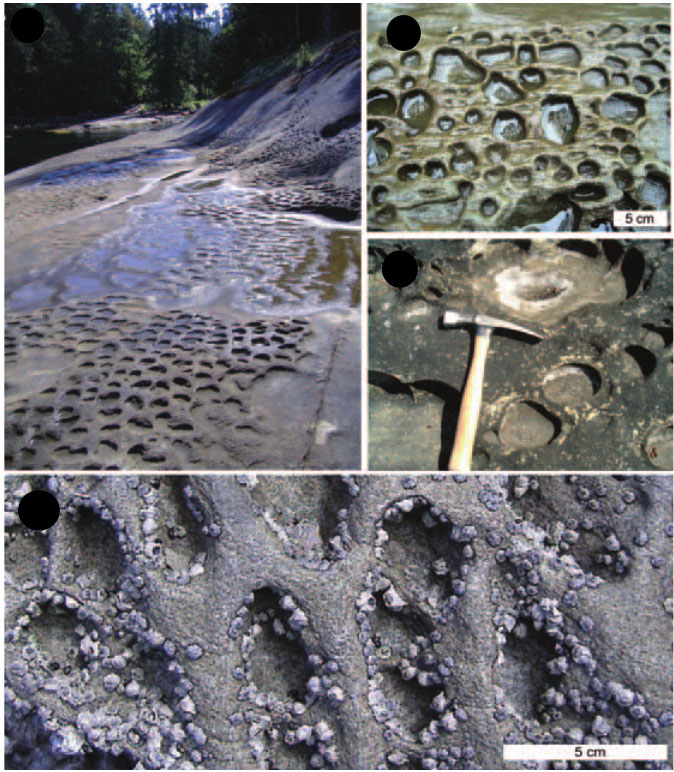
Examples of intertidal honeycomb erosion elsewhere
“The supratidal zone, is the area above the spring high tide line, on coastlines and estuaries, that is regularly splashed, but not submerged by ocean water. Seawater penetrates these elevated areas only during storms with high tides.”
Honeycomb cavities in the supratidal splash zone commonly consist of deep depressions separated by thin walls of unweathered rock. Supratidal honeycomb cavities are commonly oriented along exposed bedding edges, cross-bedding, and lithologic, but many examples can be found in apparently uniform outcrops.
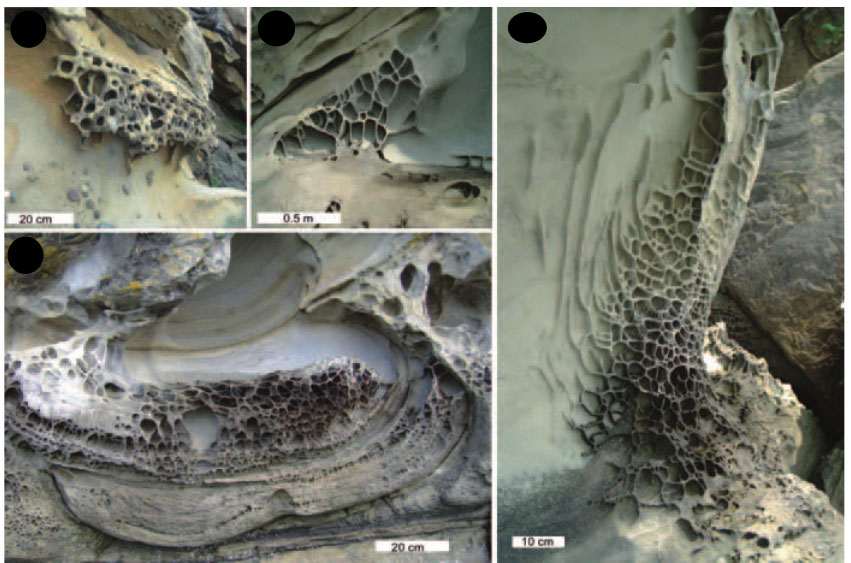
Examples of supratidal honeycomb erosion elsewhere
Logging Requirements (Questions to Answer)
This is intended to be a simple and fun EarthCache - it is easily achievable by anyone with no previous geological knowledge required. Being in a busy tourist place it aims to be good for beginners - if you've never done an EarthCache before here's a good one to start with. You only need to read the information and use your eyes. Then send me your best attempt at the answers - I only ask that you give it a good try. However if you log without sending any answers, you risk your log being deleted.
Erosion - For Q1/2 you should start at the listed coordinates - please stand on the beach and walk around the rock
Q1 - Look at the seaward side of the rock, close to the given coordinates and compare it with the side that faces the breakwater. Describe the differences in condition of the rock - how has it been eroded? A sentence or so will do.
Q2 - Which of the erosion processes outlined above do you think are responsible? Mention evidence if you wish.
Honeycomb Weathering - For Q3/4 you need to look at the top surface of the rock - climb up if you are able.
Q3 - Looking at the Honeycomb Weathering on the top of the rock here, please give a brief description of the honeycombs. What is the average size - do they vary?
Q4 - Is the Honeycomb Weathering here intertidal or supertidal - why?
Honeycomb Weathering - For Q5/6 you should be at Waypoint 1, Chapel Rock - look at the sides of the rock, around the steps
Q5 - Looking at the Honeycomb Weathering on the side of the rock here at waypoint 1, please give a brief description of the honeycombs. What is the average size - do they vary - mainly you are looking at how they might be different to the Honeycombs at the listed coordinates
Q6 - Is the Honeycomb Weathering here intertidal or supertidal - why?
Please feel free to include a photo of yourself or GPSr with any of the features as additional proof of your visit, however try and avoid including any excessive spoilers if possible. Thank you.
Thank you for visiting the Bude Breakwater: Coastal Erosion and Weathering EarthCache