As you walk down the banks of the Ayr there are some spectacular exposed cliffs, caused by the river eroding a channel down through the rocks, so when you arrive here you will find it is a particularly good place to stand a view the cliffs and to learn why the rock you see here is so varied.
This is an observational EarthCache - this means to answer the questions you only need to observe what you see here and use the information included in the listing to form your answers. No other research or previous knowledge is required so please do give this EarthCache a try!
Overview of Sedimentary Rocks
It should be fairly obvious when you arrive here to see the rock is in very well defined layers and this means these are sedimentary rocks. Sedimentary rocks can be formed from particles of sand, shells, pebbles, and other fragments of material. Together, all these particles are called sediment. Gradually, the sediment accumulates in layers and over a long period of time hardens into rock. An example might be millions of years ago a flood caused a layer of sand to be deposited. This might create one layer of the rock you see here. Then maybe a few years or many years later another flood left another layer of sand. Again, another layer is created. This process continued for millions of years, the lower layers gradually getting squeezed more and more by the heavy deposits above them. The thickness of the layer is determined by the amount of sediment deposited, therefore a bigger and longer flood would deposit more sediment creating a thicker layer.
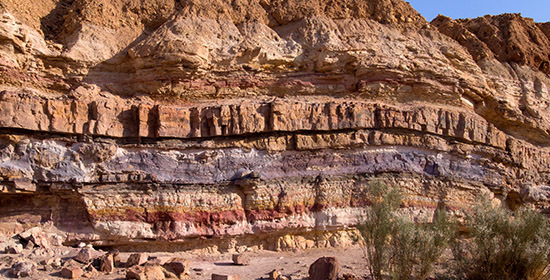
The above photo shows a great example of sedimentary rocks found elsewhere in the world. The sedimentary rocks you see before you here were deposited in a shallow sea during the Carboniferous period – about 320 million years ago. Sedimentary rock is not always consistent because each layer is formed at a different time and from a different 'batch' of sediment. This means some layers may be strong whilst some are more weak and therefore more susceptible to erosion forces many years later and could be formed from different materials.
The greywacke sandstones in the southern part of South Ayrshire are marine sedimentary rocks consisting of compact, grey sandstone interbedded with siltstone and mudstone beds. The ratio of sandstone to siltstone/mudstone varies from area to area. In the best areas sandstones are several metres thick and have almost no interbedded siltstone. Elsewhere sandstone beds are 0.01-1 m thick with a high proportion of siltstone. The next section will explain the difference between the stones.
Mudrocks are a class of fine grained sedimentary rocks. The varying types of mudrocks in this area include: siltstone, mudstone, and shale. Most of the particles of which the stone is composed are less than 0.0625 mm (1/16th mm or 0.0025 inches) and are too small to study readily in the field. At first sight the rock types look quite similar; however, there are important differences in composition. There has been a great deal of disagreement involving the classification of mudrocks.
- Mudrocks are the least understood, and one of the most understudied sedimentary rocks to date
- It is difficult to study mudrock constituents, due to their diminutive size and susceptibility to weathering on outcrops
- There is not a universal classification scheme accepted by scientists
Mudrocks make up fifty percent of the sedimentary rocks in the geologic record, and are easily the most widespread deposits on Earth. With increased pressure over time the clay minerals may become aligned, with the appearance of parallel layering (fissility). This finely bedded material that splits readily into thin layers is called shale, as a distinction from mudstone.
Oswald's Rocks
There are 4 types of rock you might be able to see here in the cliffs based on the geology of the area - but when considering your answers be aware that you may not necessarily spot them all in this one cliff.
Sandstone

Sandstone is a sedimentary rock composed of sand-size grains of mineral, rock, or organic material. It also contains a cementing material that binds the sand grains together and may contain a matrix of silt- or clay-size particles that occupy the spaces between the sand grains.
Sandstone is one of the most common types of sedimentary rock and is found in sedimentary basins throughout the world. It is often mined for use as a construction material or as a raw material used in manufacturing. In the subsurface, sandstone often serves as an aquifer for groundwater or as a reservoir for oil and natural gas.
____________________________________________________
Siltstone
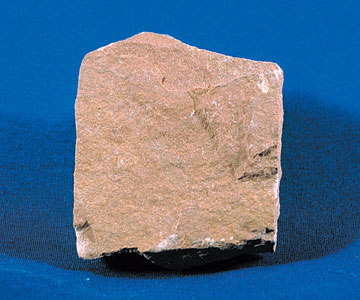
Siltstone is a sedimentary rock composed mainly of silt-sized particles. It forms where water, wind, or ice deposit silt, and the silt is then compacted and cemented into a rock.
Silt accumulates in sedimentary basins throughout the world. It represents a level of current, wave, or wind energy between where sand and mud accumulate. Sedimentary structures such as layering, cross-bedding, ripple marks, erosional contacts, and fossils provide evidence of these environments.
Siltstone is much less common than sandstone and shale. The rock units are usually thinner and less extensive. Only rarely is one notable enough to merit a specific name.
____________________________________________________
Mudstone
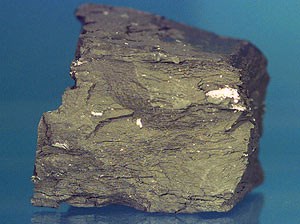
Mudstone, is a fine-grained sedimentary rock whose original constituents were silt and clay sized particles (at least 1/3 of each). Grain size is up to 0.0625 mm (0.0025 in) with individual grains too small to be distinguished without a microscope.
The lack of layering in mudstone may be due to either original texture or the disruption of layering by burrowing organisms in the sediment prior to being compacted. Mud rocks such as mudstone and shale comprise some 65% of all sedimentary rocks.
Mudstone looks like hardened clay and, depending upon the circumstances under which it was formed, it may show cracks or fissures, like a sun-baked clay deposit.
____________________________________________________
Shale
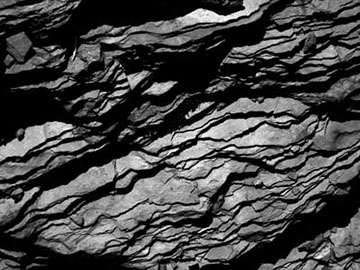
Shale is a specific type of mudstone. It is a fine-grained, sedimentary rock composed of mud that is a mix of flakes of clay minerals and tiny fragments (silt-sized particles) of other minerals, especially quartz and calcite. The ratio of clay to other minerals is variable.
With increased pressure over time, the clay minerals may become aligned, with the appearance of fissility or parallel layering. This finely bedded material splits readily into thin layers and is called shale, and this is the distinction from mudstone.
Shale is characterized by breaks along thin laminae or parallel layering or bedding less than one centimeter in thickness, called fissility. Fissility refers to the property of a rock which allows it to be split along planes of weakness into thin sheets. Mudstones, on the other hand, are similar in composition but do not show the layers, so could not be broken into thin sheets.
____________________________________________________
The Key Differences
Sandstone - sand-size grains of mineral, rock, or organic material cemented together
Siltstone – more than half of the composition is silt-sized particles.
Mudstone – hardened mud; a mix of silt and clay sized particles.
Shale – Mudstone that demonstrates fissility; the ability to be broken into thin sheets.
Questions to Answer (Logging Requirements)
All the information you need to answer the questions can be found in the listing and doesn't require any previous knowledge of geology. Please send in your answers before or soon after logging your find - I only ask you make a reasonable attempt. However, if no attempt at answers is made you risk your log being deleted. All questions can be answered by standing on the path or moving as required to get a clear view of the cliffs (if the leaves are on the trees). You can go closer to the cliffs if you wish to study the lower rocks but beware of the potential for falling stones due to the weak nature of the cliffs. I appreciate as you look higher in the cliffs it will be harder to comment on certain details but please just make your best attempt.
Q1 - Looking at the cliff, we are firstly examining the lowest band of rock, closest to the path.
a) What colour is the rock?
b) Estimate the average size of each sedimentary layer of this rock type
c) Comment on the texture - smooth/rough/size of grains etc
d) What rock type do you think this might be?
Q2 - Looking higher to the next band of rock in the cliff, the rock type very clearly changes.
a) What colour is the rock?
b) Estimate the average size of each sedimentary layer of this rock type
c) Comment on the texture - smooth/rough/size of grains etc
d) What rock type do you think this might be?
Q3 - Continue looking up the cliff to the third distinctly different band of rock.
a) What colour is the rock?
b) Estimate the average size of each sedimentary layer of this rock type
c) Comment on the texture as best you can at this distance - smooth/rough/size of grains etc
d) What rock type do you think this might be?
Q4 - As you go continue to look higher, the bands of different rock types continue to alternate.
a) How many distinct bands of different rock types can you see in total?
b) Considering the way sedimentary rock is formed, which of these bands is the oldest and which is the newest?
Please note. Non spoiler photos are always welcomed. At the time of publication if you are in an area where there is no signal and you write your answers into the message center it will not queue the message to be sent later as it does with logs - instead it will be deleted immediately by the app if it fails to send. Please be aware of this as I need to receive your answers. If you don't get a pop up saying 'message sent' then it hasn't!
November 2024 - there is been a bit of a landslide near GZ. This may block the easier view of the lower cliff area, please try and look elsewhere on the cliff a little further away and make your best attempt at the answers. I am aware of the issue, please don't worry if you don't have a perfect view.
Thank you for visiting the 'Sedimentary my dear Oswald' EarthCache