La cache
Questa cache è nascosta lungo la strada che dal centro di Asiago porta verso il colle del Leiten, dove è situato il Sacrario militare che da questo colle trae il suo nome. Si tratta di un contenitore di dimensioni piccole che contiene solo il logbook. Il posto è piuttosto frequentato, prestate attenzione e portate la vostra penna per firmare!

Il Sacrario
Il sacrario militare di Asiago, più noto come sacrario del Leiten, è uno dei principali ossari militari della Prima guerra mondiale. Sorge sul colle del Leiten presso Asiago, a 1058 m s.l.m.
Nel 1932, durante il periodo fascista, nacque l'idea di raccogliere in un unico, imponente, monumento-ossario, tutte le salme italiane presenti nei numerosi cimiteri di guerra sparsi sull'altopiano di Asiago.
Il sacrario venne progettato dall'architetto Orfeo Rossato di Venezia e venne ultimato nel 1936. Due anni dopo, nel 1938, tutte le salme italiane furono lì trasferite. Alla fine degli anni sessanta tuttavia, si concordò con l'Austria il trasferimento anche delle salme dei soldati austroungarici, rimaste a riposare nei cimiteri rimasti. Gli austriaci chiesero però che 5 cimiteri austroungarici degli allora 8 rimasti potessero rimanere dov'erano.
Nel sacrario riposano i resti di 54.286 caduti italiani ed austro-ungarici della guerra 1915-1918 di cui oltre 33.000 ignoti e 3 della guerra 1940-1945. I nominativi dei soldati noti sono incisi, in ordine alfabetico, da sinistra a destra sui singoli loculi. I resti mortali di 21.491 caduti italiani ignoti e 11.762 austro-ungarici ignoti sono invece raccolti in grandi tombe comuni nelle gallerie centrali più prossime alla cappella. Fra i noti riposano 12 caduti decorati di medaglia d'oro al valore militare.

The cache
This cache is hidden along the road that leads from the center of Asiago towards the Leiten hill, where the military memorial is located. It is a small pipe that contains only the logbook. The place is quite busy, pay attention and bring your pen to sign!
The Memorial
The military shrine of Asiago, better known as the Leiten shrine, is one of the main military ossuaries of the First World War. It is located on the Leiten hill near Asiago, at 1058 m above sea level.
In 1932, during the Fascist period, the idea was born to gather all the Italian corpses in the numerous war cemeteries scattered on the Asiago plateau in a single, imposing, ossuary monument. The shrine was designed by the architect Orfeo Rossato of Venice and was completed in 1936. Two years later, in 1938, all the Italian corpses were transferred there. At the end of the sixties, however, it was agreed with Austria to transfer also the bodies of the Austro-Hungarian soldiers, who remained to rest in the remaining cemeteries. The Austrians, however, demanded that 5 Austro-Hungarian cemeteries of the then 8 who remained could stay where they were.
In the shrine rest the remains of 54,286 fallen Italian and Austro-Hungarian soldiers of the 1915-1918 war of which over 33,000 unknown and 3 of the war 1940-1945. The names of known soldiers are engraved, in alphabetical order, from left to right on the individual niches. The mortal remains of 21,491 fallen Italian unknown and 11,762 unknown Austro-Hungarians are instead collected in large common tombs in the central galleries closest to the chapel. Among the known rest 12 fallen decorated with gold medals for military value.
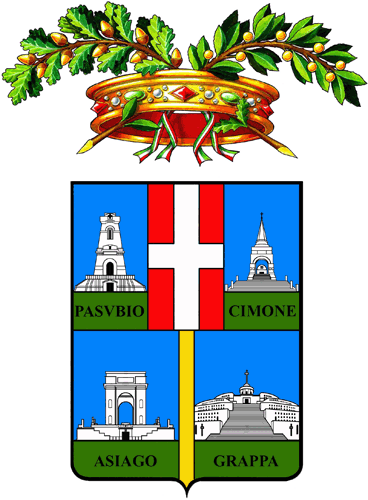
Il Sacrario militare di Asiago, insieme a quelli di Tonezza del Cimone, del monte Grappa e del Pasubio, compare in uno dei quattro quarti dello stemma della provincia di Vicenza.
The military memorial of Asiago, along with those of Tonezza, of Mount Grappa and Mount Pasubio, appears in one of the four quarters of the coat of arms of the province of Vicenza.