Best to view this earthcache at low tide unless arriving by boat.
To log this earthcache, please don’t stress about answering the questions. Simply send your best attempts in a private message to me, (the cache owner), and then go ahead and log it as found.
You don’t need to wait for my approval. All attempts will be accepted.
Go ahead and have fun learning! 
At the outcrop:
- How can you tell the rock on the top layer of the cliff is basalt lava? What are the telling features compared to the other layers?
- Which layer displays the mudstone, and what color is it?
- What type of rocks make up the dramatic bottom layer? (Basalt lava, mudstone, sedimentary rock)
- [REQUIRED] Please post a photo in your log of yourself or a personal item at the outcrop to prove you visited the site.
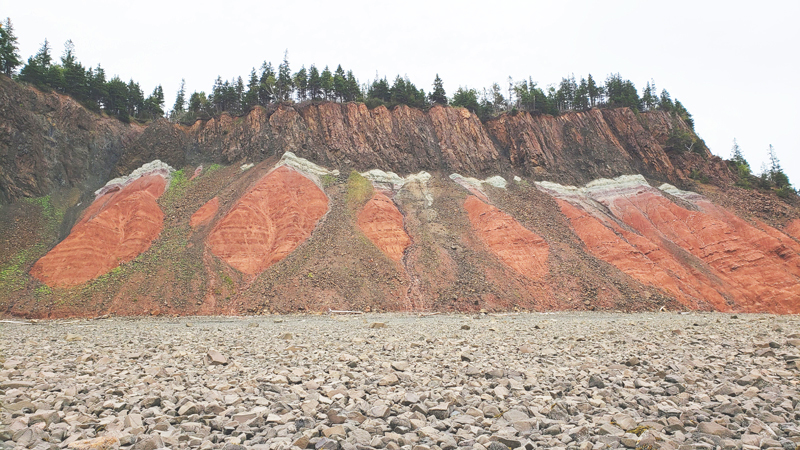
This earthcache will bring you face to face with one of Atlantic Canada’s most dramatic geological panoramas. This cliff is comprised of several different types of rocks, being crowned by a basalt lava flow capping the cliff.
Volcanic episodes
In the upper portion of the cliff are the greys and browns of a basalt flow that poured out onto the sedimentary rock. This flow represents the first of three volcanic episodes, all part of the North Mountain Basalt. The North Mountain traces its history to the Triassic period when this part of Nova Scotia occupied the center of the supercontinent Pangaea. It is a 201 million year old sequence of tholeiitic basalts, which contains columnar jointing.
The volcanic activity here ranged from emission of gases to non-explosive lava emissions. When a volcanic event occurred, there was a continuing release of surface extrusion or intrusion of magma. Basaltic lava flows are of low viscosity and can flow over long distances.

Lava
The lava at this location is the molten rock generated by geothermal energy and expelled through fractures in planetary crust. The lava flow movement was an outpouring of lava created during a non-explosive effusive eruption. When it stopped moving, it solidified to form igneous rock on the top of this cliff, covering the sediment below it.
Below the basalt lava are the light grey and orange red sedimentary layers onto which it erupted. Greenish brown fans of debris eroded from the basalt cover parts of the rock face.
The colourful lower portion of the cliff face records the accumulation of orange-red Triassic lake and river deposits in the arid Fundy Basin. They are equivalent to similar rocks at Cape Blomidon. A group of light and dark grey mudstone layers capped the sedimentary sequence, providing the cliff with a bold dash of contrast.
Mudstone
The light grey Mudstone is a type of mudrock, a fine-grained sedimentary rock whose original constituents were clays or muds. Grain size can range and can be too small to be distinguished without a microscope. With increased pressure over time, the clay minerals may become aligned, with the appearance of parallel layering. Mud rocks such as mudstone and shale account for some 65% of all sedimentary rocks. Mudstone looks like hardened clay and, depending upon the circumstances under which it was formed, it may show cracks or fissures, like a sun-baked clay deposit.
Sedimentary rocks
Unlike the basalt lava above it, the sedimentary rock layer below may have formed by the deposition of the weathered remains of other rocks; by the accumulation and the consolidation of sediments; by the deposition of the results of biogenic activity; and by precipitation from solution. As sediment deposition builds up, the overburden pressure squeezes the sediment into layered solids in a process known as lithification ('rock formation') and the original fluids are expelled.