Simplified, a lime kiln is an oven used to produce quicklime by the "calcination" of limestone. Limestone is made up mainly of three components: calcium, carbon and oxygen. When limestone is heated the carbon escapes as carbon dioxide, leaving lime. This reaction takes place at 750°F, but a temperature up to 2,000°F is usually used to make the reaction proceed more quickly. The process of lime burning was carried out by a kilnsman who was experienced in the reduction of limestone. An experienced kilnsman was required to monitor many variables in order to reduce the amount of "dead burnt" lime which was not useful as an end product. The heating and cooling process took several days.
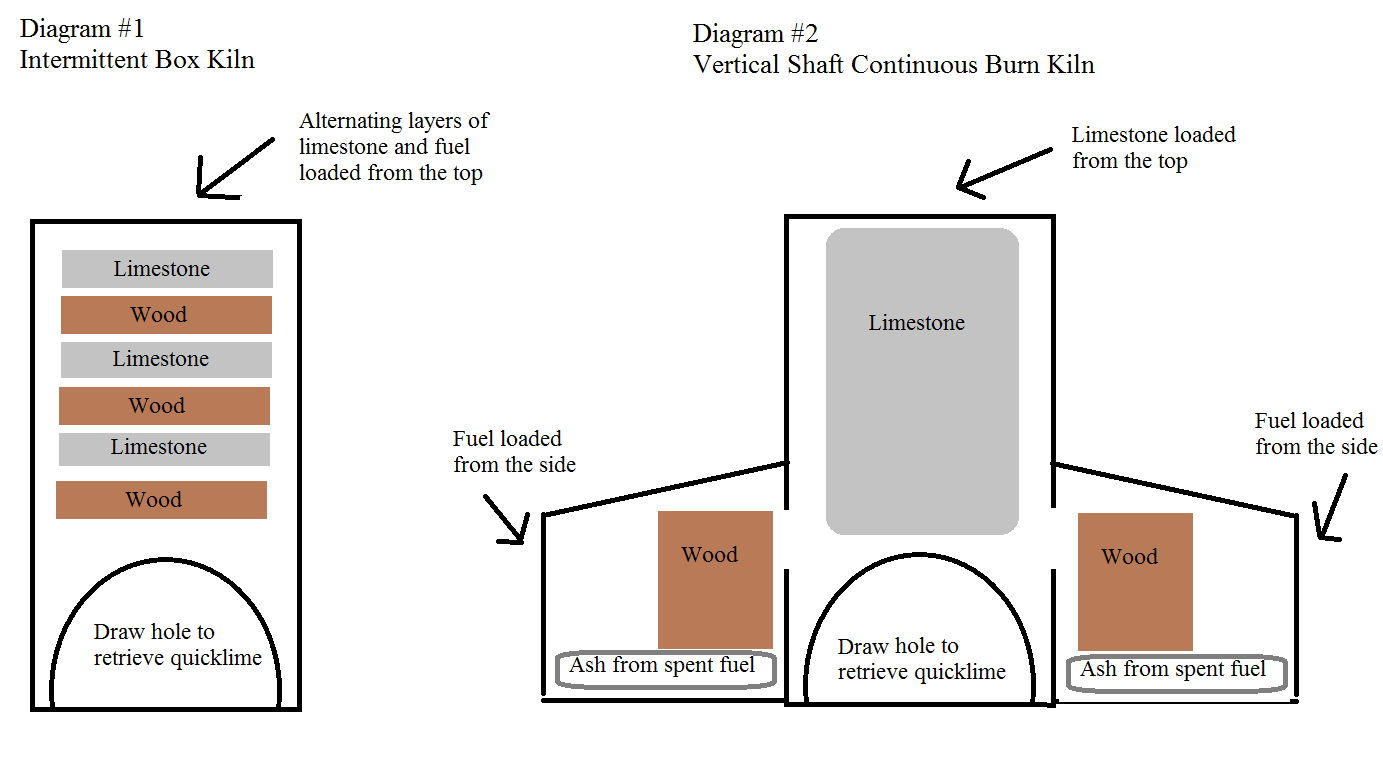
Lime is manufactured from limestone, a mineral. The limestone (CaCO3) is crushed and loaded along with a charge (load) of coal into a tapered, stationary vertical refractory lined tube with the wider bottom permitting the free downward movement of the materials. Burned out with hot air at a temperature of 2000°F, the limestone is decomposed emitting carbon dioxide gas leaving calcium oxide (CaO), more commonly known as quick lime. Following cooling, the lime is crushed into its useful powder form.
After the lime was fired it was cooled in cooling sheds and slaked. Slaking involves adding moisture to the lime; this occurred in a number of possible ways from sprinkling water on the lime to letting it sit and absorb water from the atmosphere. The correct mix is approximately one part lime to one part water. Other additives were combined with the lime to create various products.
The lime industry played a large part in Wrightsville's history. An 1894 bird's eye map of Wrightsville indicates that at least five different sets of kilns were operating in the community. During the late nineteenth and early twentieth centuries, York County was one of the largest producers of lime in Pennsylvania.
*Please don't climb the kilns
How to claim a find:
Message me the answers :
1. Using the sign at GZ, tell me what the lime was used for.
2. Estimate the height of the kilns
3. Why do you think the kilns were built where they are?
4. Take a photo of your phone/gps or yourself at GZ