This virtual will take you to one of my favourite places in Ireland. I love places that have old history and old stones - and Carrowkeel delivers that. I was visiting another Neolithic site in Sligo a few years back and the OPW guide told me that if I enjoyed that site then I should definitely head for Carrowkeel as she rated the site as one of the best in Ireland – I did just that and she was right. The location itself is lovely and peaceful - and on a clear day standing on this hill you have magnificent views over 5 counties and a wonderful view of Lough Arrow. But the real treasure is the Neolithic history.
Warning 1 – National Monument
This site gives you the chance to enter 2 Neolithic tombs and experience that feeling at your leisure and at no charge. There’s no ticket booth, no tat shop, no tour bus parking. Please respect the site – soak in the history and ambience but please treat the site properly and respectfully.
These structures are National Monuments :
- Do not climb on the tombs,
- Do not damage the tombs,
- Do not displace any rocks,
- Do not add graffiti
- Do not take anything original away from outside the tombs,
- Do not take anything original away from inside the tombs,
- Do not leave anything new in the area.
- However, if you find that people have left rubbish behind, I would ask that you CITO and remove any modern waste.
Warning 2 – The Task
Please note that the location and task may not be suitable for all but if you made it up the hill then I’d guess you’ll be capable of the task too. It will take a certain level of agility, fitness, slimness (I’m not exactly thin but made it in) and bravery. Claustrophobics may not like the entrance process – both tombs are spacious inside and you can stand up in them – we had three people inside on our last visit but could have easily fitted more in.
Warning 3 – Be Prepared
- It is Ireland so please ensure you’re kitted out properly – you might get a few different types of weather in the same half hour. We visited on 23rd June 2019 and had strong winds and rain on the hill although we walked up with sunshine/drizzle. The top of the hill can feel a lot more exposed than the walk up.
- Watch your footing - the ground is uneven and soft in places and there are plenty of holes, crevices etc and some steep cliff faces. Take special care of children.
- You may want to bring a torch for the task.
- There’s no restaurant, café or quaint tea-room – so if you’re planning on spending time here bring supplies.
Warning 4 – Break Ins
Very occassionally there have been break-ins and thefts from cars parked here. If possible please don't leave valuables in your car and make sure anything left is out of sight. We've parked here numerous times and never had a problem but break-ins do happen in these isolated areas.
GENERAL HISTORY OF THE SITE
Carrowkeel is a cluster of some 14 Neolithic Passage tombs situated on limestone plateaus on the Bricklieve Hills. They lie partially buried in peat which has accumulated over the years since their construction – the peat ranges from a couple of feet to 3m in places. Back when these tombs were constructed these hills would have looked like the limestone lunar landscape of the Burren in Clare overlooking forests where boar, deer and bear roamed.
It is believed the complex was built in the period 3400-2400 BC – which makes them probably over 5,000 years old. There are also caves, erratic stones, over 150 huts and enclosures (a Neolithic village – perhaps the tomb builders), cairns, kists/cists, more tombs on neighbouring hills, etc in the area. If you’re into history of this nature then the wider site is well worth more of your time. We will concentrate on showing you only a couple of sites.
The tombs were “rediscovered” in 1897 by Praeger who was carrying out a botanical survey. That said, earlier local records do make reference to the tombs. Move on 14 years and some of the tombs were excavated (crudely) over a week by Macalister, Praeger and Armstrong in 1911 and the findings recorded. They even used dynamite in one instance to open up a blocked tomb. Sources described the excavations as “a tragic exercise in haste and lack of preparation” and “a blot on the reputation of Irish Archaeology”. That doesn’t detract from their significance or history. Praeger described one tomb entry as follows “I had the privilege of being the first to crawl down the entrance-passage; I did so with no little awe. I lit three candles and stood awhile, to let my eyes accustom themselves to the dim light. There was everything, just as the last Bronze Age man (sic) had left it, three to four thousand years before. A light brownish dust covered all... There beads of stone, bone implements made from Red Deer antlers, and many fragments of much decayed pottery. On little raised recesses in the wall were flat stones, on which reposed the calcinated bones of young children”. With advances in technology - carbon dating has proven the site to be Neolithic and not Bronze Age which Praeger had referenced.
They found many items inside the cairns including animal bones, cremated human remains, human bones, tools, pottery, etc. In the osteological section of their report they highlight that 31 identifiable separate skeletons were found (at least 12 female) – but these were only the least burnt bones. Many many more bodies were burnt but were not identifiable. The females would have ranged in height from 5ft to 5ft 5 inches and the males generally 5ft 5 inches to 5ft 8 inches. The majority of these were suggested to be less than 25 years old and the bones of children were also found in all the tombs. Studies in 2017 found cut marks on bones suggesting dismemberment – or ritual deconstruction of the body.
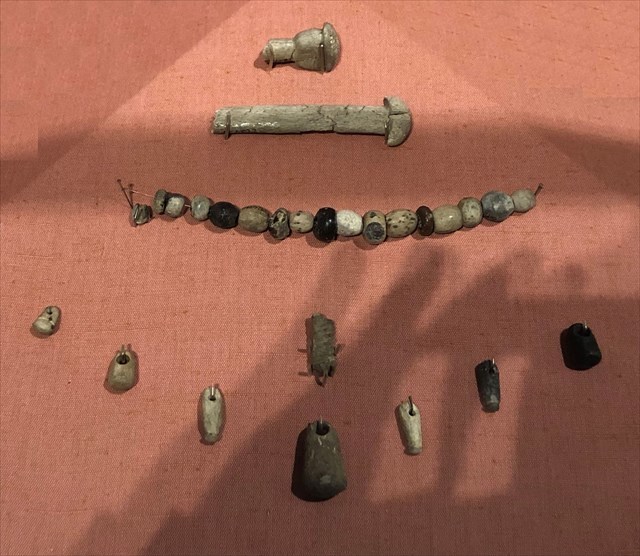
Two bone pins, eight stone pendants and seventeen stone beads - on display at the National Museum Of Archaeology in Dublin.
Many of the tombs at this site are still unexcavated - there could be countless treasures sitting below the peat and stones.
 YOUR VISIT TODAY AND HOW TO ACHIEVE THE REQUIREMENTS OF THIS VIRTUAL
I’ve identified three different parking waypoints.
- Parking1 is the safest and easiest – most sites recommend parking here.
- Parking2 is fine and it’s where we left the car on our first ever visit (after an aborted attempt at Parking3) – most cars will make it to here – a sign describes it as “The road to the cemetery is rough but traversable” – on wet days this may be tougher. Note - As you rise from Parking1 a sign says farm traffic only – but that is for the road ahead onto a farm track – the road to the cemetery that you want bears left. The background image on the page is part of the road between Parking1 and Parking2.
- Parking3 is the end of the line but I’d only head for this with a 4x4 - we did try to drive this on our first visit but retreated.
So – once you’ve chosen parking then head to the area of Parking3 and then follow the sheep paths up the hill. As you make your way up you’ll likely pass a rounded feature which is a still buried cairn (watch for the deep hole on the right side of it). You’re heading for the visible cairn of stones with no peat/earth on it. First up is Cairn G.
Cairn G
Cairn G has a short entry passage leading to a central chamber with 3 side chambers – a cruciform shape. There are 8 upright stones/slabs forming the walls (Orthostats) and the floor would originally be covered with limestone slabs. The roof that’s visible is a large slab. There isn’t art like Knowth or Newgrange in this tomb – in 2009 it was found that Cairn B does have some artwork including spirals similar in styling to Newgrange but. In 1911 Cairn G was recorded as being 21feet high and 68-70 feet in diameter. When found, the left & Middle recesses were covered with about 3-5 inches of burnt bone debris – on top of the bone debris there were smallish flat stones which it is believed were used as trays to bring the debris into the tomb. Sifting the bone debris they found stone pendants, beads, pottery fragments, bone implements (one made from a bear fibula), a pointed slate tool, rounded pebbles and a carved stone pendant (though broken). The right recess was built up to the level of the sill and the bone debris was filled to that level – they found and part reassembled what is believed to be a cinerary urn. An adult’s bone from Cairn G were radio carboned dated in 2009 as being 4494 (+/- 29) years old. A child’s bone was dated as being 4,342 (+/- 28) years old.
This tomb also has other interesting features worth noting ;
- A lightbox above the entrance similar to Newgrange – there are only a handful of known lightbox constructions with only 2 in Ireland so far - though other tombs on this hill have double lintels which could mean lightboxes. The Newgrange Lightbox is aligned to winter solstice sunrise but this one is aligned to Midsummer Sunset. Some sources would also say it aligns with the light of the setting moon at the winter solstice.
- A possible internal lightbox above the entry to the rear chamber.
- The door stone on the outside facing the entry has an unusual wavy hole.
Task 1 : at the entrance to Cairn G....Please take and upload to your log - a picture of something geocaching related sitting on the door stone with the wavy hole (a GPS, tweezers, a pen, a TravelBug, a hat, your caching name on a bit of paper.....or even a cacher).
Task 2 : Enter Cairn G. Take your time and enjoy the space formed by our ancestors some 5,000 years ago. You are now standing in a space which was created before Newgrange, before the Great Pyramids and well before that youngster at Stonehenge. You are looking at stones that were placed by neolithic people. Facing the back of the tomb, look at the orthostat stone on the righthand side of the rear chamber and find the pair of consecutive letters that someone has graffitied on the upright stone. They are to be found just above the curve, 75cm from the bottom, 15cm from the right side.
Once you’ve finished here continue on up the hill. The next cairn you find is Cairn H.
Cairn H
The passage is seemingly open but this cairn is not available to enter. It’s the only cairn in this complex with double kerb stones (one kerb 2m inside the other) and in 1911 was recorded at almost 30 metres in diameter making it the largest tomb. In 1911 it was the only cairn entrance open and the historians ended up entering through the roof as the passage was blocked. It’s the cairn where they alledgedly used dyanmite. They found a pentagonal chamber at the end of a curved passage. The blockage is believed to have happened in neolithic times as they found burials on both sides of the stone.
Once you’ve finished here you should continue on up the hill – you can detour to the left to find an erratic or past the erratic for a view over the settlements on the neighbouring hill. The next cairn you want to find is Cairn K.
Cairn K
This tomb is the highest spot. This is another cruciform shaped tomb and has an intact corbelled roof in the style found at Newgrange and it is still expertly shedding water. The entrance passage is some 7m in length. Similar bone debris etc was found here as Cairn G – unlike Cairn G some of it was under the stones that formed the floor. The highlight of this tomb is found at the back of the right hand side chamber - an interesting stone known as St Patrick’s Stone. It is the same shape as Croagh Patrick Mountain which is visible from this hill on a rare clear day. Outside the tomb entrance there used to be numerous pieces of white quartz but these have sadly been removed probably by souvenir hunters. Quartz features at other tombs here and at other neolithic sites – Newgrange and Knowth being the most notable. It is know as Grian Cloch in Irish – “Sun Stone” and may have played an important part in the rituals or highlighting the hilltop.
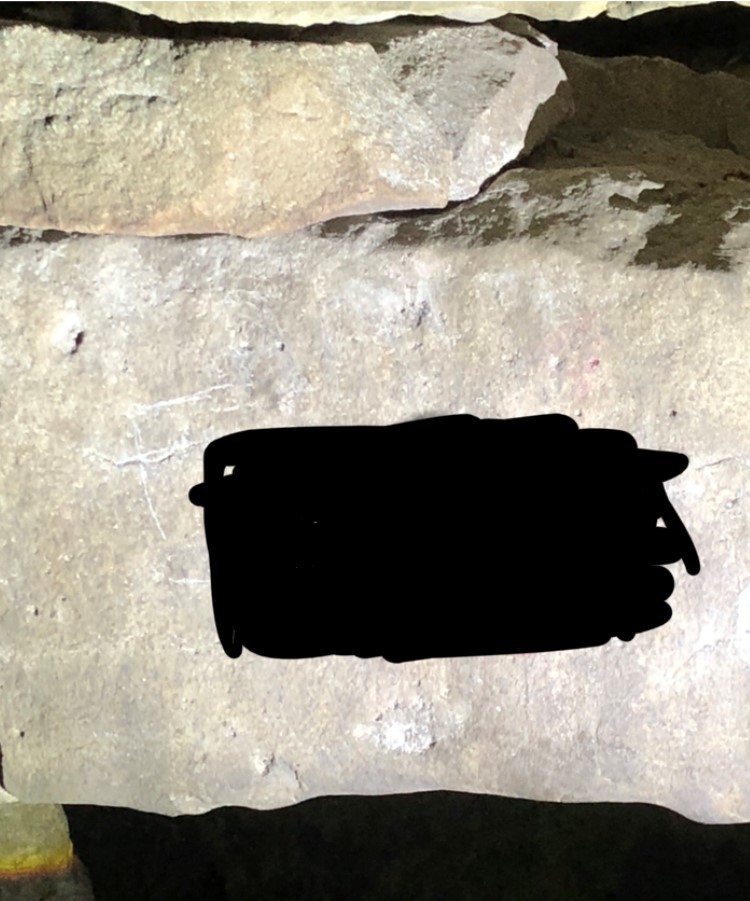
Task 3 : Enter Cairn K. Take your time and enjoy the space formed by our ancestors some 5,000 years ago. You are now standing in a space which was created before Newgrange, before the Great Pyramids and well before that youngster at Stonehenge. You are looking at stones that were placed by neolithic people. Facing the back of the tomb, look at the lintel stone (horizontal stone above the opening) above the rear chamber entrance and find the large letters that someone has graffitied on the stone with thin scratches. The picture that follows shows the first letter "F" - what three letters immediately follow the F?
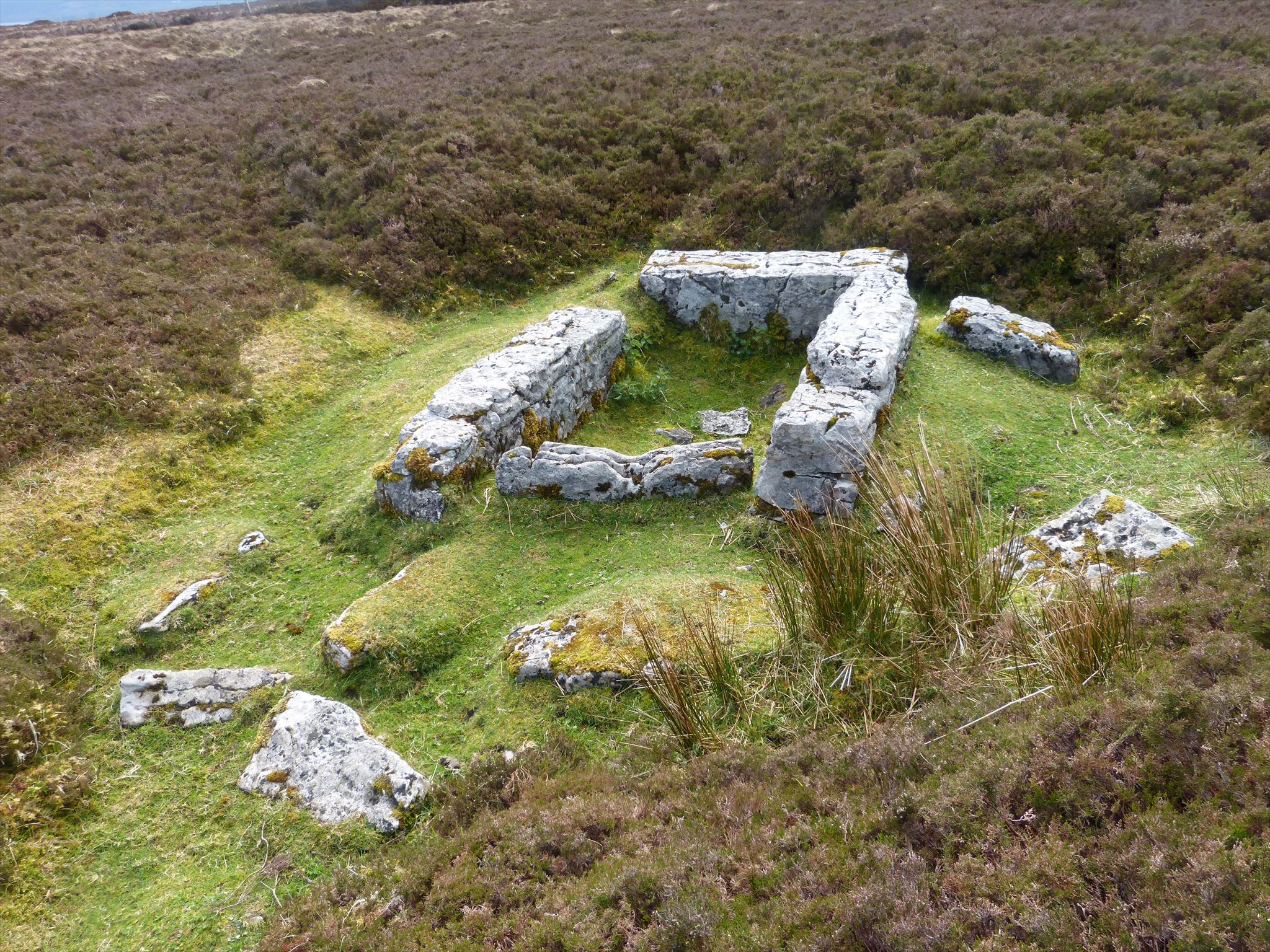
Cist / Kist (Cairn K)
A short distance away from Cairn K we find the remains of a cist – which, from old accounts, used to be covered with a large stone slab. It may have been a tomb in itself. One source suggests it may have held a ritual purpose with living people spending time in within it as an initiation. Others believe that they may have used this space to prepare the bodies - either inside or on top of the slab. There are no records and it’s a guessing game as what it may have been used for.
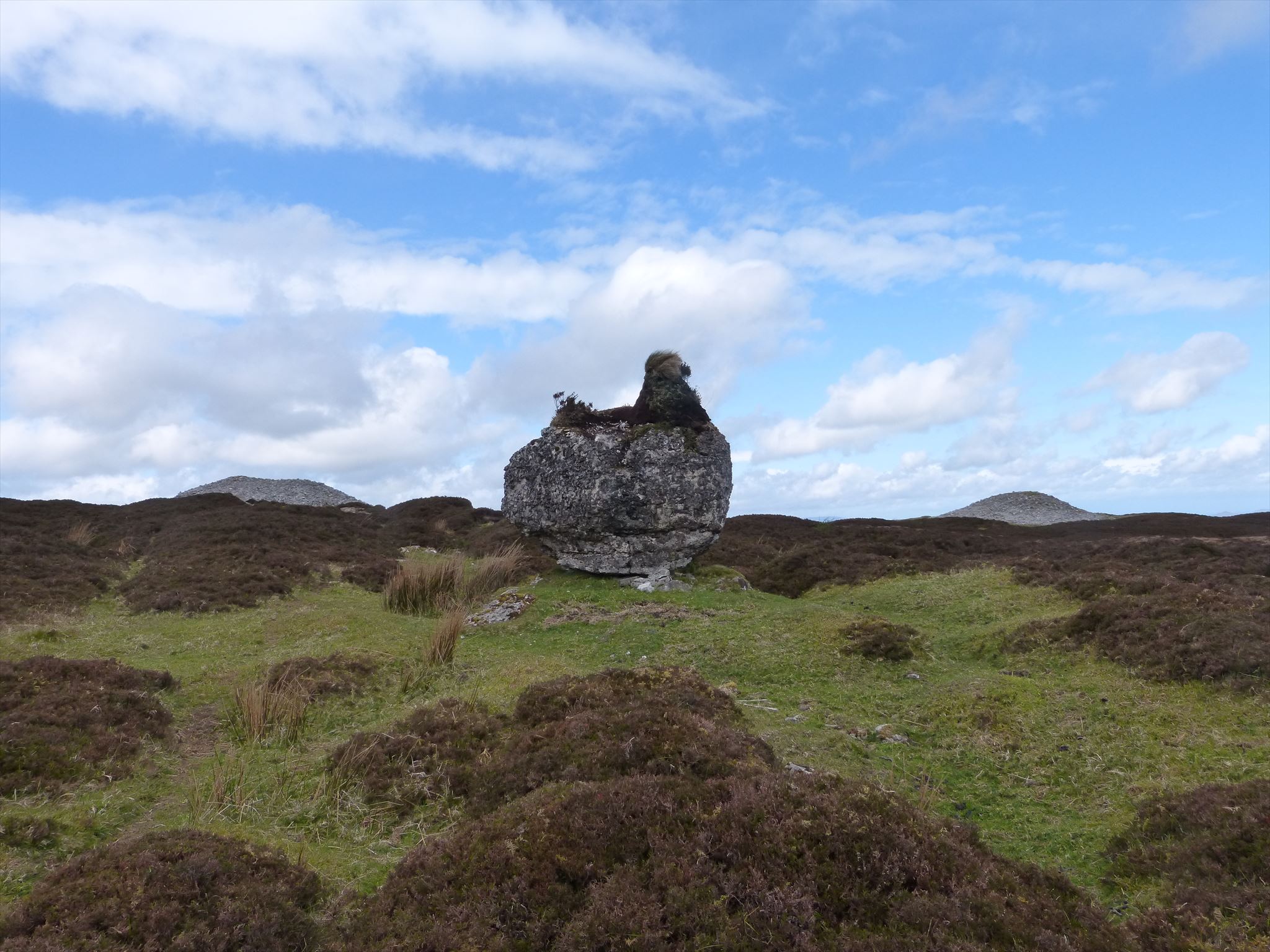
The Rocking Stone (Erratic)
There is a glacial erratic stone here which is known as the rocking stone. It doesn’t rock any more – either due to crushing the smaller stones below or perhaps having been pushed too hard in the past.
Recap of the tasks
1) Please upload a photo to your online log from the entrance to Cairn G as described above.
Please message or email me the following letters along with your caching name :
2) Cairn G – 2 consecutive letters found graffitied on the upright stone to the right of the rear chamber.
3) Cairn K – First 3 letters after the "F" found graffitied on the lintel above the rear chamber.
Please do NOT include these answers (or photos of these stones) in your logs  .
.
Logged finds may be deleted if the required information is not sent to me within 2 weeks of your online log.
They arrived First
Congratulations to Nabulungi & gaffer.gamgee for the being the first to find of my virtual and thanks for such nice logs too.
Congratulations to Diewarsi for being the first foreigners to take the time to find this virtual. It's not a cache and dash - they've used up holiday time to come to this special place.
Virtual Rewards 2.0 - 2019/2020
This Virtual Cache is part of a limited release of Virtuals created between June 4, 2019 and June 4, 2020. Only 4,000 cache owners were given the opportunity to hide a Virtual Cache. Learn more about Virtual Rewards 2.0 on the Geocaching Blog.