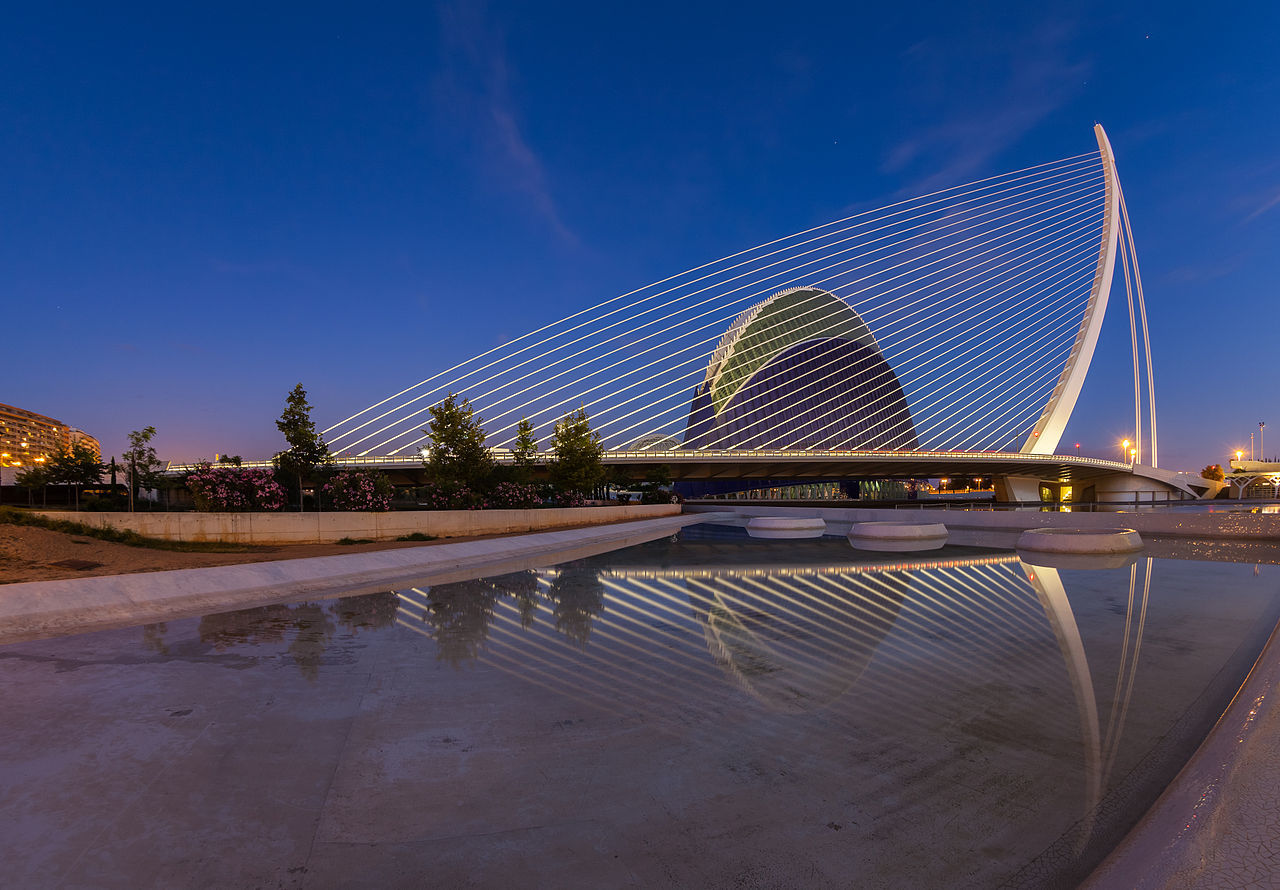
The Assut de l'Or Bridge is a cable-stayed bridge located in the city of Valencia, over the old bed of the Turia river, between the Príncipe Felipe Science Museum and the Agora. The origin of the name comes from an old dam that is preserved close to this one. It is necessary to emphasize that the promoter of such name was a city neighbor.
It was designed by the Valencian architect and civil engineer Santiago Calatrava.
The bridge deck, 180 m. long by 34 m. wide, covers a 155-meter span. It is made up of a core and ribs on both sides. Altogether, 72 ribs are necessary, 21 tons each one.
The bridge is still standing thanks to 29 cables that come out from the front of the mast and another four guy cables.
The mast of the bridge, 125 m high, is the highest point of the city (127 m including the lightning rod at the top).
It was awarded in 2004 for a total of 23.2 million euros. In the summer of 2008, it was learned that the investment already reached 34 million euros, 11 million more than originally budgeted. Finally, the “Sindicatura de Comptes” (auditor of the Government of Valencia) established that the expenditure had increase to 59.9 million euros, more than two and a half times higher than budgeted.
The construction began in 2004 until the summer of 2005, when the works were completely stopped. At the end of 2007 they continue with its construction until its completion in 2008. It was provisionally opened on August 20, 2008 due to the celebration of the European Grand Prix of Formula 1 with the intention of speeding up the traffic in the area. At the end of the event the bridge is closed again to continue with its construction and to repair some problems in one of the cables that delayed the opening for a few more months. Finally, once the work is completed, the inauguration took place on December 11, 2008.
It should be noted that the bridge, 180 m long and 125 m high, is the second longest and highest infrastructure of this type in Spain after the Alamillo Bridge in Seville, also designed by Santiago Calatrava. However, and as has happened with other works of this architect, the bridge has been subject to controversy, in particular for its instability and the need for the placement of traffic lights in one of the directions to retain the traffic and avoid accidents, since the change of grade of the bridge prevents good visibility.
Source: Wikipedia.
HOW TO GET FINAL COORDINATES
Due to the subject matter, we propose a mystery in which the bridges play a leading role and, for that, we will make use of the cinematographic universe.
The starting point is The Ides of March (George Clooney, 2011). The film is just an industrial product more or less correct, however, during its viewing, we will find a passage that attracts lots of attention:
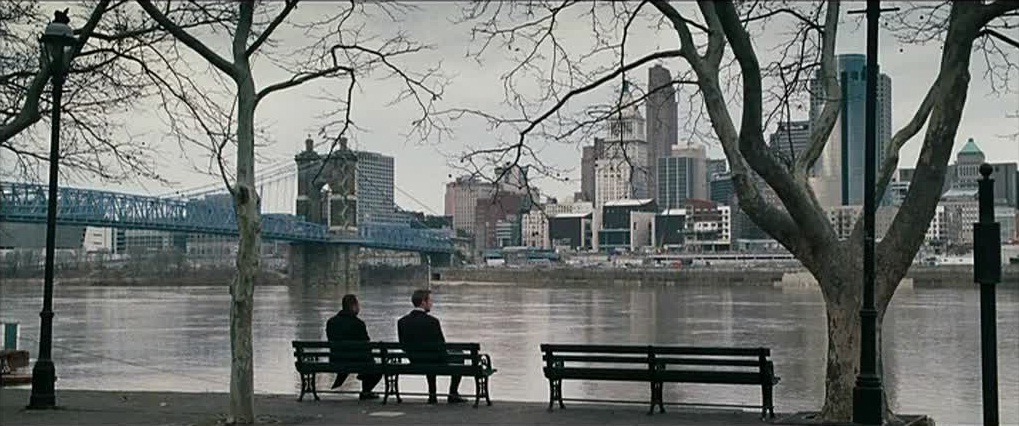
In this interesting scene the characters played by Ryan Gosling and Jeffrey Wright dialogue to reach a pact that allows the Governor of Ohio (George Clooney) to win the Democratic Party primaries. Few things are as universal as the goings-on for political power.
But let's get to the point, because what really matters here is not what is told, but what you see: the spatial configuration of the scene, the layout of the frame.
In the frame we can see the characters sitting on a bench in the foreground and the majestic John A. Roebling suspension bridge in the background on the left, crossing the Ohio River. It is in the city of Cincinnati, OH (USA).
We said that it is a very exciting shot, and it is because it is a tribute, certainly a voluntary tribute by George clooney to one of the most iconic cinema scenes ever. And this is what you have to find out: To which scene of which movie pays tribute? Surely any cinephile will have already noticed the resemblance. Even the image was the promotional poster of the famous feature film for which we asked. Anyone who has not idea has the option to search it on Google. I already anticipate that it is “a piece of cake” because it is a very iconic image and its disposition is very similar to the one shown in “The Ides of March” capture: two people sitting on a bench in the foreground next to the river bed and a bridge in the background crossing the left side of the shot. Actually, in Clooney's film the frame gives the bridge a lesser role for being more open-angled and it erects with less majesty, but the main difference is that in our mysterious film not two men appear, but a woman and a man. Besides that the bridge filmed is not the John A. Roebling, but another much more prestigious, and the city is not Cincinnati either.
Enter in Certitude the coordinates that correspond to the location of the bench where the couple of the scene of the mysterious movie are sitting. The range of error assigned is +/- 10m.
I remind you that the coordinates must be in format: N XX XX.XXX W XXX XX.XXX

Puedes validar la solución a tu puzzle con certitude.
El puente de l’Assut de l’Or, también conocido popularmente como “El Jamonero” o “Puente del Arpa”, está ubicado en la ciudad de Valencia, sobre el antiguo cauce del río Turia, entre el Museo de las Ciencias Príncipe Felipe y el Ágora. El origen del nombre proviene de un antiguo azud que se conserva en las cercanías de éste. Hay que destacar que el impulsor de tal denominación fue un vecino de la ciudad.
Fue diseñado por el arquitecto e ingeniero civil valenciano Santiago Calatrava.
El tablero del puente, de 180 m de longitud por 34 m de anchura, cubre un vano de 155 metros. Está compuesto por un núcleo y costillas a ambos lados de éste. En total son necesarias 72 costillas, de 21 toneladas de peso cada una.
El puente se mantiene en pie gracias a 29 cables que salen de la parte delantera del mástil y otros cuatro más de retenida.
El mástil del puente, de 125 m de altura, es el punto más alto de la ciudad (127 m incluyendo el pararrayos que hay en su extremo superior).
Fue adjudicado en 2004 por un total 23,2 millones de euros. En el verano de 2008 se supo que la inversión ya alcanzaba los 34 millones de euros, 11 millones más de lo presupuestado en un principio. Finalmente, la Sindicatura de Comptes (entidad auditora del Gobierno de Valencia) estableció que el gasto había ascendido a 59,9 millones de euros, una cifra superior en más de dos veces y media a lo presupuestado.
El puente se empezó a construir en el año 2004 hasta verano de 2005, cuando se paran totalmente las obras. A finales de 2007 siguen con su construcción hasta su finalización en 2008. Fue abierto provisionalmente el 20 de agosto de 2008 con motivo de la celebración del Gran Premio de Europa de Fórmula 1 con la intención de agilizar el tráfico de la zona. Al finalizar el evento se vuelve a cerrar el puente para continuar con su construcción y reparar unos problemas surgidos en uno de los cables de retenida que retrasaron la apertura unos meses más. Finalmente se finaliza la obra, inaugurando el 11 de diciembre de 2008.
Cabe destacar que el puente, con 180 m de longitud y 125 de altura, es el segundo más largo y alto de España en este tipo de infraestructuras por detrás del Puente del Alamillo de Sevilla, también diseñado por Santiago Calatrava. Sin embargo, y al igual que ha sucedido con otras obras de este arquitecto, el puente ha sido objeto de polémica, en particular por su supuesta inestabilidad y por la necesidad de la colocación de semáforos en uno de los sentidos para retener el tráfico y evitar accidentes, ya que el cambio de rasante del puente impide una buena visibilidad.
Fuente: Wikipedia.
OBTENCIÓN DE COORDENADAS
Dada la temática, plantearemos un método en el que los puentes tengan especial protagonismo y, para ello, vamos a echar mano del universo cinematográfico.
El punto de partida es Los Idus de marzo (George Clooney, 2011). La película no pasa de ser un producto industrial más o menos correcto, sin embargo, durante su visionado, encontraremos un pasaje que llama bastante la atención:
En esta interesante escena los personajes interpretados por Ryan Gosling y Jeffrey Wright dialogan para llegar a un pacto que permita al Gobernador de Ohio (George Clooney) ganar las primarias del Partido Demócrata. Pocas cosas hay tan universales como los tejemanejes por el poder.
Pero vamos al grano, porque lo que realmente importa aquí no es lo que se cuenta, sino lo que se ve: la configuración espacial de la escena, la disposición del encuadre.
En el fotograma podemos ver en primer plano a los personajes sentados en un banco y el majestuoso puente en suspensión John A. Roebling al fondo a la izquierda, alzándose sobre el río Ohio. Se trata de la ciudad de Cincinnati, OH (USA).
Decíamos que es una toma muy interesante, y lo es porque supone un homenaje, seguro que voluntario, de George Clooney a una de las escenas más icónicas de la historia del cine. Y esto es lo que tendréis que averiguar: ¿A qué escena de qué película rinde tributo? Seguro que cualquier cinéfilo medianamente aplicado ya habrá advertido el parecido. Y es que la imagen en cuestión incluso fue el cartel promocional del ilustre largometraje por el que preguntamos. A todo aquel que no se haya percatado le queda la opción de investigar en Google. Ya adelanto que está “chupao” porque, insisto, es una imagen harto emblemática y la disposición es muy parecida a la que se muestra en la captura arriba adjuntada de Los Idus de Marzo: dos personas sentadas en un banco en primer plano junto al cauce del río y un puente como fondo atravesando la parte izquierda de la toma. Cierto es que en la película de Clooney el encuadre da al puente un menor protagonismo al quedar más angulado y erigirse con menor majestuosidad, pero la principal diferencia es que en nuestra película-incógnita no aparecen dos varones, sino una mujer y un hombre. Además de que el puente filmado no es el John A. Roebling, sino otro mucho más prestigioso, y la ciudad tampoco es Cincinnati.
Introduce en Certitude las coordenadas que corresponden a la ubicación del banco donde se sienta la pareja de la escena de la película-enigma. Hemos asignado un margen de error de +/- 10m.
Recuerda que las coordenadas deben ir en formato: N XX XX.XXX W XXX XX.XXX
Puedes validar la solución a tu puzzle con certitude.