Notice: "Cache seekers assume all risks and responsibilities involved in seeking this earthcache."
Warning: This is an agricultural area where many long-haul trucks full of wheat, corn, onions, potatoes, carrots, sugar beets and other commodities are busy going down the road. Most of us locals are accustomed to these trucks. If you don’t feel safe or comfortable stopping alongside the road or in a pullout to observe the geology, “Don’t Stop”. Don’t let earthcaching control you, but rather you control earthcaching. “Just because it is there, doesn’t mean you have to stop!”
“For your safety, even though the shoulder may be wide enough to stop and make observations, please park in the designated parking pullout and walk to the final. The road does get busy at times. If you feel uncomfortable with the suggested parking location, find a wider spot down the road and walk back.”
****“Additonal safety, even though the shoulder may be wide enough to stop and make observations, please park in the designated parking pullout and walk the short distances to final. (apx. 500 ft.) US730 does get busy at times.”****
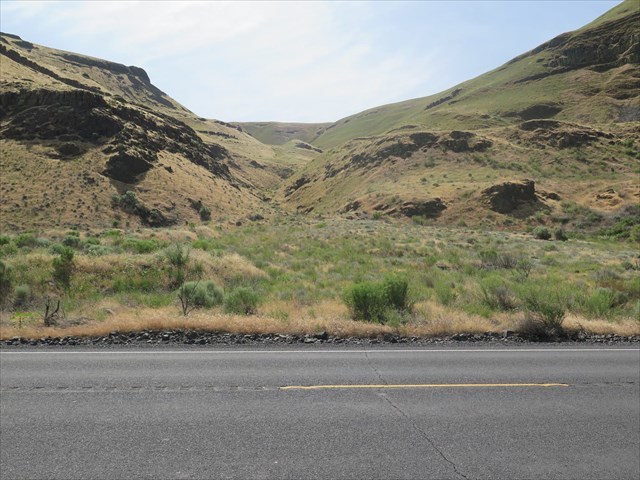
Alluvial fans are geological features made by flowing water such as a stream eroding and transporting material from one location to another transforming the landscape. The materials in alluvial fans are called alluvium which contains soil, sediment, sand, gravel and even boulders. The material is jumbled together and flows from the apex outward to the apron. Think of a Chinese folding hand fan and holding it from the handle with the leaves of the folds facing down. The handle is the source (apex) and the stretched out leaves (apron) is the direction of flow of the material. The alluvial fan forms a triangular shape. The apex is at a higher elevation and is narrow whereas the apron is spread out over a lower elevation. The slope of the debris field decreases from the apex.
Originally created by the Missoula flood (13,000 years ago) and continued with seasonal runoff from the plateau, water pushes material through the steep narrow apex constriction at a high velocity and energy. Large boulders and other coarse material are pushed down the slope. The pressure decrease, the velocity slows on the apron to the point where the water can no longer push the load and the material settles in place.
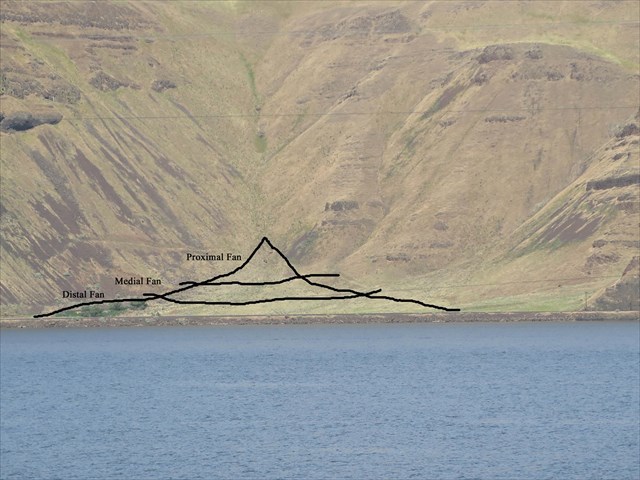
There are three zones in an alluvial fan.
Proximal fan is the apex where the slope is the greatest, the stream or canyon is the narrowest. This is where the largest gravel and boulders may be found.
Medial fan is the point where the stream, canyon or apex opens up. This is where fewer boulders are found with smaller gravel.
Distal fan is the bottom third of the flow where much of the finer sand, loose soil and other sediment settles.
To log this Earthcache, please send a private message to me with answers to the following questions.
1. Describe the material deposited at this alluvial fan.
2. At this alluvial fan, in which zone are most of the larger boulders located and why.
3. Looking west across the Columbia River and count the number of alluvial fans in view.
Optional: Upload a photo to the page of any local wildlife, unique vegetation or geology in the area.