To log this earthcache, please don’t stress about answering the questions. Simply send your best attempts in a private message to me, (the cache owner), and then go ahead and log it as found.
You don’t need to wait for my approval. All attempts will be accepted.
Go ahead and have fun learning! 
- [REQUIRED] Please post a photo in your log of yourself or a personal item at the outcrop to prove you visited the site.
- What is the average size and colour of the granite pebbles?
- How do these compare with the LAYERS and pebbles on the North Head itself? (See second waypoint)
- What makes the North Head conglomerate unique from the other rocks in the area, as far as appearance goes?

To find this outcrop, follow the trail about 60 metres before the bare ground of the North Head. Here you will find conspicuous layers of coarse conglomerate appear for the first time in the rock sequence. This rock is typical of the Cuckold Formation.
The Cuckold Formation is a stratigraphic unit of the Signal Hill Group, cropping out on eastern Newfoundland; it comprises red conglomerates and sandstones. A stratigraphic unit is a volume of rock of identifiable origin and relative age range that is defined by the distinctive and dominant, easily mapped and recognizable features.
A Conglomerate
A Conglomerate in geology is a coarse-grained clastic sedimentary rock that is composed of a substantial fraction of rounded to subangular gravel-size clasts, (granules, pebbles, cobbles, and boulders) at least larger than 2 mm in diameter. Conglomerates typically contain finer grained sediment; sand, silt, clay or combination and are often cemented by calcium carbonate, iron oxide, silica, or hardened clay.
The size and composition of the gravel-size fraction of a conglomerate may or may not vary in composition, sorting, and size. In some conglomerates, the gravel-size class consist almost entirely of what were clay clasts at the time of deposition. Conglomerates can be found in sedimentary rock sequences of all ages but probably make up less than 1 percent by weight of all sedimentary rocks. In terms of origin and depositional mechanisms, they are closely related to sandstones and exhibit many of the same types of sedimentary structures, e.g., tabular and trough cross-bedding and graded bedding.
Sample conglomerate (not at this site)
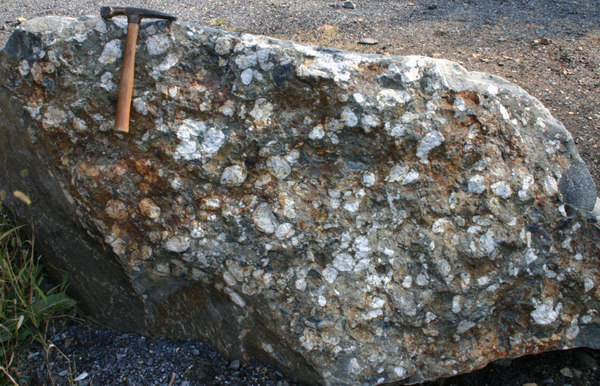
80% of the pebbles in the conglomerate are from volcanic ash or lava. The most abundant are granite pebbles, with fragments of sedimentary and dark green mafic rock making up the rest.