Der Radonstollen in Bad Kreuznach
Die Kopfkoordinaten führen Euch an eine Informationstafel am Radonstollen in Bad Kreuznach:

Der Radonstollen Bad Kreuznach wurde ursrprünglich als Quecksilbermine geplant. Wegen der geringen Ausbeute wurde dieser Plan später aufgegeben. Erst als der Apotheker Dr. Karl Aschoff 1904 das radioaktive Isotop in der Sole in Bad Kreuznach nachweisen konnte, wurde hier ein Inhalatorium (1912) eingerichtet, das mit der Luft aus dem alten Bergwerksstollen gespeist wurde. Im Krieg wurde das Inhalatorium zerstört und erst im Jahre 1974 in der Form eines begehbaren Stollens wieder eröffnet.
Neben anderen Radonstollen beziehungsweise Bädern für die Radonbalneologie in Deutschland, gibt es solche therapeutisch genutzten geologischen Formationen auch an aderen Orten in Europa: z.B. in Ungarn (Hévíz) Österreich (Gastein) oder auch Tschechien (Joachimsthal). Bei all diesen Bädern werden die radioaktiven Eigenschaften des Radium Isotops 222 für die Zelltherapie von chronisch-entzündlichen Erkrankungen wie Morbus Bechterew oder Rheumatoider Arthritis eingesetzt. Die Wirkweise, der therapeutische Nutzen und das mit der Therapie verknüpfte Risiko sind zum Teil ungeklärt bzw. umstritten. Aber dieses ist nicht Thema eines ECs....
Diese therapeutischen Anwendungen stehen im Gegensatz zu den nicht nur in den Medien beschriebenen Problemen mit hohen Strahlenbelastungen durch Radon in geschlossenen Räumen. So rät die WHO zu Grenzwerten in geschlossenen Räumen von durchschnittlich maximal 100 Bq/m⊃3;. In der Europäischen Union ist gemäß der Richtlinie 2013/59/Euratom ein durchschnittlicher Maximalwert von 300 Bq/m⊃3; zulässig.
Aber was ist Radon eigentlich und wo kommt es her?
Radon ist ein radioaktives Edelgas und kommt natürlich als vier Isotopen vor: 222Rn, 220Rn, 219Rn und 218Rn. Wenn allgemein von Radon-Messungen gesprochen wird, beziehen sich dies auf das 222Rn und dessen Zerfallsprodukte. 222Rn selbst ist ein Zerfallsprodukt in einer langen Reihe von radioaktiven Zerfällen, die bis auf das Plutonium Isotop 242Pu und 238U zurückgehen. 222Ra selbst zerfällt mir einer Halbwertszeit von ca. 3.5 Tagen. Die weiteren Isotope der Zerfallsreihe sind deutlich kurzlebiger. Am Ende steht das stabile Blei 206 (206Pb).
--------
Leider ist hier ein Fehler im listing. Ich habe von blues_man eine Korrektur bekommen, die ich hier einfüge. Danke dir!
Ein kleiner Hinweis zur Beschreibung: 242Pu ist nicht relevant aus Ausgangspunkt der Entstehung von 222Rn. 242Pu ist zwar ein theoretisches Mutternuklid von 238U, jedoch wird 242Pu nicht als primordiales Nukild angesehen, da die Halbwertszeit mit 375 000 Jahren vergleichsweise niedrig ist. Quasi sämtliches heute existierendes 242Pu stammt somit aus Brutprozessen in Kernreaktoren und ist daher für die Entstehung von 222Rn im Gestein nicht relevant. Ursprung ist also 238U als Ausgang der Uran-Radium-Reihe. Wenn man 220Rn noch mit betrachtet (9% Isotopenanteil, knapp unter 1 Minute Halbwertszeit), dann muss man 232Th aus Ausgangspunkt der Thorium Reihe noch mit nennen.
--------
Da Uran in der Erdkruste überall in unterschiedlichen Konzentrationen zu finden ist, ist das spätere Zerfallsprodukt 222Ra auch überall zu finden. Je nach Standort, kann Radon in Konzentrationen über 10.000 Bq/m⊃3; gefunden werden - oft auch deutlich höher. Die Geschwindigkeit, mit der Radon an die Oberfläche austritt, ist sehr stark abhängig von der Beschaffenheit des Gesteins, in dem es gebildet wird. Handelt es sich also um ein sehr poröses Gestein oder ein Gestein mit sehr vielen Rissen und Verwerfungen, ist der Austritt relativ schnell. Andere Ablagerungen sind deutlich dichter und lassen die Radongase nicht so ohne weiteres hindurchtreten.
Der Rotenfels im Westen des Caches besteht vor allem aus Rhyolith magmatischen Ursprungs. Während der Abkühlprozesse sind hier Risse durch die Schrumpfungsprozesse entstanden. Im Nordosten befinden sich vor allem Sedimentgesteine des Rotliegenden. Hier sind feine Sedimente zu beobachten, die sich in dichten Schichten verfestigt haben.
Und schon sind wir bei Euren Aufgaben:
1. Gehe zu Stage 1 und betrachte die natürlichen Felsformationen oberhalb und links vom Nebeneingang des Radonstollens. Beschreibe die Struktur und die Zusammensetzung des Gesteins.
2. Gehe zu Stage 2 und beschreibe auch hier die Formation.
3. Gehe zu Stage 3 (optional) und suche das Bild unten. Diese Station ist ein kleiner Ausflug / Umweg, der für den interessierten Beobachter die eine oder andere Erklärung bieten könnte. Wichtig ist aber die Aussicht über die Szenerie unten am Fluss. Ein guter Ort für ein Foto das Ihr optional Eurem Log beifügen könntet. Suche hier folgende Formation (rechts am Hang, im Sommer könnte sie etwas überwuchert sein) und versuche die sichtbaren Strukturen den Stationen 1 und 2 zuzuordnen. Mir selbst fällt das schwer, aber Ihr seit ja erfahrenen Adepten der Geologie.
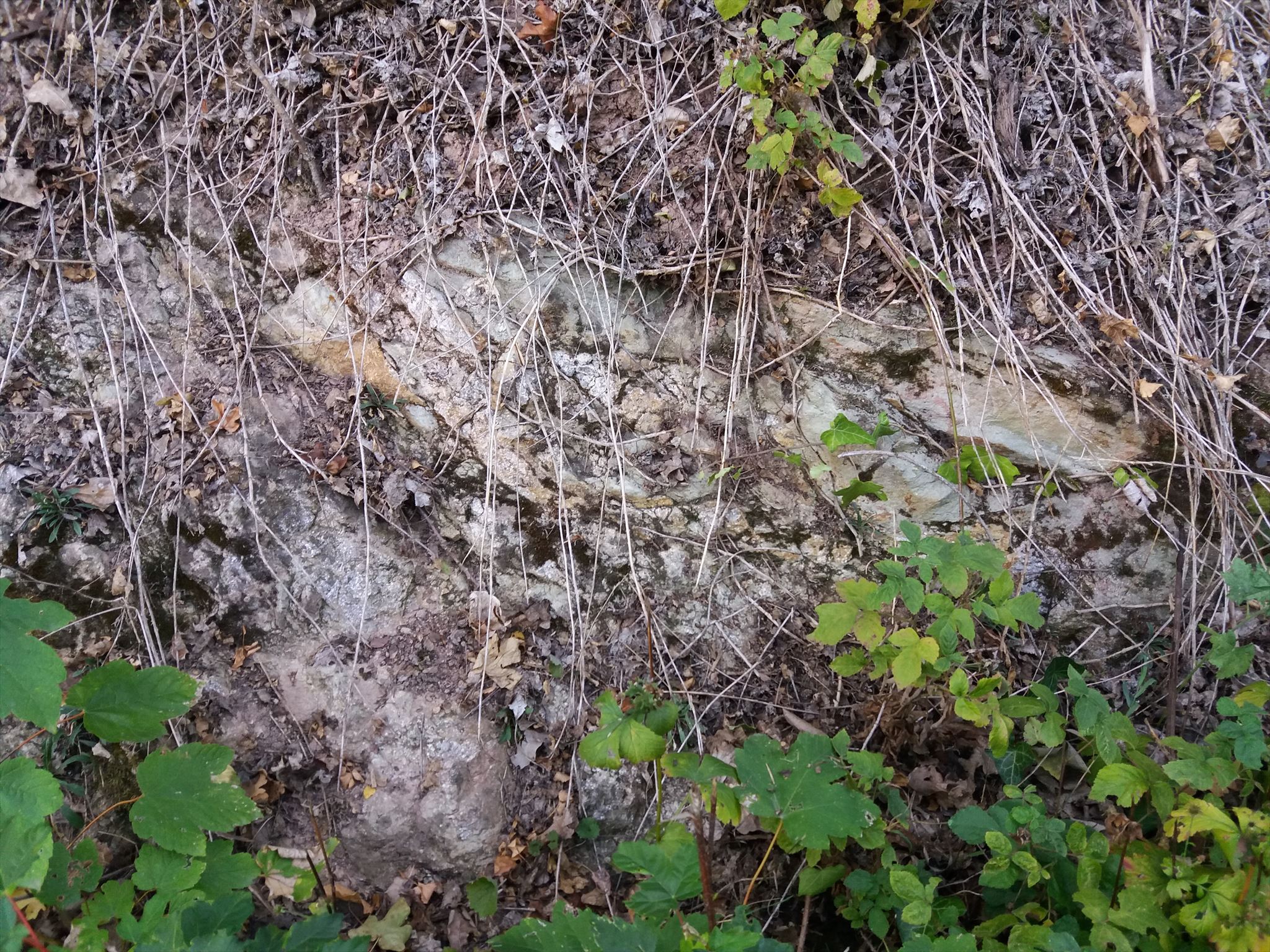
4. Spekuliere oder begründe warum an Stage 1 und nicht an Stage 2 der Radonstollen "Sinn" macht. Berücksichtige was einen starken Einfluss auf die Radonkonzentration in eingeschlossenen Räumen hat.
Schickt mir die Antworten an die Email im Profil. Ihr könnt dann direkt loggen. Ich melde mich, wenn mir etwas auffällt. Falls Ihr weitere Anregungen oder Korrekturen habt, nehme ich diese auch gerne mit in das Listing auf.
Eine Führung durch den Stollen ist kostenlos möglich. Hier habe ich allerdings unterschiedliche Angaben gefunden und ich rate jeden Besucher sich vorab zu informieren, ob die Führung auch stattfindet. Der Besuch des Radonstollen ist nicht für die Lösung des ECs nötig.
Quellen:
- https://de.wikipedia.org/wiki/Radonbalneologie
- Richtlinie 2013/59/Euratom
- Infotafel vor Ort
- hier und da im Internet
~*~
Eng:
The Radon Mine in Bad Kreuznach
The Radon mine Bad Kreuznach was originally planned as a mercury mine. Due to small amounts of mercury this plan was later abandoned. Only when the pharmacist Dr. Karl Aschoff was able to prove the radioactive isotope in the brine in Bad Kreuznach in 1904, an inhalatory (1912) was set up here, which was fed with the air from the old mine tunnel. In the war, the inhalatory was destroyed and reopened in 1974 in the form of a walk-in gallery.
In addition to other radon tunnels or baths for radonbalneology in Germany, such therapeutically used geological formations are also found elsewhere in Europe: e.g. in Hungary (Hévíz) Austria (Gastein) or the Czech Republic (Joachimsthal). In all these baths, the radioactive properties of the Radium Isotope 222 are used in cell therapy of chronic inflammatory diseases such as ankylosing spondylitis or rheumatoid arthritis. The mode of action, the therapeutic benefit and the risk associated with the therapy are not resolved or at least controversial. But this is not a topic of an EC ....
These therapeutic applications are in contrast to the problems, not only mentioned in the media, of high levels of radon exposure in confined spaces. For example, the WHO advises limit values in closed rooms of no more than 100 Bq / m⊃3; on average. In the European Union, according to Directive 2013/59 / Euratom, an average maximum value of 300 Bq / m⊃3; is permitted.
But what is Radon actually and where does it come from?
Radon is a radioactive noble gas and naturally occurs as four isotopes: 222Rn, 220Rn, 219Rn and 218Rn. Radon measurements generally refer to 222Rn and its decay products. 222Rn itself is a decay product in a long series of radioactive decay, which goes back to the plutonium isotope 242Pu and 238U.
Since uranium can be found everywhere in different concentrations in the earth's crust, the later decay product 222Ra can also be found everywhere. Depending on the location, radon can be found in concentrations above 10,000 Bq / m⊃3; - often much higher. The speed with which radon exits to the surface depends very much on the nature of the rock in which it is formed. If it is a very porous rock or a rock with very many cracks and faults, the exit is relatively fast. Other deposits are significantly denser and do not let the Radon gas pass through easily.
The Rotenfels in the west of the cache consists mainly of rhyolite of magmatic origin. During the cooling processes, cracks arose from the shrinkage processes. In the north-east, mainly sedimentary rocks of the Rotliegenden, here are fine sediments to observe that have solidified in dense layers.
And we are already at your task:
1. Go to Stage 1 and see the natural rock formations above and to the left of the side entrance of the Radon mine. Describe the structure and composition of the rock.
2. Go to Stage 2 and describe the formation here as well.
3. Go to Stage 3 (optional) and search for the image below. This station is a small excursion / detour that could offer one or two explanations to the interested observer. But important is the view over the scenery down by the river. A good place for a photo that you could optionally add to your log. Look for the following formation (right side of the slope, in summer it could be a bit overgrown) and try to assign the visible structures to stations 1 and 2. It's hard for me, but for you, the experienced adept of geology, this should be easy.
4. Speculate or justify why at stage 1 and not at stage 2 the construction of the Radon mine makes "sense". Consider what has a strong influence on the radon concentration in enclosed spaces.
Send me the answers to the email in the profile. You can then log directly. I'll get in touch if something strikes me. If you have further suggestions or corrections, I also like to include them in the listing.
A tour of the mine is possible for free. Here, however, I have found different information and I advise each visitor in advance to inform themselves if the tour takes place. Visiting the Radon mine is not necessary for the EC's solutions.
Sources:
- https://de.wikipedia.org/wiki/Radonbalneologie
- Directive 2013/59 / Euratom
- Information board on site
- here and there on the internet