Pasties are a Devonian delicacy
In November 2006 Dr Todd Gray, chairman of the Friends of Devon's Archives, claimed that the pasty is a Devonian delicacy and Cornwall stole it. His claim is based on a document found in the historic Audit Book and Receivers Accounts for the Borough of Plymouth, which dates back to the 16th century.
Dr Gray said he spotted four key lines of text which refer to the financial cost of making a pasty, using venison from the Mount Edgcumbe estate in Devon. The words date back to 1510. So Dr Gray contacted the Cornwall Record Office and found that its earliest record of a pasty recipe was in 1746. Thus Devon wins the pasty war by 236 years.
On 20 July 2011, after a nine-year campaign by the Cornish Pasty Association – the trade organisation of about 50 pasty makers based in Cornwall – the name "Cornish pasty" was awarded Protected Geographical Indication (PGI) status by the European Commission According to the PGI status, a Cornish pasty should be shaped like a 'D' and crimped on one side, not on the top. The PGI status also means that Cornish pasties must be prepared in Cornwall. However, they can be 'exported' elsewhere raw, and baked anywhere.
Whilst the PGI rules state that a Cornish pasty must be a "D" shape, with crimping along the curve (i.e., side-crimped), crimping is variable within Cornwall, with some advocating a side crimp while others maintain that a top crimp is more authentic.
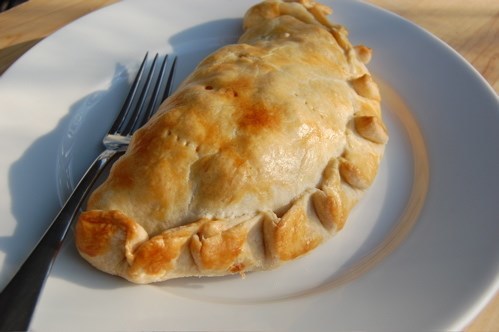
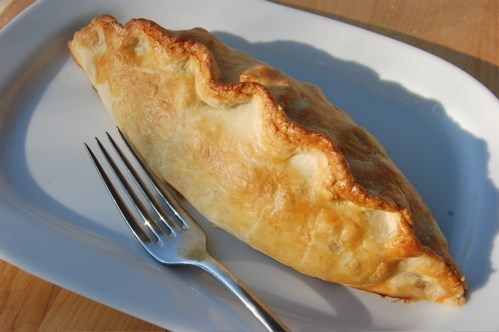
Some sources state that the difference between a Devon and Cornish pasty is that a Devon pasty has a top-crimp and is oval in shape, whereas the Cornish pasty is semi-circular and side-crimped along the curve. But, pasties with a top crimp have been made in Cornwall for generations, and now Cornish bakers who favour this style cannot legally call their pasties "Cornish".