
Welcome to Dinosaur National Monument
Take a step back in time 150 million years and explore the Morrison Formation along the the Fossil Discovery Trail to learn how these dinosaurs died and why their bones are found here.
Dinosaur National Monument is an incredible place to visit because there is so much to see and a lot to learn. There are 23 layers of rock visible throughout different locations in the park. In certain locations you can see dinosaur bones preserved in the rock, like the location that you are standing at.
What happened here?
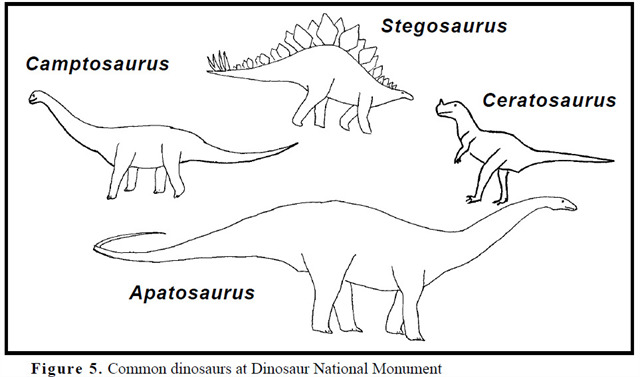
Over the years thousands of bones have been discovered at Dinosaur National Monument. Some are from incredibly large dinosaurs and others from very small dinosaurs. Of the dinosaur bones, all have been found in the Morrison Formation layer of rock. So what happened that all of these dinosaur bones are found here?
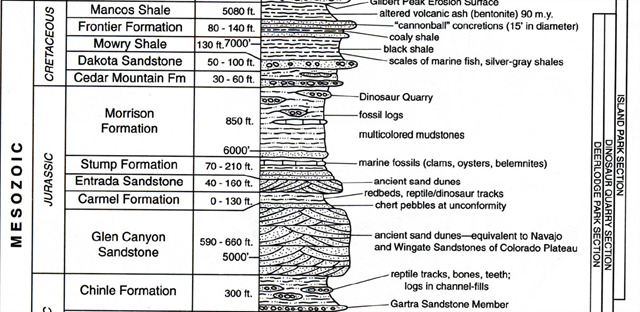
Most of the Morrison Formation is mudstone and clay, but the area highlighted by this earthcache is sandstone. Sandstone is a sedimentary rock composed of sand-size grains of mineral, rock, or organic material.
Geologists and paleontologists believe that the area you are standing was once a riverbed. There are two theories as to how all the dinosaur bones ended up in this area. 1) The dinosaurs would come to drink here. Overtime this riverbed dried up and the dinosaurs had no where else to go for water so they died due to lack of water. 2) The dinosaurs were drinking at this riverbed when a flash flood event happened and they were killed.
Whatever the reason, the dinosaur bones were in the riverbed and they were covered by sand-size particles and became encased and preserved in sandstone. Eventually paleontologists discovered them and began to remove some of them and catalog them. Now you get to be a geologist/paleontologist and answer a few questions.
In order to log this Earthcache...
Please read the following questions and send me your answers.
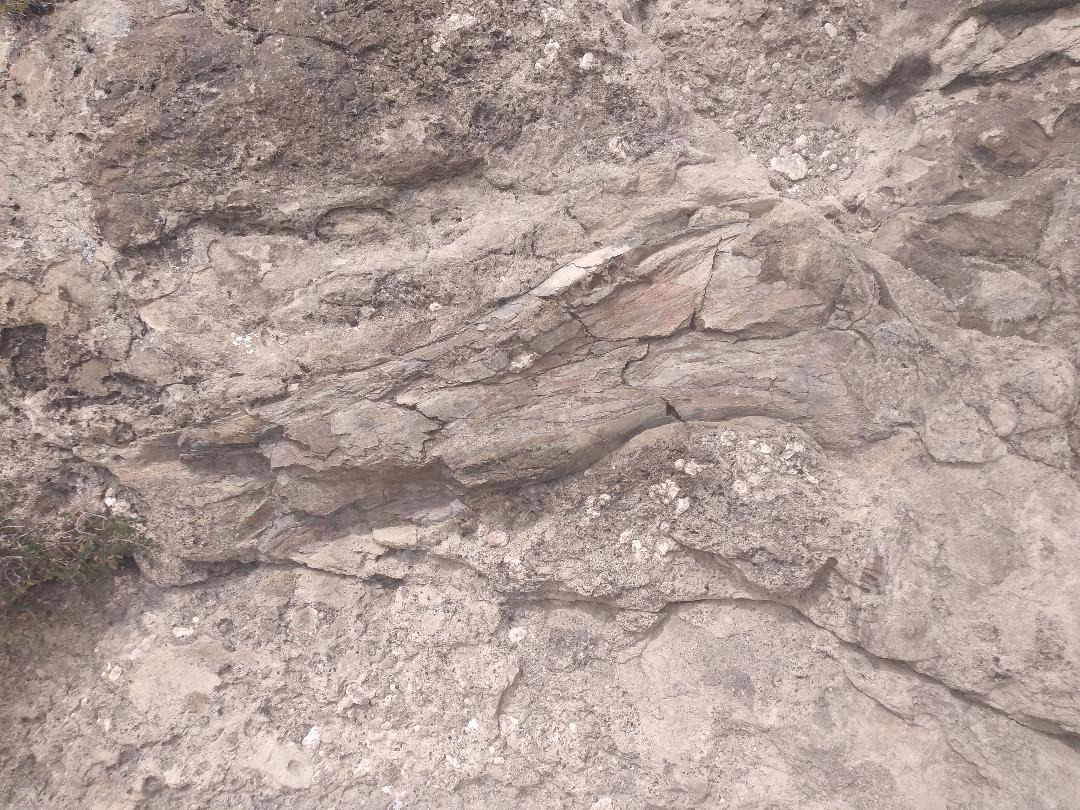
- The above picture was taken where you are standing. It is the femur bone of a dinosaur. If you were not told this, would you have had any idea this was a dinosaur bone? How is it different from the stone around it?
- Why are there so many fossil fragments in this section of stone?
- Walk from the posted coordinates down to stage 2 (Morrison Formation sign). What color is the stone? What direction is the stone going? Is it smooth or rough? Do you spot any other fossil fragments?
- Post a picture with your log. As an avid fan of earthcaches and national park properties I love seeing others adventures to these unique places.
- Bonus Question (optional): As stated above, most of the Morrison Formation is mudstone and clay. This portion of the Morrison Formation is sandstone. How does it differ from the other stone you have walked passed to get here?
Sources:
- https://www.nps.gov/subjects/fossils/upload/dino.pdf
- https://www.nps.gov/dino/learn/nature/geology.htm
- https://geology.com/rocks/sandstone.shtml
| I have earned GSA's highest level: |
 |