The North American swamp fairy (Pyske americanus) is an insect which looks like a mammal, even to the point of having "hair" (actually a specially modified form of chitin). The evolutionary advantage of this hair is unknown, save in that swamp fairies have been known to set traps for young, impressionable humans, using their apparent humanity to lure their prey far from rescue. The bodies of those who have been taken in this manner are frequently unrecognizable.
Swamp fairies are intelligent. This is both a good thing and a bad thing. Good thing: they can be reasoned with, to a degree, and convinced that perhaps attacking people who regularly carry both firearms and flyswatters is a bad idea. Bad thing: they are capable of long-term planning, carrying grudges, and double-crossing those who vex them. The list of "those who vex them" is long, and generally consists of anything and everything larger than they are.
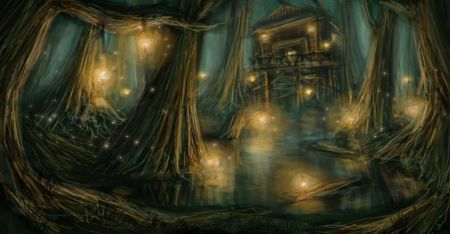
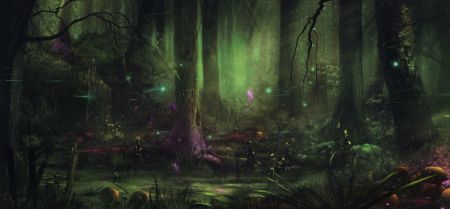
The natural habitat of the North American swamp fairy consists, perhaps unsurprisingly, of swamps and wetlands across the continent. There are several subspecies, three of which are currently believed to be extinct. When two species of swamp fairy are introduced into the same environment, they will inevitably fight until one of the varieties has been entirely eradicated. They are incapable of tolerating competition. Approach with caution.
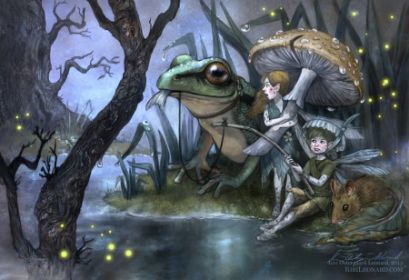
The swamp fairy is biologically similar only to other members of the genus pyske, although they share certain evolutionary roots with the more common, less homicidal, firefly. The swamp fairy has followed an evolutionary path similar to that proposed for the Johrlac, or cuckoo, first developing lungs, and then shedding their exoskeleton in favor of an internal "bone" structure formed from hardened chitin. Their wings are structurally akin to those of dragonflies, although they are usually folded downward when the swamp fairy is at rest. Swamp fairies produce luciferase in a specialized space between the layers of their skins, rendering them capable of bioluminescence. Each species has its own distinct color range and mating pattern, generated by controlled strobing of the luciferase by the courting male. Infant swamp fairies glow continually, making them easy for their parents to keep track of. Swamp fairies have been observed using their light to stun frogs and even small mammals, keeping them frozen until they can be killed by the rest of the hunting party.
There are no known diseases which infect swamp fairies, although they are quite capable of carrying contagion, sometimes intentionally when trying to clear an unwanted human population out of their territory. The average lifespan of a swamp fairy not eaten by something larger is approximately eight years, with sexual maturity occurring at two years of age. Swamp fairy gestation lasts four months; babies are normally born in groups of three.
While each species of swamp fairy will demonstrate variation in coloration and the strength of their luminescence, they are all humanoid, between four and seven inches in height, and absolutely vicious. Sexual dimorphism is moderate, with both males and females mimicking the human form, although females tend to be slight and small-breasted (the "breasts" are non-functional fatty deposits, and do not contain glands for feeding the young).
Pictured above is the Northwest swamp fairy, Pyske americanus menominee in full territorial display. When a swamp fairy poses in this manner, it is best to back away slowly, and demonstrate that you are armed. Only a show of force will be respected.