I have heard many a person saying that they live in a city, and will never see any fossils, or that they cannot physically get to fossil sites in the Dales as they are not able. Well, no need to worry, there is plenty to see in the city of Leeds itself. This EarthCache is suitable for the disabled, those with strollers and children. It is meant to be interesting and educational. Its is an easy walk from the railway station. There is parking, but please note that at certain times of the day, you will have to pay to park.
So, this EarthCache takes you to Holbeck, namely at the junction of David Street and Manor Road. You are here to look at the sandstone boulders on the corner. There are plenty of EarthCaches which talk about sandstone, so we won't digress further as we are here to look at a type of fossil.
Look at the boulders and you will see some lines and markings, these are fossils, namely fossil relics of the calamite tree. Calamites were a genus of extinct tree-like horsetails to which the modern horsetails are closely related. These plants were medium-sized trees, growing to heights of more than 30 meters (100 feet). The trunks of Calamites had a distinctive segmented, bamboo like appearance and vertical ribbing. The branches, leaves and cones were all borne in whorls. The leaves were needle-shaped, with up to 25 per whorl. The stems of modern horsetails are typically hollow or contain numerous elongated air-filled sacs. Calamites were similar in that its trunk and stems were hollow, like wooden tubes. When these trunks buckled and broke, they could fill with sediment. This is the reason pith casts of the inside of calamite stems are so common as fossils. Pith casts are also known as steinkern. As a Calamite tree matured the center of the stem (pith) became hollow, developing into a tube-shaped air cavity. The pith cast preserves an impression of the pith cavities outside surface, which represents the inside vascular and cortex tissue. It must be remembered that a fossil was probably surrounded with 4-5 times its width in (unpreserved) vascular tissue, so the organisms were much wider than the internal casts preserved.

Calamite fossil, the lines crossing the fossil are known as Node Lines.
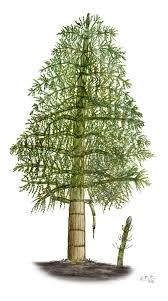
Calamite Tree.
This is an EarthCache. In order to log it, I ask that you answer some questions. Please send them to me, and do not include them in your log. You can send them to me by using the message facility or email, both of which can be found by looking at my profile. Alternatively, if you meet me at one of the local Leeds events, you could always discuss in person. Please remember it is meant to be fun, enjoyable and educational.
1. Please describe the colour of the stone, is it all the same, or are the calamite fossils a different colour?
2. Find the pith casts, what is the distance in cm, between each of the node lines.
3. Please explain why it is a pith cast.
4. Measure the width of the widest fossil, and then work out the diameter of the original stem.
5. Please describe the aligment of the calamite fossils.