CANADA'S LARGEST MARBLE MINE (AN EARTHCACHE)
 Please note: THIS IS AN EARTHCACHE. There is no physical container to find. In order to log a "found it" for this Earthcache, please send the Cache Owner (Inuksuk.) an email answering the 3 questions below. Feel free to log your find immediately after sending me the email. It might take me a few days to repond to your email. However, please do not forget to send me the answers via email, as I do delete logs that have not met the requirements. Thank you.
Instructions:
1. Find a sample of marble and describe its colour, lustre and texture.
2. Rate your sample in terms of its purity: high purity, medium purity, or low purity?
For example, High purity: homogenous in colour, with zero visible veins of a different colour or mineral running through it or flecked throughout
Low purity: having veins of different colours and flecks of other minerals throughout
Hint: in this mine, the high purity samples are very white.
3. If you visit during spring, summer or fall, walk to a spot where you can pick up a handful of crushed marble. Let it sift through your hands like sand. Does it feel soft or gritty? Why does it feel this way? (Hint: Read about the characteristics of marble, and the difference between “crushed stone” and “stone dust” in the description below).
BONUS: Bring a mesh sieve or strainer of any size (you can even bring your kitchen spaghetti noodle strainer if you wish) and conduct a sieve analysis (or gradation test). Take a photo of your strainer’s holes with something for scale like your finger or a pencil for example.
A sieve analysis is a practice or procedure used to determine the particle size and distribution (also called gradation) of a granular material by allowing the material to pass through a series of sieves of progressively smaller mesh size and weighing the amount of material that is stopped by each sieve as a fraction of the whole mass. For the purposes of this Earthcache, you don’t need to do a complete test. Just pour some of the marble from the parking area or beside the parking area through your sieve and describe the results. Remember, this is just a BONUS question. Have fun!

DESCRIPTION
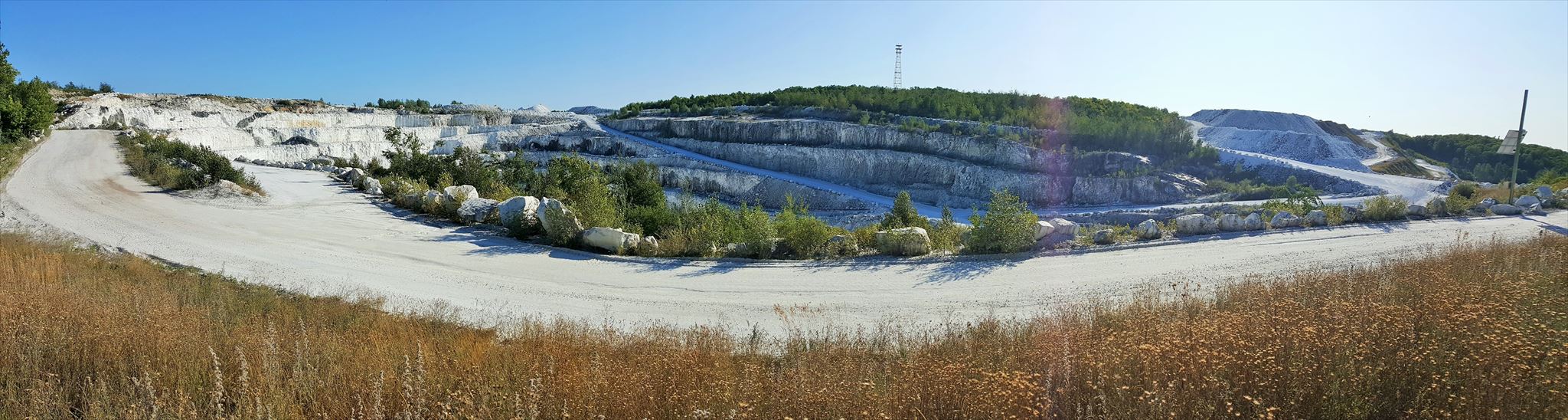
Welcome to the Tatlock Marble Mine (quarry) owned by Swiss mineral company OMYA. The quarry is open to the public and can be accessed from Highway 511 about 12 km north of Lanark then east on County Road 9. There are two “claims to fame” here. First, it is asserted that Tatlock Marble Mine is the largest marble mine in Canada, and secondly that it produces the purest calcium carbonate in the world. These two claims could be contested as the Vancouver Island Marble Quarries Company is producing marble for countertops and slabs, and the marble mines in Italy and China might have something to say about the quality of their marble. Nonetheless, local rockhounds do brag.

OMYA is currently working on a permit from the Government of Ontario to mine the calcium carbonate at the Tatlock quarry. They crush the stone on site, then ship it to their plant west of Perth along Highway 7. The crushed white marble is used in paint, plastic, construction material, fillers, paper, toothpaste, and packaging materials. Secondarily, the marble here is sometimes sold for terrazzo chips and as ornamental landscaping stone.
The word "marble" is thought to originate in the ancient Greek language and translates "crystalline rock, shining stone",
Pure white marble is the result of metamorphism of a very pure sedimentary carbonate rock, mostly limestone or dolomite (limestone with very little silica). Metamorphism causes variable recrystallization of the original carbonate mineral grains. The resulting marblerock is typically composed of an interlocking mosaic of carbonate crystals. Marble is considered a strong, hard stone, even though its primary mineral, calcite, only has a Mohs hardness of 3 to 4.
Marble that has a high purity also has a uniform texture. There can be a lot of variation in the colour and texture of marble that is less pure. The difference in purity can be accounted for in the materials that make up the parent rock and the kind and degree of metamorphism. Marble can include colours such as black, red, green, blue and brown.

Marble can appear shiny and semi-translucent, and, the purest marbles have a uniformity in texture and colour. The characteristic swirls or veins of many colored marble varieties are usually due to various mineral impurities such as the presence of clay, iron, sand and chert. There is a rock cut on Highway 511 to the west of the quarry which appears green due to the presence of talc and serpentine.
Crushed Stone
Crushed stone is simply stone that has been reduced in size and screened to ensure size uniformity.
- 3/4 inch crushed stone – usually used as an aggregate in cement or asphalt, commonly used in the construction of roads
- 1 1/2 inch crushed stone – used for gravel driveways, septic fill, ballast for railroads and to enhance drainage
- 2 1/2 inch crushed stone – mainly used to prevent erosion on roadsides and in drainage ditches
Stone Dust
Stone dust, also known as “stone screenings”, is stone crushed into a fine powder. When used by itself, stone dust can act as a binding agent in cement or asphalt for roads, driveways and sidewalks. Stone dust can also form a strong, non-porous surface hard surface that is water resistant.
Nearly two-thirds of all stone quarried and mined in Canada is crushed and used by the construction industries for concrete and asphalt, as a stabilizing base material in road building, for rubble used for fill and embankment reinforcement, as railway ballast, as roofing granules, and as chips for stucco and terrazzo.
Other industries consume about 36% of annual quarry production. Here are just some of the uses of crushed stone:
* neutralizing of acids
* extraction of aluminum oxide from bauxite
* manufacture of soda ash, calcium carbide, calcium nitrate and carbon dioxide
* pharmaceuticals
* manufacture of dye, rayon, paper, sugar, toothpaste and glass
* water treatment
* fluxing material to cleanse impurities from molten metal. insecticides, paper, wood putty, paints
* fertilizers and other agricultural applications
Finally, about 3% of all stone quarried in Canada is used as dimension stone or ornamental building stone.
Sources:
https://mininglifeonline.net/company_page_479.html
https://www.flickr.com/photos/deanspic/15240962260
http://lanarkhighlandsbta.ca/listings/872/omyas-tatlock-quarry/
http://fossilslanark.blogspot.com/2016/07/mark-your-calendars-for-guided-quarry.html
https://www.thecanadianencyclopedia.ca/en/article/quarrying-industry
| I have earned GSA's highest level: |
 |