
The Tuia Mātauranga GeoTour is about having fun discovering the history of Aotearoa New Zealand by finding sites of significance in local communities from early Pacific voyaging and migration, European settlement to present day. The interaction between people, and people and the land have provided a rich history that the GeoTour invites you to explore.
---
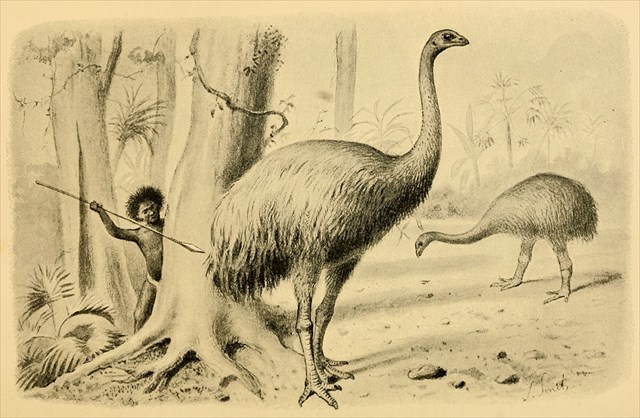
One of the most important and largest moa-hunting locations in New Zealand, the Korotuaheka/Waitaki River mouth moa-hunting ste dates from the thirteenth century. This site is the source of the famous Willet’s Collection of 9,210 archaic taonga held at the North Otago Museum. The site has cultural, archaeological, scientific and historical significance.
The land on which the site is located was surveyed as a Native Reserve in 1868, named Korotuaheka. In 1916 the Māori Land Board sanctioned leasing the reserve to a Pākehā farmer, and a few years later allowed the sale of the reserve, though the urupā was reserved. In 1879 a number of families, led by Te Maiharoa, were evicted from their settlement at Ōmarama where they had been protesting the land sales. They established a settlement at Korotuaheka and built a church/meeting house and established a wānanga on the reserve. Te Maiharoa died at Korotuaheka and was buried there in 1885 or 1886.
The name Waitaki (the waterway of tears) is often referred to in whaikōrero as ‘representing the tears of Aoraki which spill into Lake Pukaki and eventually make their way south along the river to the coast. The whakataukī ‘Ko Waitaki te awa, ka roimata na Aoraki I riringi’ captures this significance – ‘Waitaki is the river, the tears spilled by Aoraki’
This site attracted amateur archaeologists’ attention in 1926, when what became identified as the No. 1 terrace was ploughed, apparently for the first time, exposing moa bones and middens. H.S McCully and A.G. Hornsey of Timaru worked here and on No. 2 terrace. Teviotdale followed their work in 1931, and again in 1936-37, although it has not been possible to identify precisely the area he excavated – his article in the Journal of Polynesian Society provides a detailed description of the site at this time. Hardwicke Knight and Peter Gathercole visited the site in the 1960s, hoping to make contact with knowledgeable locals and examine collections in private hands, to record the occupation area, and to carry out trial excavations. They were successful in determining an extent for the occupation site.
The site is situated about one and a half kilometres south of the Waitaki River Mouth. The site extends over an area of approximately 50 hectares. It is believed by Athol Anderson to possibly be the largest moa hunting site on the east coast of the South Island. Anderson notes that up to 90,000 moa could have been processed here. In 2002 archaeologists Shar Briden and Matthew Schmidt were shown an intact area of the site by the landowner. In places the site is eroding and has also been ploughed. Ploughing and fossicking have destroyed the surface indications of stone pavings and huts. Surface evidence of occupation is scattered over the three river terraces. On the northern side, the occupation evidence finishes at an old water course, with the western and southern margins also clear. On the eastern (seaward) side, the site is being eroded. The Waitaki River Mouth site has been interpreted ‘as an intermittently occupied moa-hunting camp and as a transit camp for summer inland expeditions into the Waitaki catchment for birds and silcrete.’
Ngāi Tahu recognise Korotuaheka as one of the oldest recorded settlement sites in the island. In 2018, the Waitaki River mouth moa-hunting site is in private ownership.
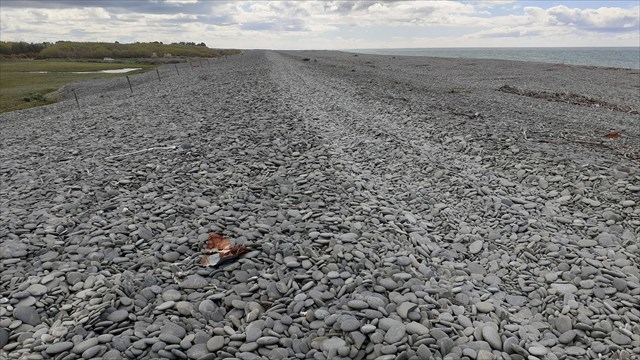
Park at the give parking coordinates and take a walk along the top of the huge wall of stones which have travelled down the Waitaki river and swept up by the waves into the shoreline. This cache is a 400 ml container with a log book only. Bring your own pen to sign the log.
To be able to complete this Geotour and receive your special geocoin, remember to take a note of the codeword on the log book of the cache. This will need to be recorded in your passport which can be downloaded from here. If the passport is unavailable for any reason just keep a note of the codeword and try again later.