Submit your answers by E-Mail before logging your find.
Logs submitted without emailing an answer will be Deleted.
If you are doing this earth cache as a group, each person logging a find must submit their own answers to each earth cache question.
The questions:
1 - Which of the three types of beaches do you see at this location?
2 - Is the pond behind the beach salt water or fresh water. Is it cut off completely.
3 - What is the elevation of the dune at this location?
[REQUIRED] In accordance with the updated guidelines from Geocaching Headquarters published in June 2019, photos are now an acceptable logging requirement and WILL BE REQUIRED TO LOG THIS CACHE. Please provide a photo of yourself or a personal item in the picture to prove you visited the site.
Barrier beaches protect lagoons, estuaries and salt marshes from the direct action of the sea. They often are cut by tidal inlets and are connected by underwater tidal flats. They convert irregular shorelines to nearly straight ones.
There are three kinds of barrier beaches.
1. Bay barriers form between two adjacent headlands. The lagoons that are created by bay barriers may in time become freshwater ponds if the beach is not breached by the sea. This barrier is most common along the rocky coastlines of Canada. In contrast to the extensive barrier beach systems of, for instance, the Outer Banks of North Carolina, the beaches in New Brunswick are significantly shorter, framed by the bedrock topography.
2. Barrier spits form where materials carried from a headland but currents, build a sandy “arm” into a bay or sound.
3. Barrier islands are the third type of barrier beach. They are long, low, usually narrow islands with inlets to the back bay waters at either end.
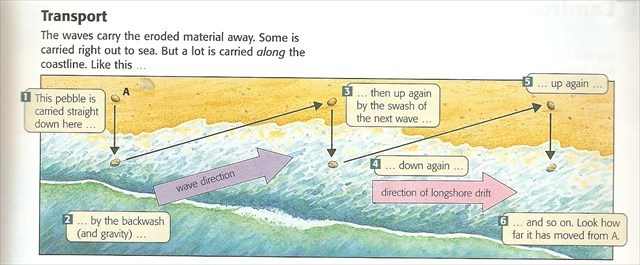
In a natural barrier beach system the primary process of sediment distribution is longshore transport. In longshore transport, waves breaking obliquely to the coast carry sand parallel to the coast helping to create the elongated form of the barrier beach. The barrier beaches also move shoreward in gentle seas and seaward in rough seas.
Beach sand is composed of a number of different minerals. Clear, glassy grains with uneven fractures are probably quartz. This mineral comes in several shades from clear to gray and black. Milky red, pink or white grains are usually feldspar. Glassy black or clear flakes are made up of mica. Most of the dark grains are varieties of hornblende. All beaches reflect the material of their parent rock and tend to become sorted in size based on the waves and energy of the beach. Higher energy beaches have coarser particles, up to the extremes of rocky beaches in which all smaller sand has been removed. Fine beach sand can only exist on beaches with gentle waves or extensive breakwaters.
Beachgrass (Ammophila breviligulata) stabilizes existing dunes and builds new dunes along the coastline. This vegetation spreads rapidly. It reduces wind velocity near the ground and traps windblown sand around the grass. As the sand deposits accumulate, the grass grows up through it maintaining a protective cover. This grass is not very tolerant of vehicle passage or people trampling it, so stay off the dunes. Beach grass is designed to snap off at the base, so only a few steps can result in beach grass dying, being blown out by the next storm and creating bald patches.