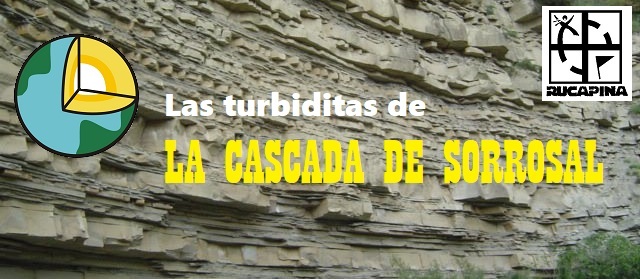

Una turbidita es una facies sedimentaria que se deposita durante una corriente turbidítica, una avalancha submarina que redistribuye grandes cantidades de sedimentos clásticos provenientes del continente en las profundidades del océano. Cuando se depositan sucesiones con secuencias alternantes de diferente composición se denominan flysch.
Las rocas que podemos observar en la formación de la Cascada de Sorrosal son de origen turbidítico, formadas bajo el mar. Posteriormente fueron levantadas y plegadas, de esta manera tan espectacular muy por encima del nivel del mar hace de 50 a 20 millones de años, con la Orogenia Alpina.
La secuencia ideal de las turbiditas de Bouma
Las turbiditas fueron descritas en detalle por primera vez por Bouma (1962), que estudió los sedimentos de aguas profundas y reconoció secuencias grano-decrecientes (con el tamaño de sus partículas decreciendo hacia arriba), incluyendo conglomerados de cantos rodados en la base y lutitas de grano fino en las partes más superiores. Esto era inesperado porque históricamente se había supuesto que en el fondo de los océanos no existe ningún mecanismo mediante el cual transportar sedimentos de grano grueso a profundidades abisales.
El ciclo de Bouma comienza con una superficie de erosión que pasa de guijarros a grava en una matriz de arena. Por encima de estas capas se depositan capas de arena cada vez más fina alternada con arena limosa, y, por último, limo y arcilla. Esta sucesión vertical de capas sedimentarias y el cambio de litología denota una disminución de la turbulencia del flujo del agua que los transporta antes de la sedimentación.

Es inusual observar un ciclo de Bouma completo: las sucesivas corrientes de turbidez suelen erosionar secuencias anteriores no consolidadas. Por otra parte, si la sección expuesta se encuentra en el borde del lóbulo deposicional sólo están presentes las secuencias más finas.
Formación
Las turbiditas son sedimentos transportados y depositados por una corriente marina generada por la inestabilidad en la distribución de densidad del flujo de agua debida al contenido irregular de sedimento en suspensión (similar a un flujo piroclástico volcánico). El flujo de densidad se produce por licuefacción de los sedimentos durante el transporte, los cuales provocan un cambio en la densidad del sistema fluido agua+sedimento. Esta licuefacción o suspensión se alcanza generalmente en condiciones muy turbulentas del líquido sustrato. En estas circunstancias se pueden transportar grandes fragmentos de roca a velocidades que de otra manera serían demasiado bajas. Suelen tener su origen en los márgenes de plataformas y en los taludes continentales y los depósitos acumularse en las llanuras próximas, más profundas.
Estos flujos de densidad ocurren en otros entornos aparte de las profundidades del océano, como los lahares junto a volcanes, en deslizamientos de lodo y en flujos piroclásticos (que crean secuencias sorprendentemente similares a las turbiditas).
El origen de la Cuenca Turbidítica Surpirenaica fue el choque de las placas Africana, Ibérica y Euroasiática, que fue cerrando el mar de Thetis. Entre los 50 y los 30 millones de años, se generó un surco sedimentario que se rellenó de E a W (de la Cuenca de Tremp y Graus hacia el País Vasco).
El Earthcaché
Para poder dar por encontrado este Earthcaché deberás enviarme un mensaje privado con las respuestas a las siguientes preguntas (no las publiques en tu log):
(1) ¿Qué estarías viendo en este punto que te encuentras hoy si hubieras viajado atrás en el tiempo 50 milones de años?
(2) ¿El choque de qué placas dio lugar a las turbiditas que puedes observar desde el punto en el que te encuentras?
(3) Desde este mirador puedes ver las turbiditas. De izquierda a derecha, los estratos de las capas superiores qué dirección llevan? ¿Suben, bajan o van paralelos al fondo del valle?
(4) ¿Y los estratos de las capas inferiores? ¿Suben, bajan o van paralelos al fondo del valle?
(5) En esta explanada hay otro "mirador" desde el que podrás observar el valle de Broto, de típico modelado glaciar. Dirígite a él para observar la ciudad de Broto. ¿En qué coordenadas estás?
(6) OPCIONAL: Sube una foto desde este punto con Broto al fondo, pero bajo ninguna circunstancia subas ninguna foto con la cascada de Sorrosal al fondo donde se puedan ver las turbiditas

A turbidite is a sedimentary facies that is deposited during a turbiditic stream, an underwater avalanche that redistributes large amounts of clastic sediments from the continent in the deep ocean. When sequences with alternating sequences of different composition are deposited, they are called flysch.
The rocks that we can observe in the formation of the Sorrosal Waterfall are of turbiditic origin, formed under the sea. Subsequently they were lifted and folded, so spectacularly high above sea level 50 to 20 million years ago, with the Alpine Orogeny.
The ideal sequence of Bouma
The turbidites were described in detail for the first time by Bouma (1962), who studied the deep-sea sediments and recognized grain-decreasing sequences (with the size of their particles decreasing upwards), including boulders conglomerates in the base and shales of fine grain in the upper parts. This was unexpected because historically it had been assumed that at the bottom of the oceans there is no mechanism by which to transport coarse-grained sediments to abyssal depths.
The Bouma cycle begins with an erosion surface that passes from pebbles to gravel in a matrix of sand. Above these layers are deposited layers of thinner sand alternated with silty sand, and finally, silt and clay. This vertical succession of sedimentary layers and the change in lithology denotes a decrease in the turbulence of the water flow that transports them before sedimentation.

It is unusual to observe a complete Bouma cycle: successive turbidity currents usually erode previous unconsolidated sequences. On the other hand, if the exposed section is at the edge of the depositional lobe, only the finest sequences are present.
Origin
Turbidites are sediments transported and deposited by a sea current generated by instability in the distribution of water flow density due to irregular content of suspended sediment (similar to a volcanic pyroclastic flow). The density flow is produced by liquefaction of the sediments during transport, which cause a change in the density of the fluid system water + sediment . This liquefaction or suspension is generally achieved in very turbulent conditions of the liquid substrate. In these circumstances, large fragments of rock can be transported at speeds that would otherwise be too low. They usually have their origin in the margins of platforms and in the continental slopes and the deposits accumulate in the nearest, deeper plains.
These density flows occur in other environments apart from the depths of the ocean, such as lahars along volcanoes, mud slides and pyroclastic flows (which create strikingly similar sequences to turbidites).
The origin of the Surpirenaica Turbiditic Basin was the clash of the African, Iberian and Eurasian plates, which was closing the Thetis Sea. Between 50 and 30 million years, a sedimentary groove was generated that was filled from E to W (from the Tremp and Graus Basin to the Basque Country).
The Earthcache
To be able to find this Earthcache you must send me a private message with the answers to the following questions (do not publish them in your log):
(1) What would you be seeing at this point that you are today if you had traveled back in time 50 billion years?
(2) The clash of which plates gave rise to the turbidites that you can observe from the point where you are?
(3) From this viewpoint you can see the turbiditas. From left to right, the layers of the upper layers which direction do they lead? Do they go up, down or go parallel to the bottom of the valley?
(4) And the layers of the lower layers? Do they go up, down or go parallel to the bottom of the valley?
(5) In this esplanade there is another "viewpoint" from which you can observe the Broto Valley, of typical glacier modeling. Go there to observe the city of Broto. What coordinates are you in?
(6) OPTIONAL: Upload a photo from this point with Broto in the background, but under no circumstances upload any photo with the Sorrosal waterfall in the background where turbidites can be seen
