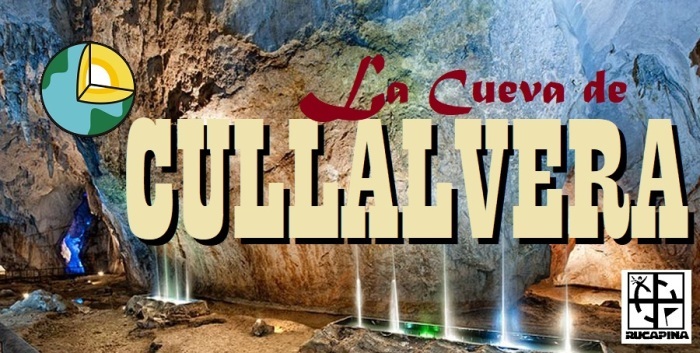

Aunque la cueva de Cullalvera posee arte rupestre, éste no se visita por estar a unos 600 y 1200 metros de profundidad, y por permanecer su sistema cárstico activo con corrientes de agua. De hecho, en los días de mucha lluvia el río vuelve a brotar desde sus entrañas, discurriendo por debajo de la pasarela de 150 metros que se recorre durante la visita (visita que no es necesaria para poder registrar este caché). Su boca, de dimensiones espectaculares, emerge de un frondoso encinar cantábrico de gran valor ecológico.
En este Earthcaché, nos centraremos en las estalagmitas y las estalactitas que se pueden ver visitando la cueva: Las estalactitas y las estalagmitas son dos tipos de formaciones de forma conoidal que se forman por precipitación química en cuevas y cavidades. Las primeras se forman en el techo y las segundas nacen en el suelo.
Cuando el agua se filtra por el suelo, disuelve aquellos minerales que son solubles en agua como la calcita o el yeso, y cuando este agua que contiene los minerales disueltos se topa con una cavidad, es entonces cuando los minerales precipitan y se solidifican de nuevo. Y al acumularse forman las estalactitas y las estalagmitas. Éste es un proceso extremadamente lento que puede durar cientos o miles de años. Por eso es tan importante no tocar estas formaciones, ya que si se rompen de seguro vosotros no volveréis a verlas regeneradas de nuevo (si es que alguna vez lo llegan a hacer)
El agua con los minerales disueltos sigue fluyendo por el centro de las estalactitas donde se crea un conducto que diferencia las estalactitas de otras formaciones que son morfológicamente similares. En la punta de las mismas el agua que gotea cuando cae al suelo forma las estalagmitas por acumulación de precipitados. Por eso es tan común que las estalagmitas y las estalactitas se encuentren una encima de la otra en el techo y en el suelo. Conforme van aumentando en tamaño se acercan entre si y si llegan a unirse forman las columnas de acrecencia.
Debido al proceso de formación que acabamos de describir, las estalactitas serán siempre más alargadas y puntiagudas que las estalagmitas y estas últimas serán más redondeadas e irregulares.
El Earthcaché
(1) ¿Qué formación y por qué esperarías que fuese más maciza: una estalactita o una estalagmita?
(2) En la boca de la cueva de Cullalvera ¿qué puedes ver? ¿Estalactitas? ¿Estalagmitas? ¿Ambas? ¿Ninguna de ellas?
(3) ¿Qué dimensiones dirías que tiene la boca de la cueva? (si hacéis la visita a la cueva podréis saberlo con precisión)
(4) ¿Qué sensación térmica tenéis cuando estáis en la boca de la cueva?
(5) Si entráis en la boca de la cueva, y váis saliendo de ella, veréis que la luz, aparte de entrar por la cavidad principal, se cuela por otras aberturas o cavidades. ¿Cuantas de estas "ventanas" hay? ¿Ninguna, una, dos, tres o más de tres (en este último caso no hace falta que las contéis todas)?

Although the cave of Cullalvera has rock art, it is not visited because it is about 600 and 1200 meters deep, and because its active karstic system remains with water currents. In fact, on rainy days the river sprouts again from its bowels, running below the 150-meter walkway that is covered during the visit (a visit that is not necessary to register this cache). Its mouth, of spectacular dimensions, emerges from a leafy Cantabrian oak of great ecological value.
In this Earthcache, we will focus on the stalagmites and stalactites that can be seen by visiting the cave: Stalactites and stalagmites are two types of cone-shaped formations that are formed by chemical precipitation in caves and cavities. The first ones are formed on the ceiling and the last ones are born on the ground.
When the water filters through the soil, it dissolves those minerals that are soluble in water such as calcite or gypsum, and when this water that contains the dissolved minerals meets a cavity, it is then that the minerals precipitate and solidify again. When they accumulate then they form stalactites and stalagmites. This is an extremely slow process that can take hundreds or thousands of years. That is why it is so important to not touch these formations, since if they break for sure you will not see them regenerated again (if they ever do)
The water with the dissolved minerals continues to flow through the center of the stalactites where a duct is created. This duct differentiates the stalactites from other formations that are morphologically similar. At the tip of them, water drips. When the water falls to the ground, it forms stalagmites due to accumulation of precipitates. This is why it is so common for stalagmites and stalactites to be found one on top of the other on the ceiling and on the floor. As they grow in size, they get closer to each other and if they come together they form the growth columns.
Due to the formation process that we have just described, stalactites will always be more elongated and pointed than stalagmites and the last ones will be more rounded and irregular.
The Earthcache
(1) Which and why would you expect it to be more massive: a stalactite or a stalagmite?
(2) In the mouth of the Cullalvera cave, what can you see? Stalactites? Stalgmites? Both? None of them?
(3) What dimensions would you say the mouth of the cave has? (If you visit the cave you can know precisely)
(4) What thermal sensation do you have when you are at the mouth of the cave?
(5) If you enter the mouth of the cave, and leave it, you will see that the light, apart from entering through the main cavity, sneaks through other openings or cavities. How many of these "windows" are there? None, one, two, three or more than three (in this last case you don't have to count all them)?
