A joint is a break of natural origin in the continuity of either a layer or body that lacks any visible or measurable movement parallel to the surface (plane) of the fracture. Although they can occur singly, they most frequently occur as joint sets and systems. A joint set is a family of parallel, evenly spaced joints that can be identified through mapping and analysis of the orientations, spacing, and physical properties. A joint system consists of two or more intersecting joint sets.
Joints are among the most universal geologic structures as they are found in most every exposure of rock. They vary greatly in appearance, dimensions, and arrangement, and occur in quite different environments. Often, the specific origin of the stresses that created certain joints and associated joint sets can be quite ambiguous, unclear, and sometimes controversial. The most prominent joints occur in the most well-consolidated, lithified, and highly competent rock such as the quartz diorite in this area. Joints may be open fractures or filled by various materials. Joints infilled by precipitated minerals are called veins and joints filled by solidified magma are called dikes.
Joints which dip towards a road, such as in this location, can lead great loss of life as the rock can slide down the joints. More than 18% of the total number of Canada’s landslide related deaths (>600) occur in the Sea to Sky Corridor. The slides along the sea to sky corridor were caused by debris flows and rocks slipping down joint planes onto cars.
This is a sketch of the joints in the area, taken from http://gac-cs.ca/publications/FT_Slope_Stability_and_Mountain_Torrents.pdf, a field trip guidebook of the GAC.
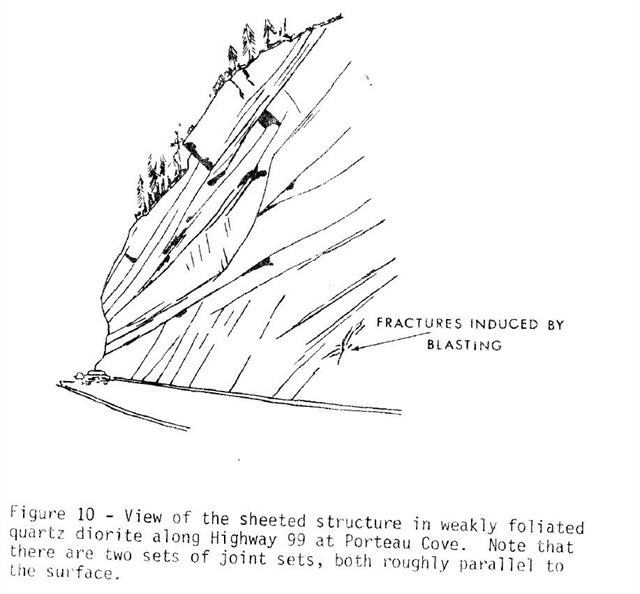
At the north end of the section where you are now, the highway and railway follow the shoreline around a nearly overhanging cliff. Note the joints in the rock form parallel sets, both of which dips steeply (about 500)toward the highway. Vibration and cycles of freezing loosen the rock slabs, which constitute a threat to the highway. The joints are regularly measured and steel bolts have been installed to postpone rock fall. Broken pavement or new patches of tarmac beneath the cliffs indicate recent failures. Slides from this section of road have resulted in tragedy.
This is one of the safest, best places, arguably, in BC to see very large active joint planes. If you know of any better, please include them in you log.
Your task to log this earthcache is the folowing: Message or e-mail the answers at the time of logging. Logs with no messages or e-mails will be deleted.
Do not cross the road, make your observations from beside the Porteau Cove Sign. You can park 40m away near the washrooms at the entrance to the park.
1. What is your estimate of the length and breadth of the largest joint, in the slab of quartz diorite you see?
2. How many slabs (joints) do you see dipping towards the road?
3. How many rock bolts can you see directly across the road from you?