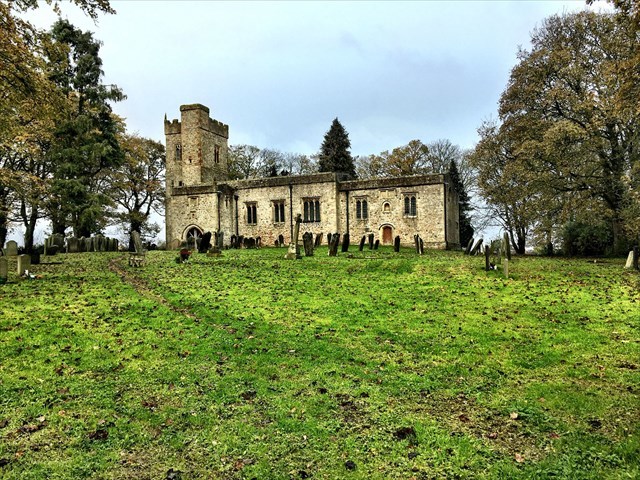
The church of St Mary at South Cowton stands alone in a field, at the end of a farm lane. It was built in the years 1450-1470 by Sir Richard Conyers, whose late 15th-century tower house of South Cowton Castle can be reached by a footpath to the south-east. The church consists of a nave, west tower, chancel, two-storey south porch and a vestry.
St Mary's Church is a redundant Anglican church standing in open countryside in the former village of South Cowton, near Scotch Corner in North Yorkshire, England. It is recorded in the National Heritage List for England as a designated Grade I listed building, and is under the care of the Churches Conservation Trust.
The Church (historically)
The church of ST. MARY THE VIRGIN consists of a chancel 17 ft. 7 in. by 13 ft. 2 in., with a small north vestry, nave 34 ft. 3 in. by 19 ft. 3 in., south porch, and a tiny brick tower 4 ft. 10 in. by 4 ft. 6 in., inside measurements.
The church appears to date from the 14th century, although it is not improbable that there is earlier work in the walling of the nave; but it has been so much altered in its details since its erection that there is no original detail left except in the chancel. It is now a mean-looking little building, and being at some distance from the village, and in a bad state of repair, has been abandoned in favour of a new church built in the village.
The east window appears to have old tracery of three trefoiled lights with mullions crossing in the head; the label outside is of plain section and has mask stops. To the north of the window is a moulded image bracket, and to the south part of a projecting string-course of red sandstone, very much decayed. The only opening in the north wall is a modern doorway into the vestry; the latter is of brick. The south-east window of the chancel is now blocked; it was a single light, but of what form cannot now be seen. The south-west window was a low-side window, but its lower part is now filled in; it is a single square-headed light with a segmental rear arch. The walls of the chancel are of rubble, plastered outside and in. The roof is modern. The chancel arch is apparently of 14th-century date; the jambs and arch are of two chamfered orders, the bases are buried, and the moulded capitals have been more or less recut. On the soffit of the arch is a groove which received the former boarding behind the rood loft.
All the windows of the nave have wood frames of 18th-century or later date, generally with brick jambs. At the west end is a wooden gallery. The south doorway is modern. The south porch is of brick. In the west wall is a small square-headed doorway into the turret, and over it the round head of a former window, now blocked by the tower. The brick 'tower' is open from the ground, and is lighted near the top by small round-headed windows; it used to contain two bells, one of which has now been transferred to the new church.
The font is of 12th-century date, cylindrical in form, with a cable mould and edge roll at the top and zigzag carving on the sides. One of its old staples remains, and it shows signs of having once been painted. There is an 18th-century altar-table and panelling, also a 'three-decker' pulpit.
A piece of an early 14th-century coffin-lid is used as a chancel step; it has leaf carving on its chamfered edge. In the churchyard east of the church is another long slab with a cross carved upon it, having a floreated head, and leaves on both sides of the stem.
The plate includes a cup of 1570, with a maker's mark R. G. for Robert Gylmyn of York. It is bellshaped, with egg pattern round the base of the bowl. The paten is dated 1910.
The registers begin in 1754.
'Parishes: East Cowton', in A History of the County of York North Riding: Volume 1, ed. William Page (London, 1914), pp. 160-162. British History Online http://www.british-history.ac.uk/vch/yorks/north/vol1/pp160-162 [accessed 5 November 2019].
****************** ********************
For full information on how you can expand the Church Micro series by sadexploration please read the Place your own Church Micro page before you contact him at churchmicro.co.uk
See also the Church Micro Statistics and Home pages for further information about the series.
****************** *******************