I have heard many a person saying that they live in a city, and will never see any fossils, or that they cannot physically get to fossil sites in the Dales as they are not able. Well, no need to worry, there is plenty to see in the city of Leeds itself. This EarthCache is suitable for the disabled, those with strollers and children. It is meant to be interesting and educational.
This EarthCache takes you to the northern corner of where Albion Street meets Albion Place. We are here to look at the limestone panelling of the building, and to discover a type of fossil.
Limestone is a sedimentary rock.
Sedimentary rocks are types of rock that are formed by the deposition and subsequent cementation of that material at the earth's surface and within bodies of water. Sedimentation is the collective name for processes that cause mineral and/or organic particles to settle in place. The particles that form a sedimentary rock by accumulating are called sediment. Before being deposited, the sediment was formed by weathering and erosion from the source area, and then transported to the place of deposition by water, or wind. Sedimentation may also occur as minerals precipitate from water solution or shells of aquatic creatures settle out of suspension.
Limestone is a sedimentary rock composed largely of the minerals calcite and aragonite, which are different crystal forms of calcium carbonate. Many,but not all limestones are composed of skeletal fragments of marine organisms such as coral, crinoids and molluscs.
A fossil is trace or remains of a plant, animal or other organisms. However, there is more to fossilization than just bones, or remains of a T Rex.
There are many EarthCaches which can teach you about the whole process of fossilization, what we are concerned with is this certain type of fossil.
We are here to look for the fossil of an marine animal called Orthoceras, which was part of the family of shellfish known as Cephlapods. Orthoceras had long slender conical shells, which were hunters in a marine sea. The animal lived in the end chamber of the shell - the wide end, and as it grew, it developed more chambers as it got larger. The term for the line in between each chamber is known as a septa. Orthoceras fossils also have a line running along their length, this line is known as a siphuncle. This was a tube that ran the entire length of the shell, and had two functions, once filled with water, the nautiloid could force the water out, propelling itself backward with a kind of jet propulsion. By releasing the water and leaving air space, the tube could serve as a bouyancy device allowing the animal to rise and lower itself to different depths.
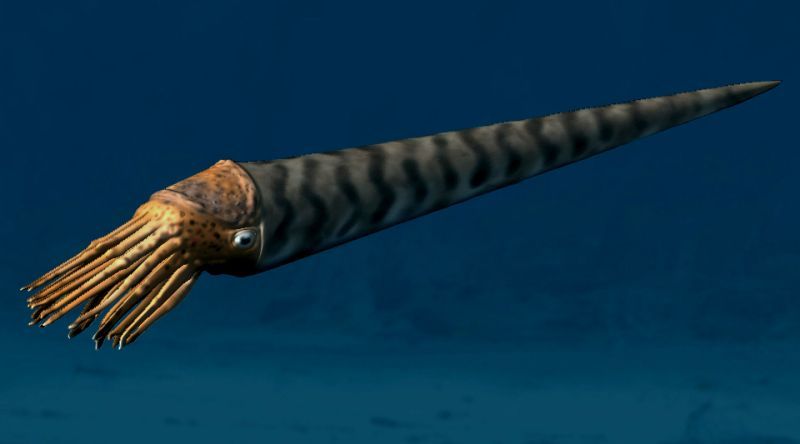
Orthocera
This is meant to be an enjoyable experience, allowing you to discover this fossil, though this being an EarthCache, in order to log it, I ask that you answer the above questions. Please send them to me, and do not include them in your log. You can send them to me by using the message facility or email, both of which can be found by looking at my profile.
1. Please examine the limestone panelling, please find the longest Orthocera fossil:
(a) How long is this fossil in cm?
(b) Please describe the fossil, detailing how many septa it has, and how long the visible remains of the siphuncle is.
(c) What colour is the fossil.
(d) Please describe the limestone that the fossil forms part of.