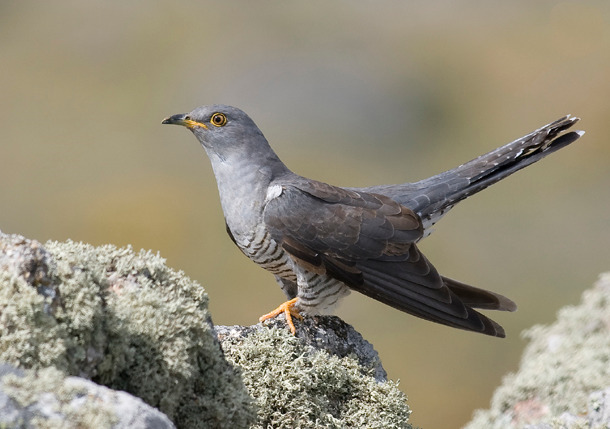
Cuculus canorus (cuco común)
Los peculiares hábitos reproductores del cuco, basados en el parasitismo, constituyen, sin duda, la principal seña de identidad de este pájaro migrador e insectívoro, cuya dieta se basa en el consumo de larvas de diferentes lepidópteros. Más de un centenar de especies de pequeñas y medianas aves insectívoras pueden llegar a ser víctimas del sorprendente comportamiento parásito de este popular cucúlido.
Reproducción
 La estrategia reproductora del cuco se basa en el nidoparasitismo, es decir, en depositar sus huevos dentro del nido de otra especie, la cual se encargará de la incubación, el cuidado y la manutención de la descendencia del parásito.
Cada hembra de cuco produce una gran cantidad de huevos —hasta 25—, que serán colocados de uno en uno —rara vez dos— en nidos previamente seleccionados. Si la pareja propietaria no detecta la intrusión, incubará el huevo parásito —que imita en diseño y colorido a los propios— durante 12 días.
La eclosión del cuco suele anticiparse varios días a la de los pollos legítimos, lo que le permite deshacerse del resto de los huevos o de los polluelos recién nacidos, que serán arrojados fuera del nido por el intruso. A partir de ese momento, el joven cuco recibirá en exclusiva todas las atenciones de los propietarios del nido asaltado, a los que, con frecuencia, supera considerablemente en volumen. La estancia del cuco en el nido se prolonga durante 13- 20 días, tras los cuales emprenderá una vida independiente.
Su canto
El canto habitual del macho consiste en un característico y reconocible cuu-cu, cuu-cu bisilábico, que repite regularmente en largas sesiones. La estrofa puede acelerarse nerviosamente cuando entra en contacto con la hembra, la cual produce un trino burbujeante y muy rápido: guik-kui-kui-kui-kui-kui.
Puedes escuchar su canto en el siguiente enlace: Canto del cuco
Información extraída de SEO/BirdLife
El caché
Está ubicado en un parque donde suele haber movimiento de gente por lo que se requiere sigilo. Te adelanto de que no vas a ver al cuco ya que ha abandonado la zona, pero sí queda una prueba de que ha estado hace escasos minutos...
~~~~~~~~~~~~~~~~~~~~~~~~~~~~~~~~~~~~~~~~~~~~~~~~~~~~~~

The peculiar reproductive habits of the cuckoo, based on parasitism, are undoubtedly the main sign of identity of this migratory and insectivorous bird, whose diet is based on the consumption of larvae of different lepidoptera. More than a hundred species of small and medium insectivorous birds can become victims of the surprising parasite behaviour of this popular cuculid.
Reproduction
The cuckoo's reproductive strategy is based on nidoparasitism, i.e. depositing its eggs inside the nest of another species, which will be responsible for the incubation, care and maintenance of the parasite's offspring.
Each female cuckoo produces a large number of eggs -up to 25-, which will be placed one by one -rarely two- in previously selected nests. If the owner couple does not detect the intrusion, they will incubate the parasite egg -which imitates their own design and colours- for 12 days.
The cuckoo's hatching is usually several days earlier than that of legitimate chicks, allowing it to get rid of the rest of the eggs or the newly hatched chicks, which will be thrown out of the nest by the intruder. From that moment on, the young cuckoo will receive all the attention of the owners of the assaulted nest, which it often considerably exceeds in volume. The cuckoo's stay in the nest lasts for 13-20 days, after which it will begin an independent life.
His singing
The usual singing of the male consists of a characteristic and recognizable cuu-cu, cuu-cu bisyllabic, which he repeats regularly in long sessions. The strophe can be nervously accelerated when it comes into contact with the female, which produces a bubbling and very fast trill: guik-kui-kui-kui-kui-kui.
You can hear her singing at the following link: Cuckoo singing
Information extracted from SEO/BirdLife
The cache
It is located in a park where there is usually movement of people so secrecy is required. I'm telling you that you won't see the cuckoo because he has left the area, but there is proof that he was there a few minutes ago...
Contador de visitas a esta web:
