This example of PETRIFIED WOOD was donated to the Topeka Public Library over 100 years ago. Private philanthropy has always played an important role, and the Topeka and Shawnee County Library has received many beautiful and unusual gifts. This particular benefactor helped raise the funds to build the first permanent library in Topeka. The couple were generous donors of contemporary art and also created the first public art collection in Topeka. You can find out who this is by visiting this earthcache.
Creation of Petrified Wood:
Petrified wood (from the Greek root petro meaning "rock" or "stone"; literally "wood turned into stone") is the name given to a special type of fossilized remains of terrestrial vegetation. It is the result of a tree or tree-like plants having completely transitioned to stone by the process of permineralization. All the organic materials have been replaced with minerals (mostly a silicate, such as quartz). It preserves the original structure of the stem tissue in all its detail, down to the microscopic level. Structures such as tree rings and the various tissues are often observed features. Unlike other types of fossils which are typically impressions or compressions, petrified wood is a three-dimensional representation of the original organic material.
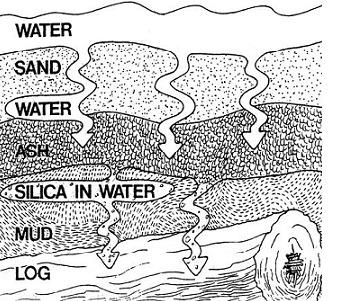
In general, the fallen plants get buried in an environment free of oxygen (anaerobic environment), which preserves the original plant structure and general appearance. Once a tree has fallen and is quickly covered by mud it will retain its shape before the decay process begins. As the trees start to decay, due to the anaerobic environment, volcanic ash with high concentrations of silica and other minerals dissolved in the water seep into the cells of the tree. The result is petrified wood, a plant, with its original basic structure in place, replaced by stone. As the water evaporates the minerals replace the cells of the tree making it look like the original tree, however heavier. Petrified wood weighs about 150 pounds per cubic foot and is considered one of the harder minerals, being rated between 7 & 8 on Moh’s Hardness Scale.
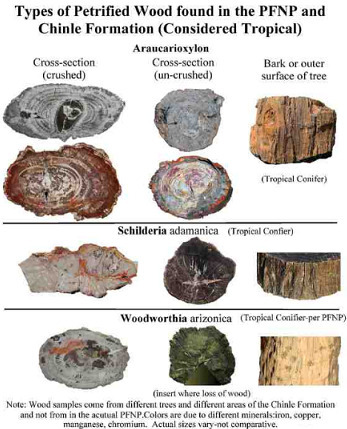
Elements such as manganese, iron, and copper in the water/mud during the petrification process give petrified wood a variety of color ranges. Pure quartz crystals are colorless, but when contaminants are added to the process the crystals take on a yellow, red, or another tint. Exotic minerals allow red and green hues that can be seen in rarer specimens.
Contaminants & Hues:
- RED – IRON (FERRIC)
- ORANGE - IRON (FERRIC)
- YELLOW - IRON (FERRIC), URANIUM
- GREEN - IRON (FERROUS), COPPER,COBALT,
CHROMIUM, URANIUM,NICKLE
- BLUE - COPPER,MAGANESE,
COBALT,CHROMIUM
- VIOLET - MAGANESE, IRON (FERRIC)
- PURPLE - IRON (FERRIC), MAGANESE
- BROWN - IRON (FERRIC), URANIUM
- BLACK - MAGANESE, CARBON,
IRON (FERRIC)
- WHITE - SILICON DIOXIDE
- GREY - SILICON DIOXIDE
Petrified Wood Locations
Petrified wood is not rare. It is found in volcanic deposits and sedimentary rocks at many of locations worldwide. It is sometimes found where volcanic activity covered plant material with ash, mudflows or pyroclastic debris. It is found where wood in sedimentary deposits was replaced by minerals precipitated from groundwater. It is especially abundant around coal seams, although many of the wood specimens in these locations are casts and molds rather than petrifications. One almost unbelievable material from Western Australia is known as "peanut wood" because of its ovoid markings, but those markings are actually boreholes drilled by a clam!
In the United States, noteworthy locations where abundant fossilized wood can be seen include:
- Petrified Forest National Park near Holbrook, Arizona
- Petrified Palm Deposits in the Catahoula Formation of Louisiana, Texas and Mississippi
- Ginkgo Petrified Forest near Wanapum Reservoir, Washington
- The Petrified Forest near Calistoga, California
- Mississippi Petrified Forest near Flora, Mississippi
- The Gilboa Fossils near Gilboa, New York
- Florissant Fossil Beds near Florissant, Colorado
- Gallatin Petrified Forest near Yellowstone, Wyoming
- Escalante Petrified Forest State Park near Escalante, Utah
- Petrified Wood Park in Lemmon, South Dakota (a rock sculpture park - some made of local petrified wood)
To Claim this earthcache send a message or email with the answer to the following questions. GeoMessenger (at top of page) preferred. Hopefully, you learned a little something and had some fun!
1. In your opinion, based on the coloring of the petrified wood, which contaminating elements were present?
2. What does mirific mean? (The nearby building may be helpful.)
3. What does lapidific mean?
4. There is a plaque facing the building at the base of the wood. Tell me the name (or names) on the plaque.
5. OPTIONAL: What is the airspeed velocity of an unladen swallow?
6. OPTIONAL: Post a photo of you or a Geocacher-identifying item with the petrified wood. Please do not include the plaque in the photo. Please no drive by photos, answering question #4 is very easy.
Permission: The Topeka library is aware that this is an earthcache, a "virtual" geocache; and nothing ever needs to be signed, touched or taken for it to exist.
Resource: http://www.npshistory.com/brochures/pefo/trees-to-stone-2006.pdf

