Planetary Geology on Earth: C🌎ncretions EarthCache

To get credit for this EarthCache, be sure to complete the logging tasks at the bottom of this page.
Before We Begin:
- Martin Park Nature Center is open daily from 5am to 6pm, with extended hours to 9pm from April 1st through September 30th.
- This park has 2.5 miles of woodland trails with trail maps set up throughout.
- The safest route to GZ is to start at the bridge and take the trail to the east around the creek.
- Even though you may be tempted to go off trail, the edges of the bank up top are unstable so please be careful.
- This is a wildlife park so you may come in contact with wild animals or bugs. Just like anytime you are outdoors, use caution and be aware of your surroundings.
- The park practices a Leave No Trace policy. Please do not dig up the concretions here so others may enjoy them.
- Be sure to check out the other EarthCache in this same park: Power 🌎f Water.
As this is an EarthCache, there is no container to find. Instead, this EarthCache will focus on a unique geological feature along the stream bank in the red sandstone.
Let's get started!
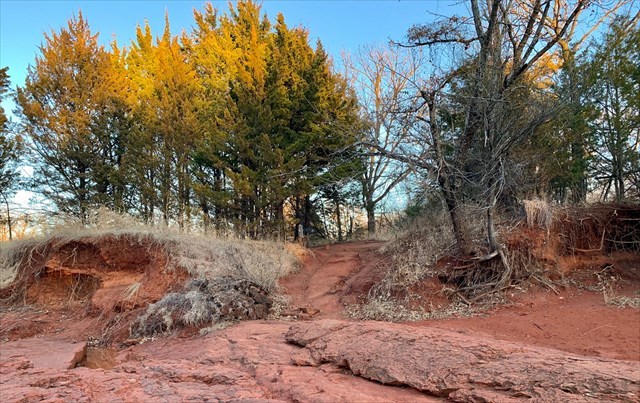
This is where you will enter the creek area.
What are concretions?
Concretions are masses of mineral matter embedded within rock layers, including sandstone, limestone, and shale. They often take shape when minerals precipitating (settling) out of water collect around a nucleus, such as a pebble, leaf, shell, bone, or fossil. Concretions most often form in sediment before it is compacted into rock, but they also can form in hardened sedimentary rock when minerals in groundwater are deposited in rock pores and cavities.
Generally, concretions are harder than the rocks around them. Over time, a concretion may weather out when the softer rock surrounding it erodes away. Although often rounded, concretions can be lumpy, long, oval, disk-shaped, or irregular. They vary in color, hardness, and size (from smaller than the head of a pin to several hundred pounds) and are sometimes misidentified as fossils, dinosaur eggs, or meteorites.
Concretions in Oklahoma can be formed from any of a number of sedimentary minerals. Some of these include calcite, iron oxides, silica, barite, pyrite, limonite and gypsum to name a few.

Concretions at Martin Park Nature Center
What is the difference between a concretion and a geode?
Geodes and concretions are two kinds of rock formed by different processes over time. While similar, geodes have hollow interiors and concretions have solid interiors, both often containing crystals or other minerals. You can see some local examples of geode-like structures by visiting the Oklahoma Mudballs Earthcache just east of here at Lake Arcadia in Edmond, OK.
Concretions on Mars?
In 2004, NASA's Opportunity rover discovered concretions and "blueberries" on the Red Planet's surface that are very similar to the concretions found in Utah's National Parks. Geologists at the University of Utah are studying the hematite concretions and suggest both formed underground when minerals precipitated from flowing groundwater. Read more about it in the article Earth Has 'Blueberries' Like Mars!
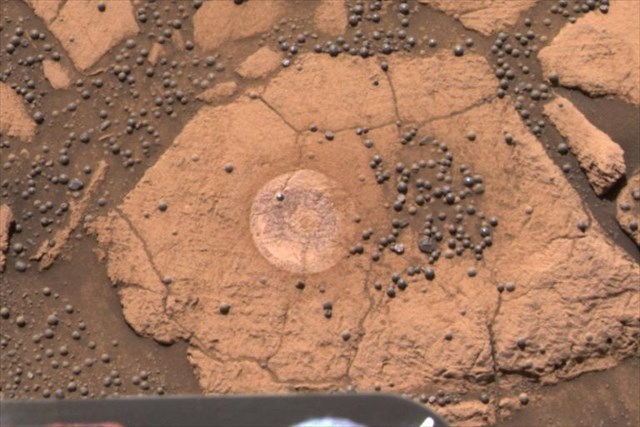
Concretions on Mars!
To Get Credit For This EarthCache
Copy the questions below and send your answers via geocaching messages.
- DO NOT post the answers in your log.
- Group answers are fine, just let me know who all was there.
- Note: The photo task is a requirement for each account claiming a find. See acceptable EarthCache logging tasks effective June 10th, 2019. If you don't want to post the photo with your log, you may send it to me with your answers instead.
- Please send the answers in a timely manner or it may result in the deletion of your log (no offense intended).
Logging Tasks
1| The name of this EarthCache: Planetary Geology on Earth: C🌎ncretions
2| In your log, provide a photo of yourself where the concretions are located.
- If you prefer, the photo can be of a personal item here instead. Just make the photo unique to you and your visit. Feel free to have fun with this!
Examine the concretions and answer the following questions from your observation:
3| Compare the concretions in this area with one another. Describe what they look like. Are they sitting on top of the sandstone or are they inside it? Are there many or only few?
4| In your opinion, why do you think these concretions are flat instead of spherical?
5| Estimate the size of the smallest and largest concretions you see here. Do they all look the same?
Optional: I'd love to see other photos you took from your visit here!
*IF YOU ENJOYED THIS EARTHCACHE,
CONSIDER GIVING A FAVORITE POINT!*
Sources:
Permission for this EarthCache was granted by the staff at Martin Park Nature Center.