The Proton is a subatomic particle with a positive electric charge of +1e elementary charge and a mass slightly less than that of a neutron. Protons and neutrons, each with masses of approximately one atomic mass unit, are collectively referred to as "nucleons" (particles present in atomic nuclei). One or more protons are present in the nucleus of every atom; they are a necessary part of the nucleus. The number of protons in the nucleus is the defining property of an element, and is referred to as the atomic number (represented by the symbol Z). Since each element has a unique number of protons, each element has its own unique atomic number.
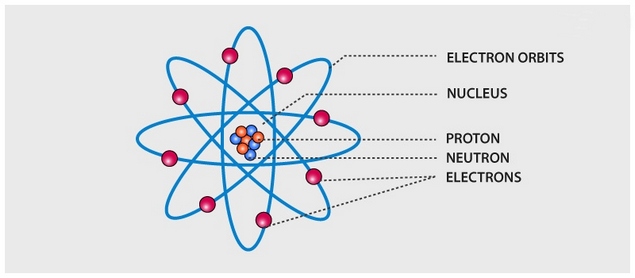
The word proton is Greek for "first", and this name was given to the hydrogen nucleus by Ernest Rutherford in 1920. In previous years, Rutherford had discovered that the hydrogen nucleus (known to be the lightest nucleus) could be extracted from the nuclei of nitrogen by atomic collisions.[3] Protons were therefore a candidate to be a fundamental particle, and hence a building block of nitrogen and all other heavier atomic nuclei. Although protons were originally considered fundamental or elementary particles, in the modern Standard Model of particle physics, protons are classified as hadrons, like neutrons, the other nucleon. Protons are composite particles composed of three valence quarks: two up quarks of charge +2/3e and one down quark of charge –1/3e. The rest masses of quarks contribute only about 1% of a proton's mass.[4] The remainder of a proton's mass is due to quantum chromodynamics binding energy, which includes the kinetic energy of the quarks and the energy of the gluon fields that bind the quarks together. Because protons are not fundamental particles, they possess a measurable size; the root mean square charge radius of a proton is about 0.84–0.87 fm (or 0.84×10⁻¹⁵ to 0.87×10⁻¹⁵ m).[5][6] In 2019, two different studies, using different techniques, have found the radius of the proton to be 0.833 fm, with an uncertainty of ±0.010 fm.

At sufficiently low temperatures, free protons will bind to electrons. However, the character of such bound protons does not change, and they remain protons. A fast proton moving through matter will slow by interactions with electrons and nuclei, until it is captured by the electron cloud of an atom. The result is a protonated atom, which is a chemical compound of hydrogen. In vacuum, when free electrons are present, a sufficiently slow proton may pick up a single free electron, becoming a neutral hydrogen atom, which is chemically a free radical. Such "free hydrogen atoms" tend to react chemically with many other types of atoms at sufficiently low energies. When free hydrogen atoms react with each other, they form neutral hydrogen molecules (H2), which are the most common molecular component of molecular clouds in interstellar space.
More details: wikipedia.org
Subatomic particle
In the physical sciences, subatomic particles are particles that are smaller than atoms.These may be composite particles, such as the neutron and proton; or elementary particles, which according to the standard model are not made of other particles.Particle physics and nuclear physics study these particles and how they interact.The concept of a subatomic particle was refined when experiments showed that light could behave like a stream of particles (called photons) as well as exhibiting wave-like properties. This led to the concept of wave–particle duality to reflect that quantum-scale particles behave like both particles and waves (they are sometimes described as wavicles to reflect this citation needed]). Another concept, the uncertainty principle, states that some of their properties taken together, such as their simultaneous position and momentum, cannot be measured exactly.The wave–particle duality has been shown to apply not only to photons but to more massive particles as well. Interactions of particles in the framework of quantum field theory are understood as creation and annihilation of quanta of corresponding fundamental interactions. This blends particle physics with field theory.
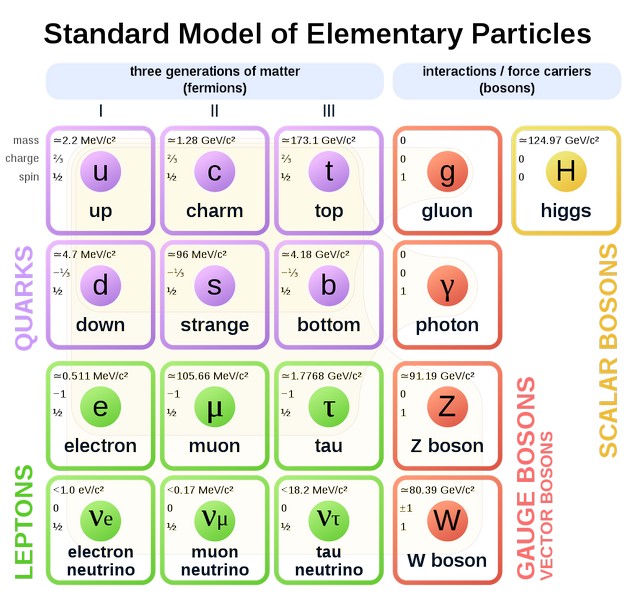
All observable subatomic particles have their electric charge an integer multiple of the elementary charge. The Standard Model's quarks have "non-integer" electric charges, namely, multiple of 1/3e, but quarks (and other combinations with non-integer electric charge) cannot be isolated due to color confinement. For baryons, mesons, and their antiparticles the constituent quarks' charges sum up to an integer multiple of e.
Through the work of Albert Einstein, Satyendra Nath Bose, Louis de Broglie, and many others, current scientific theory holds that all particles also have a wave nature. This has been verified not only for elementary particles but also for compound particles like atoms and even molecules. In fact, according to traditional formulations of non-relativistic quantum mechanics, wave–particle duality applies to all objects, even macroscopic ones; although the wave properties of macroscopic objects cannot be detected due to their small wavelengths. Interactions between particles have been scrutinized for many centuries, and a few simple laws underpin how particles behave in collisions and interactions. The most fundamental of these are the laws of conservation of energy and conservation of momentum, which let us make calculations of particle interactions on scales of magnitude that range from stars to quarks. These are the prerequisite basics of Newtonian mechanics, a series of statements and equations in Philosophiae Naturalis Principia Mathematica, originally published in 1687.
Subatomic particle : detailed specification and data
SAFETY WARNINGS
Terrain specified in the header corresponds to the real situation in terrain of the cache placement. Please consider your options, capabilities weather conditions. Remember that the safety is in first place in all circumstances. All you are doing is on your own risk, the author assumes no responsibility. Please protect the nature.
BEZPEČNOSTNÍ UPOZORNĚNÍ
Terén uvedený v záhlaví odpovídá skutečnému uložení krabičky a proto prosím zvažte vaše možnosti, schopnosti, povětrnostní podmínky. Pamatujte že bezpečnost je až na prvním místě. Kešku lovíte na vlastní nebezpečí, autor nenese žádnou odpovědnost. K přírodě se chovejte ohleduplně a neničte ji.
Thank DDM Vracov Geocaching club for the BETA test and help with the installation.
You guys are really awesome team :)