Pu'u Huluhulu Trail (Saddle Road) is a 1.1 mile loop trail located near Hilo, Hawaii that offers the chance to see wildlife and is good for all skill levels. The trail is primarily used for hiking and bird watching and is accessible year-round. Dogs are also able to use this trail but must be kept on leash. You do not need to hike the entire trail to claim this earthcache. Much of the information that you need to gather to log this cache can be found by looking at the landmark from the parking lot. The trail is an optional and fun add-on to this earthcache.

If you are interesting in hiking this trail visit https://www.alltrails.com/trail/hawaii/hawaii/puu-huluhulu-trail-saddle-road?u=i for more information.
What is a volcanic cone?
Volcanic cones are a hill-shaped landform that are formed by particles emitted from a volcanic vent. A volcanic vent is a rupture in the crust where lava, pyroclastic material, and gases are released.
There are many different types of volcanic cones that vary in size and shape.
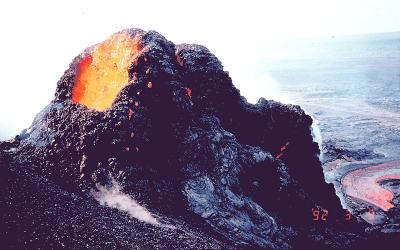
Spatter cones:
Spatter cones are small but steep hills that are made out of a volcanic material known as spatter. Spatter is made up of lava fragments that solidify on the outside of spatter cones. Below is a photo of a spatter cone formed after a volcanic eruption. Spatter cones range from 3 to 5 meters in height.
Cinder cones:
Cinder cones are relatively steep volcanic cones that are formed from the accumulation of cinder and volcanic ash over time. Cinder cones rarely contain large chunks of lava or other volcanic material as violent eruptions have pulverized lava into small fragments. Cinder cones are generally 50-350 meters high. Most cinder cones are red and/or greyish-white because of the cumulation of cinder and ash.

Now it’s time to learn a new Hawaiian word during your stay on the Big Island! 😄

What is a kīpuka?
A kīpuka is an area of land where existing rock has been completely surrounded by later lava flows. Mauna Loa’s eruption of 1984 created an immense lava field that surrounds Puʻu Huluhulu today. Many kīpukas have vegetation and wildlife that is completely different from the surrounding area.
Logging Requirements:
-
Is Puʻu Huluhulu a spatter or a cinder cone? What is some evidence at the GZ that backs up this statement? (What is the approximate height of this landform? What is the color of the cone’s slopes?)
-
Why is Puʻu Huluhulu considered to be a kīpuka?
-
As of June 2019, earthcaches are now allowed to have a required photo logging task. Please provide a photo of yourself, your GPSr, or a personal item that proves that you have visited this site. Please post this in your log.
**Confirm your find by answering these questions on this Google Form or by sending your answers to us via message center**
Enjoyed finding this EarthCache? Consider awarding it a favorite point!
Sources:
https://en.wikipedia.org/wiki/Pu%CA%BBu_Huluhulu
https://en.wikipedia.org/wiki/1984_eruption_of_Mauna_Loa
https://www.nationalgeographic.org/encyclopedia/volcanic-cones/
https://en.wikipedia.org/wiki/Volcanic_cone#Tuff_cones
https://www.britannica.com/science/kipuka
| We have earned GSA's highest level: |
 |