
The octopus is a soft-bodied, eight-limbed mollusc of the order Octopoda.
Around 300 species are recognized, and the order is grouped within the
class Cephalopoda with squids, cuttlefish, and nautiloids.
Many people would agree that the octopus is one of the most fascinating and strange creatures on the planet. After all, it’s a creature with more than half a billion years of evolution on an entirely different path than that of our own, yet is extremely intelligent and resourceful.
Much of that intelligence is distributed in a way in the creature that is totally alien from mammals – with neurons distributed throughout their suckers, arms, and brain rather than centralized like our own human brain. They have three hearts, blue blood, a venomous beak, no bones, and therefore can squeeze themselves into all kinds of shapes and spaces. They can change the color as well as the texture of their skin into a myriad of dazzling colors and patterns, and blend-in with their surroundings.
Perhaps this is why the octopus has long been the subject of mythical tales and urban legends. They almost seem other-worldly. They appear to have magical abilities, and of course, they live in the ocean – adding a sense of mystery that naturally leads to fantastical stories. Here is just one of the many legends from popular literature, film, and culture that focus on these remarkable cephalopods.

Truly they are unlike any other creature, and in Detroit, they hold an even more magical allure for many fans in a magical place that we call:
"Hockeytown"
The Detroit Red Wings of the National Hockey League have a tradition that connects to this unique creature in a rather unusual and strange way.
The Detroit Red Wings are one of the Original Six teams of the league and as of 2020, the Wings have won the most Stanley Cup championships of any NHL franchise based in the United States, and are third overall in total Stanley Cup championships, behind the Montreal Canadiens and Toronto Maple Leafs.
The Red Wings are one of the most popular and successful franchises in the NHL with fans and sports commentators referreing to the Detroit area as "Hockeytown", which has been a registered trademark owned by the franchise since 1996.
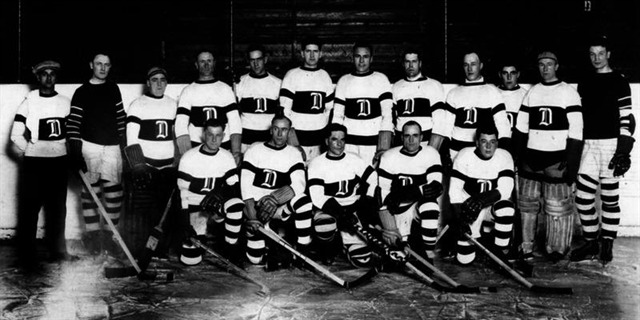
1926-27 Detroit Cougars Team photo
The team was founded in Detroit in 1926, the team was known as the "Detroit Cougars" until 1930. For the 1930–31 and 1931–32 seasons the team was called the Detroit Falcons, and in 1932 they finally changed their name to the Red Wings, of which it has remained ever since.
The Wings have called three different venues "home" over the years and the fan base has just kept building from the beginning.

Olympia Stadium - 1960s
The First, Olympia Stadium, was home from October 15, 1927 thru December 15, 1979. Games were played here for over 50-years, but the 1960's riots had taken its toll on the area surrounding Olympia, and the decison was made to create a new home for the team.
Downtown Detroit gained a new site along the riverfront in the late 1970's in the form of Joe Louis Arena and that was to be the new, and second home for the Wings.

11-10-2016 - Joe Louis Arena Entrance
Joe Louis Arena, saw its first game on On December 27, 1979. There was many good times had at the JLA, but over time the owners wanted to create a newer, more modern venue for the team to play.
Construction began on Little Ceasar's arena (the Wings third home since they began) with a formal groundbreaking ceremony on September 25, 2014. After many construction delays and setbacks, the facility would finally be ready for the team in the Fall of 2017.

A graphic commemorating the Red Wings Home at the JLA
Unfortunately JLA would never see another playoff season after the 2015-2016 season, as the team had various player-health issues, along with the passing of owner Mike Ilitch, who was a beloved member of the team.
2016–17 had no playoff appearance for the Wings, which ended one of the longest consecutive team playoff appearance streaks which had lasted 25 years.
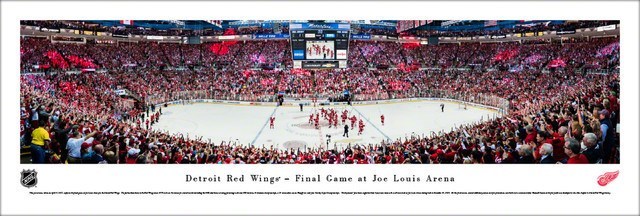
Final Game at Joe Louis Arena
JLA would host The Red Wings last game at the venue on April 9, 2017. The Wings won 4–1 against the New Jersey Devils.
The Red Wings played their first regular season game at Little Caesars Arena on October 5, 2017, winning 4–2 over the Minnesota Wild. The wings would go-on to finish the 2017–18 season with a 30–39–13 record, and missed the playoffs for the second season in a row. This was the first time since the early 1980s the team missed the playoffs in two or more consecutive years.
The Red Wings finished the 2018–19 season with a 32–40–10 record, missing the playoffs for a third consecutive season.

Little Caesars Arena - 2017
When the team did make the playoffs, there were many happy fans and many emotions felt around not only the stadium but the entire Metro Detroit area. A strange tradition began in the early 1950's, and has continued to this day during those playoff games.
"The Legend of the Octopus" is a sports tradition during Red Wings home playoff games where seafood-grade (already dead/not live) octopuses are thrown onto the ice surface in support of the Wings and their playoff hopes.
The origins of the activity go back to the 1952 playoffs, when a National Hockey League team played two best-of-seven series to capture the Stanley Cup. The octopus, having eight arms, symbolized the number of playoff wins necessary for the Red Wings to win the Stanley Cup.
The practice started April 15, 1952 when Pete and Jerry Cusimano, brothers and storeowners in Detroit's Eastern Market, hurled an octopus into the rink of The Old Red Barn (Olympia Stadium) in support of the team.
The team went on to sweep the Toronto Maple Leafs and Montreal Canadiens en route to winning the championship, as well as winning two of the next three championships in the following years.

Al Sobotka, the Joe Louis Arena head ice manager and one of the two
Zamboni drivers to refresh the ice between periods or as-needed.
Since the practice began, it has been a persistent fan-supported activity and has continued from Olympia, to JLA, and hopefully soon to Little Caesars Arena for a playoff game or more.
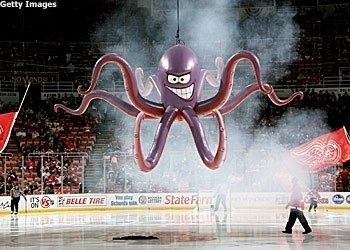
At Joe Louis Arena in 1995, fans threw 36 octopuses, including a specimen weighing 38 pounds (17 kg). Because of this tradition, eventually the Red Wings unofficial mascot became a purple octopus named "Al" or "Alsie" (ayl-zee). During recent playoff runs, there were two of these gigantic versions of Al hung from the rafters of the JLA to symbolize the now-16 wins that are needed in modern times to clench Lord Stanley's prized trophy.
The tossing of the octopus has has become such an accepted part of the team's lore, that fans have even developed what is considered proper etiquette and technique for throwing an octopus onto the ice.
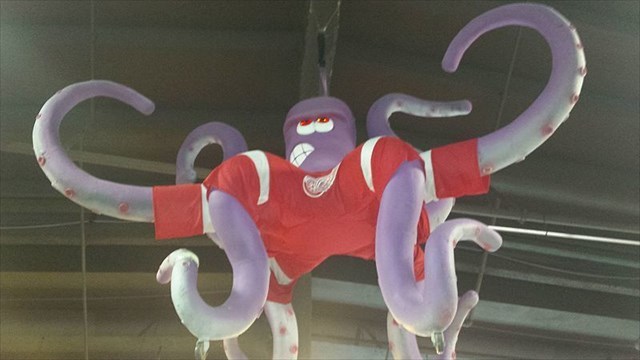
There have been other traditions started because of the Octopus tossing by Red Wings fans. Some folks believe that the tossing will help their teams go all the way to the Stanley Cup Finals as well.
During the 1995 Stanley Cup Playoffs, as the hype about the Wings' run to the Finals grew, a fan at the Boston Garden threw a lobster onto the ice during a playoff game between the Boston Bruins and the New Jersey Devils. Lobster harvests are often identified with the Bruins' home region, the New England States, particularly Maine.
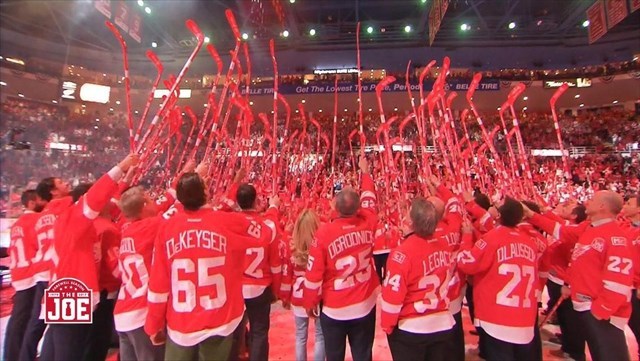
Final-game ceremony at JLA
When in the 1995 Stanley Cup Finals the Red Wings took on the New Jersey Devils and Devils fan threw a fish in Brendan Byrne arena after the Devils scored a goal.
During the 1996 Stanley Cup Playoffs, fans of the Florida Panthers threw thousands of toy rats on the ice whenever the Panthers scored, instigated by the octopus toss and the story of Scott Mellanby killing a rat in the Panthers' dressing room. The NHL eventually cracked down on the rat-tossing because of the lengthy delays they could cause, and it ceased altogether shortly after the Panthers' Cup Finals run ended.

Several years later, during the opening-round series between the Wings and the Edmonton Oilers, an Edmonton radio host suggested throwing Alberta beef on the ice before the game. Oilers fans continued throwing steaks, even at away games, resulting in several arrests at the away cities.
In the 2002–03 season, the Nashville Predators fans began throwing catfish onto their home ice, in response to the Red Wings tradition. The first recorded instance occurred on October 26, 2002 in a game between the Detroit Red Wings and the Nashville Predators. One of the employees who helps clean the ice in the Gaylord Entertainment Center had expressed their opinion of tossing the catfish as follows: They are gross, huge, heavy, and they stink along with leaving a slimy trail. But if it's good for the team, i guess we can deal with it.
This "tradition" seems to have continued into 2008 where during Game 3 of the 2008 Western Conference quarterfinals, there were 4 catfish tossed onto the ice during the matchup between the Detroit Red Wings and the Nashville Predators.

During Game 4 of the 2007 Stanley Cup Western Division Semifinals between the Detroit Red Wings and home-team San Jose Sharks, a Sharks fan threw a 4-foot leopard shark onto the ice at the HP Pavilion at San Jose after the Sharks scored their first goal with 2 minutes left in the first period.
During the 2008 Stanley Cup finals, in which the Red Wings defeated the Pittsburgh Penguins, seafood wholesalers in Pittsburgh, led by Wholey's Fish Market, began requiring identification from customers who purchased octopuses, refusing to sell to buyers from Michigan.
In the first game of the 2009-10 playoff series between the Detroit Red Wings and the Phoenix Coyotes, a rubber snake was thrown onto the ice following the Coyotes' Keith Yandle's goal.
In the second game of the 2009-10 playoff series between the Detroit Red Wings and San Jose Sharks, a small shark was tossed to the ice with an octopus inside its mouth.

In 2008, the NHL attempted to create a directive that would be a ban on the Twirling of the Octopus.
On April 19, 2008, NHL director of hockey operations Colin Campbell sent a memo to the Detroit Red Wings organization that forbids Zamboni drivers from cleaning up any octopuses thrown onto the ice and imposes a $10,000 fine for violating the mandate. The linesmen will instead perform any clean-up duties. In an email to the Detroit Free Press, NHL spokesman Frank Brown justified the ban because "matter flies off the octopus and gets on the ice" when Al Sobotka swings it above his head. In an article describing the effects of the new rule the Detroit Free Press dubbed the NHL's prohibition as "Octopus-gate". By the beginning of the third round of the 2008 playoffs the NHL loosened the ban to allow for the octopus twirling to take place at the Zamboni entrance.

Al Sobotka is usually the person who retrieves the thrown octopuses from the ice.
After he retrieves an octopus, he has been known to twirl it above his head
as he walks across the ice rink to the Zamboni entrance.
Times have changed and the Red Wings now have settled into their new home at Little Caesars Arena, which has yet to see the playoff energy come to call as it has with the Wings previous homes.
Al the Octopus is awaiting the time that he can once again drop from the rafters durign playoff time, and his bretheren take the ice in the tradition that has adorned the Wings for more than 65-years.
**Sources: PBS, Wikipedia, Google, Detroit Red Wings
***PUZZLE***
Research will be needed to solve the puzzle and the information
needed for this is contained both in this page as well as online.
N 42° AB.CDE'
W 083° FG.HJK'
A: How many "Homes" have the Red Wings had prior to LCA?
B: Team Player Numbers (as Red Wings): Alex Delvecchio, Plus Gordie Howe, Minus Steve Yzerman
C: Larry Murphy played for the Wings before he retired but had been traded from the Toronto Maple Leafs to begin his final seasons of his career. How many seasons did he play (full or partial) with Detroit?
D: Sid Abel won the Hart Memorial Trophy how many times?
E: Gordie Howe was one of the longest-time players in Professional Hockey.
He wore a specific number as a rookie. What is the first digit of this number?
F: How many NHL teams did Nicklas Lidström play for, besides the Red Wings, during his NHL Career?
G: In addition to playing for the Detroit Red Wings, Vladimir Konstantinov had participated in how many international tournaments for the Soviet Union? Divide this number by two.
H: How many Olympics did Sergei Fedorov win Medals?
J: What number month of the year did Octopus Tossing begin in Detroit? Subtract 1 from this number
K = Y subtract Z
Bob Probert was the 46th Draft Pick overall in what year? Z = The last digit of this year.
Ted Lindsay wore what sweater number? Y = Ted's sweater number