Welcome to the Kirtland's Warbler GeoTrail (KWGT). This trail will take you in a loop in central Northern Michigan through the Jack Pine ecosystem, breeding home of the Kirtland's Warbler. This tour takes you to a total of 25 caches with an amazing trackable geocoin as a reward. The KWGT Passport can be downloaded here: https://f81c572e-1d95-4026-befc-8c60f69cbcd9.filesusr.com/ugd/31e003_41b2f3aa918442e8b08c880e746e6946.pdf
One of the threats to Kirtland's Warblers is the Brown-headed Cowbird. Cowbirds are obligate brood parasites, meaning they lay eggs in nests of other species, and have completely lost the ability to construct nests and incubate eggs. Females typically remove an egg from a nest and replace it with one or more of her own eggs. Cowbird young usually hatch quicker and are larger than host young. These advantages enable young cowbirds to outcompete host young for resources. Brown-headed Cowbirds have laid eggs in the nests of more than 220 species of birds. They are native to short-grass prairies, where they followed herds of bison, eating insects stirred up and seeds knocked down by their passing.
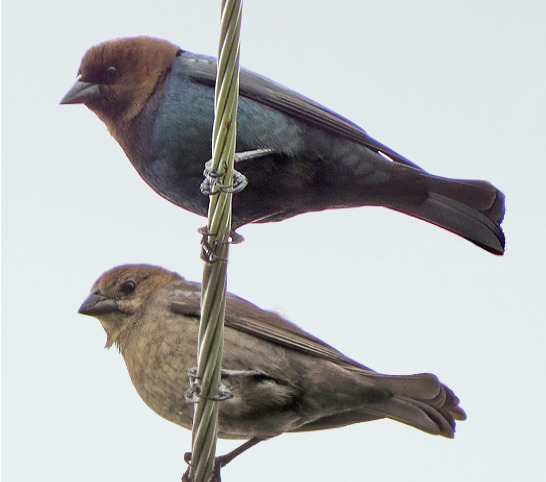
Brown-headed Cowbirds did not reach northern Michigan until around 1880, after the virgin forests had been logged and settlers moved in, so Kirtland's never had the chance to evolve with cowbird parasitism. From 1961 to 1971, Kirtland's Warbler numbers dropped by 60%, mainly due to cowbird parasitism. During the period from 1966 to 1971, 69% of Kirtland's nest were parasitized, and only 0.8 young Kirtland's lived to leave the nest. It was discovered that if one cowbird egg was laid in a nest, Kirtland's nestlings may survive. If two cowbird eggs were laid, no Kirtland's nestlings survived. In 1972, a cowbird removal program was initiated, resulting in an increase to 2.7 young leaving the nest, and only 6% of nests had cowbird eggs.
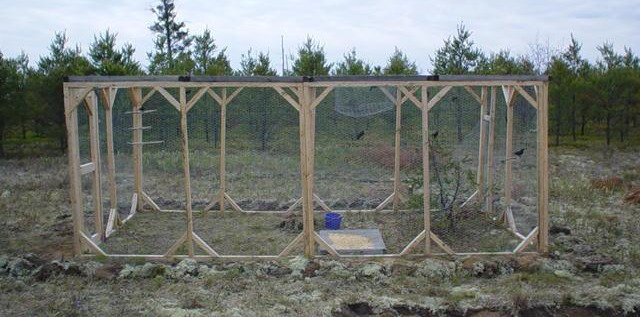
USFWS photo
Cowbird traps are wooden framed, 16 feet long by 8 feet wide by 6 feet high, and covered by chicken wire, baited with water, millet, and live cowbird decoys. There is a drop panel made of wire mesh with larger openings. Traps are operated from mid-April through June when cowbirds are highly social. The vocalizations of the decoys attract other cowbirds to the trap.
Cache
The cache is located near the site of an early 1990s cowbird trap (the open spot on the corner). The trees are the result of the 1980 Mack Lake Fire. In 1991, there was a Red-winged Blackbird that had learned to zip in and out of the drop panel by folding its wings at just the right moment. We were never able to catch the bird so it could be banded, even with two of us trying.