This cache is about the difference between weathering and erosion.
| EDUCATIONAL LOGGING REQUIREMENTS
In order to substantiate your visit and comply with the educational requirement for Earth Caches you have to submit your answers to the following questions to the cache developers via their profile:
For purposes of logging this cache you must answer the following questions.
1) Was the shape of the rock that makes up the Lady's Slipper formed by weathering, erosion or both? Explain your answer.
2) When a seed of a tree falls in a crack in a rock and the subsequent root growth forces the crack wider - is this weathering or erosion?
3) When parked at Waypoint 1, is the "slipper" identifiable? Describe the rock formation from this view.
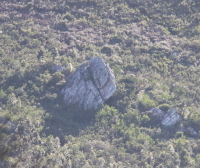
4) Can you see the rock in the picture in the description from this point?
|
LADY'S SLIPPER

The Lady's Slipper is a rocky feature on the van Stadensberg mountain range about 35km to the west of Port Elizabeth. This feature was easy to be seen from the R102 which was the main road between Port Elizabeth and Cape Town. You should have a good view from the published coordinates and along the road to Uitenhage.
Once the N2 was built further away from the range the "slipper" feature is not as easy to see and less people are aware where the name came from. Hopefully the animated gif will solve that question.
The rock formation making up the Lady's Slipper is Table Mountain Sandstone, a sedimentary rock that stretches from Clanwilliam (200km north of Cape Town) and ends in this area. Table Mountain Sandstone is made up predominantly of quartzitic sandstone laid down between 510 and 400 million years ago. It is the hardest, and most erosion resistant layer of the Cape Supergroup.
The van Stadensberg range is part of the The Cape Fold Mountains which were kilometers high. Over the years the rock has been weathered and eroded to what they are now.
Large pieces of the Lady's Slipper broke off and are visible on the slope of the mountain. There is a walking path up to the "Falcon Rock" and to the top of the Lady's Slipper. The walking trails are accessible from the Falcon Rock Restuarant. There is no charge for the use of the trails.
Now onto the subject of this Earth Cache.
It is commom to use the terms "weathering" and "erosion" as synonymous. In fact they are two different processes affecting the earth.
WEATHERING
Weathering is the process where rock is dissolved, worn away or broken down into smaller and smaller pieces. There are mechanical, chemical and organic weathering processes. Water, ice, acids, salts, plants, animals, and changes in temperature are all agents of weathering.
There are three types of weathering, physical, chemical and biological.
Physical weathering is caused by changing temperatures. Chemical weathering is caused by rain water reacting with minerals in the rock. Biological weathering is caused by living organisms.
EROSION
Erosion is the geological process in which earthen materials are worn away and transported by natural forces such as wind, water or ice. Erosion happens when rocks and sediments are picked up and moved to another place by ice, water, wind or gravity.
SO WHAT IS THE DIFFERENCE?
Weathering occurs in situ (on site), that is, in the same place, with little or no movement, whereas erosion involves the movement of rocks and minerals by agents such as water, ice, snow, wind, waves and gravity and then are transported and deposited in other locations.
|
|
| Rock on slope. |
References:
National Geographic
Wikipedia
One Geology