The Sun
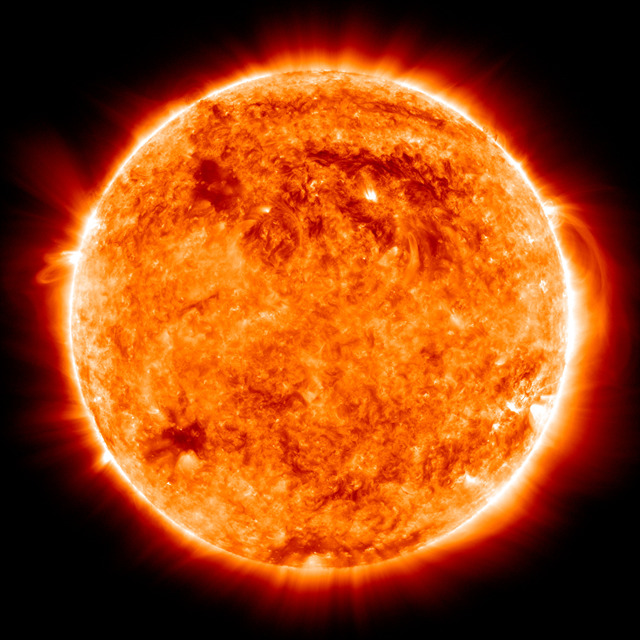
photo credit: NASA
Parking waypoint (at the "end" of Hill Canyon Road) is available on the cache page of Western Gate to the Western Plateau (Conejo Cyn#1) (GC38VEQ). Note that, if this small lot is full, parking is now free in the Santa Rosa County Park. Restrooms are also available there  The hike from this parking is about five miles, round-trip, with absolute elevation gain of about 500 feet. Access is also available from a lot on Rancho Conejo Road: a shorter hike, and the lot is at about the same elevation as this cache, but the road is NOT flat!
The Sun, AKA Sol (the old Roman name), is the source of nearly all the light, heat and energy that we get on the earth. Compared to other stars, it is neither very big nor very small. In fact, it is a G-type star, putting it squarely on the Main Sequence of star classification. Its visible light is a pale yellow (almost white), making it a fairly common "yellow dwarf", albeit on the large side for this type of star. The Greeks called the Sun Helios and in ancient Egypt, Ra (later Atum-Ra) was the sun-god.
The Sun is far-and-away the largest object in the solar system. Its Mass is 1.989 x 10^30 kg, which is more than 99.8% of the total mass of the Solar System: Jupiter contains most of the rest. Its diameter is 1.39 million kilometres (864,000 miles), more than 100 times that of Earth.
The Sun is composed primarily of hydrogen. 600 million metric tonnes of this element are fused in to helium every second, deep in the core. 4 million tonnes of that hydrogen are converted directly into heat, which takes 10,000 years or more to reach the surface, where it is blown off into space, some tiny fraction of which reaches Earth as sunlight. Despite this huge conversion of mass, the Sun has enough hydrogen to continue this process for approximately 4½ billion years. BTW, the temperature on the surface (called the Photosphere) averages 5,772 ºK, which is a little less than 10,000 ºF (about 5,500 ºC).
In redoing this series, we used the subtitles, for most of the planets, from Gustav Holst's orchestral suite "The Planets", op. 32, to avoid confusion with the old set hidden by BLIG 15 years ago. Because Holst did not write a piece for the Sun, we used a piece by the Welsh composer, Alun Hoddinott, instead.

You're looking for a camo-duct taped, medium-sized, plastic pill bottle, with only a logsheet in it, so bring your own pen/pencil! It was originally a cache in the Los Padres NF which was archived by GHQ for being in a Wilderness Area: oops! It's in a fairly-obvious spot about 10-12 feet off the trail, under some small rocks. Take care to avoid the burned remains of cactus. Be sure to copy the clue to the Solar System Tour. From here, all of the planets of the Solar System are spread out in an arc of about 90 degrees.
Use caution when reaching into places where you can't see. And bring more water than you think you will need. FYI: on the Rim Trail there is a nice bench, near Monday Night MTB (GC48FQ5), which is perfect for enjoying your lunch and some marvelous views.