Aplitgang
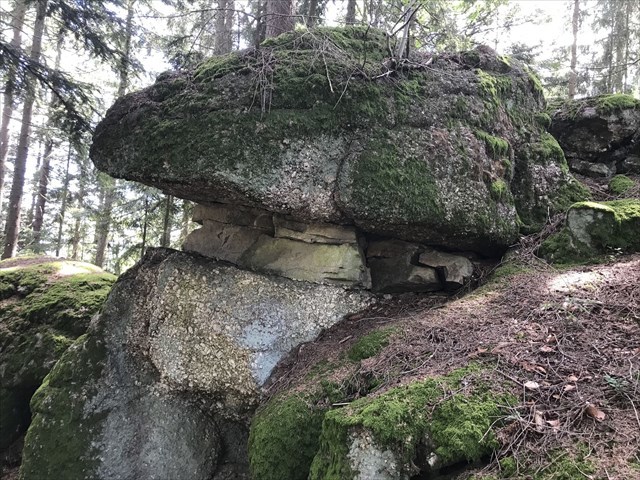

Der Weinsberger Granit, eine der ältesten Gesteinsarten der Erde, entstand vor fast einer halben Milliarde Jahren, als gewaltige glutflüssige Magmamassen gegen die Erdkruste vordrangen, die Oberfläche nicht erreichten und langsam erstarrten.
Das Mühlviertel ist allerdings nicht einheitlich aus Granit aufgebaut. Die granitene Grundmasse ist oft von Gneis überlagert und von Aplitadern durchzogen. Im Karbon, der Steinkohlenzeit, war das Mühlviertel ein Hochgebirge, das sich bis etwa 6000 Meter über den Meeresspiegel erhob.
Einige tausend Meter unter der Erdoberfläche lagerten alte Granite. Nun drangen aus der Tiefe neuerlich Magmamassen vor, schmolzen den Granit zum Teil auf und erkalteten zu neuem Granit. Reste des alten Granits wurden durch die Hitze und den Wasserdampf in kristallin-schiefrigen Gneis umgewandelt. In der festen Masse rissen Klüfte auf, in welche neuerdings Magma eindrang und zu Aplitadern erstarrte. Im Lauf der Zeit wurde das Gebirge abgetragen und die einstigen Tiefengesteine kamen an die Oberfläche.
Aplite sind sehr helle, dichte und feinkörnige Gang- oder Adergesteine. Der Name Aplit leitet sich vom griechischen "haplos" ab, was "einfach" bedeutet, dies verweist auf den einfachen mineralogischen Aufbau des Gesteins. Die Adern bzw. Gänge sind meist sehr schmal und bewegen sich im Zentimeterbereich, insofern ist der Aplitgang, den man vor Ort finden kann, außergewöhnlich und einzigartig. Die Farbe des Aplits ist meist weiß bis hellgrau bis zu rosa. Das Gefüge ist meist gleichkörnig und nichtporphyrisch, also nicht von Einsprenglingen durchsetzt. Die Korngröße des Aplits bewegt sich im Submillimeterbereich, zum Erkennen der Minerale ist eine Lupe bzw. ein Mikroskop erforderlich. Auf Grund der sehr geringen und einheitlichen Korngröße wird bei magmatisch entstandenen Apliten von einer sehr raschen und einheitlichen Kristallisation ausgegangen. Aplite sind vorwiegend aus Quarz, Alkalifeldspat (Orthoklas) und Plagioklas zusammengesetzt. Biotit und andere ferromagnetische Minerale kommen nur sehr selten vor. Aplite zeigen oft erhöhte Konzentrationen der Elemente Beryllium und Lithium.

Weinsberg granite, one of the oldest types of rock on earth, was created almost half a billion years ago when huge, glowing molten magma masses penetrated the earth's crust, did not reach the surface and slowly solidified.
However, not the whole Mühlviertel region is made up of granite. The granite base is often covered with gneiss and criss-crossed with aplitic veins. In the Carboniferous Period, the Mühlviertel region was a high mountain range that rose up to 6000 meters above sea level.
Old granites were stored a few thousand meters below the surface. Now magma masses penetrated the earth's crust again from the depth, partially melted the granite and cooled to new granite. Remnants of the old granite have been transformed into crystalline-gneiss by the heat and water vapor. Fissures broke open in the solid mass, into which magma has recently entered and solidified into aplitic veins. In the course of time, the mountains were eroded and the former deep rocks came to the surface.
Aplites are very bright, dense and fine-grained duct or vein stones. The name aplite is derived from the Greek "haplos", which means simple, which refers to the simple mineralogical structure of the rock. The veins or passages are usually very narrow and in the centimeter range, so the aplite vein that can be found on site is extraordinary and unique. The colour of the aplite is mostly white to light grey to pink. The structure is mostly uniform and non-porphyric, i.e. not interspersed with sprinklers.
The grain size of the aplite is in the submillimeter range, a magnifying glass or microscope is required to identify the minerals. Due to the very small and uniform grain size, magma-like aplites are assumed to undergo very rapid and uniform crystallization. Aplites are mainly composed of quartz, alkali feldspar (orthoclase) and plagioclase. Biotite and other ferromagnetic minerals are very rare. Aplites often show increased concentrations of the elements beryllium and lithium.
Deine Aufgaben zum Loggen dieses Earthcache / Your task to log this Earthcache:
Schicke mir die Antworten auf folgende Fragen per Message (nicht Mail) über mein Profil:
Send me your answers on the following questions via message (not mail):
1.) Wie mächtig ist die Aplitader, die du vor Ort deutlich erkennen kannst? How thick is the aplite vein, which you can clearly see on site?
2.) Vergleiche den Granit und den Aplit (Oberfläche, Struktur, Farbe...) und beschreibe beide Gesteine und die Unterschiede in eigenen Worten!
Compare the granite and the aplite (surface, structure, color...) and describe both rocks and the differences in your own words!
3.) Optional: Gerne kannst du ein Foto von dir und/oder deinem GPS vor Ort dem Log hinzufügen!
Optional: If you like you can add a picture of you and/or your GPS unit at the location to your log entry!
Du brauchst nicht auf eine Logfreigabe zu warten! Sobald die Antworten abgeschickt sind, kannst du loggen! Ich melde mich bei dir, falls irgendetwas nicht passt.
There is no need to wait for a log permission! You can log immediately after you sent me your answers! If there's something wrong, I'll contact you.
Viel Freude beim Erkunden der Location! Have fun and enjoy the location!
Quellen / Sources:
wikipedia.org
Wimmenauer, W.: Petrographie der magmatischen und metamorphen Gesteine. Stuttgart 1985.
Die Fotos stammen vom Verfasser / The pictures were taken by the author.
 The most exciting way to learn about the Earth and its processes is to get into the outdoors and experience it first-hand. Visiting an Earthcache is a great outdoor activity the whole family can enjoy. An Earthcache is a special place that people can visit to learn about a unique geoscience feature or aspect of our Earth. Earthcaches include a set of educational notes and the details about where to find the location (latitude and longitude). Visitors to Earthcaches can see how our planet has been shaped by geological processes, how we manage the resources and how scientists gather evidence to learn about the Earth. To find out more click HERE.