Visting the Bramber Flowerpot
It is essential to time your visit corresponding to low tide. Consult these tide tables, and plan accordingly. DO NOT ATTEMPT this within an hour of high tide. This area is part of the Bay of Fundy and not too far from Burntcoat Head Park where the hiighest tides in the world have been recorded.
Sea Stacks
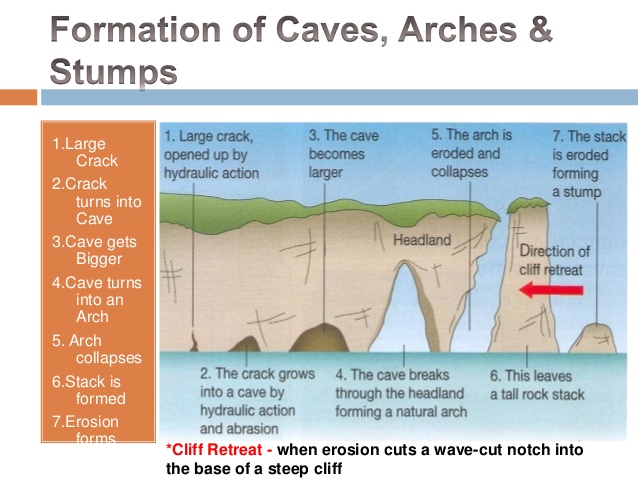
A stack or sea stack is a geological landform consisting of a steep and often vertical column or columns of rock in the sea near a coast, formed by wave erosion. Stacks are formed over time by wind and water, processes of coastal geomorphology. They are formed when part of a headland is eroded by hydraulic action, which is the force of the sea or water crashing against the rock. The force of the water weakens cracks in the headland, causing them to later collapse, forming free-standing stacks and even a small island. Without the constant presence of water, stacks also form when a natural arch collapses under gravity, due to sub-aerial processes like wind erosion. Erosion causes the arch to collapse, leaving the pillar of hard rock standing away from the coast—the stack. Eventually, erosion will cause the stack to collapse, leaving a stump.
Geology of the natural rock formations on the Bay of Fundy
This area was once a dry rift valley, but after the Ice Age, the valley filled with glacial meltwater and the sea level rose. This was the birth of the Bay of Fundy. The cliffs along the Bay of Fundy were first formed over 600 million years ago when two continents collided and the Caledonia Highlands Mountain range was formed. It was a massive mountain range - older than the Appalachians and larger than the Canadian Rockies.
Through the millennia, as the earth's crust twisted and tilted, the mountains uplifted and tilted to a 30-45º angle creating vertical fissures. Surface water filtering down through the vertical cracks in the cliffs whittled away at these fissures, causing the fissures in the rocks to widen and erode from the top. This gradually separated large blocks of rock from the adjoining cliffs - many with the vegetation still intact and formed the beginnings of the flowerpot formations.
As tidal action became stronger advancing and retreating tides and the associated waves have eroded the base of the rocks at a faster rate than the tops, resulting in their unusual shapes. While rain and ice continue to erode from the top, the daily tidal action wears away at the bases of the cliffs and rock formations. The large volume of water flowing in to and out of the Bay of Fundy modifies the landscape surrounding it. One can clearly see how high the tides rise by looking at the narrow curved base of the stack.
In order to log this earthcache, please send a private message to the cache owner with the answers to the following questions:
*** All sincere efforts to answer the questions and complete the tasks will be accepted.
1. What is the prominent feature of the flowerpot and describe the physical appearance of it (formation, color, size, etc).
2. Estimate the height of the flowerpot and the height of the high tide mark.
3. What do you think will happen to this flowerpot in future years when you look at the structure?
4. What is another name for flower pot?
5. [REQUIRED] In accordance with the updated guidelines from Geocaching Headquarters published in June 2019, photos are now an acceptable logging requirement and WILL BE REQUIRED TO LOG THIS CACHE. Please post a photo in your log of yourself or a personal item with the flowerpot in the background to prove you visited the site.

This cache owner
supports the
Association of Nova Scotia Geocaching