Santorini caldera is a large, mostly submerged caldera, located in the southern Aegean Sea, 120 kilometers north of Crete in Greece. Visible above water is the circular Santorini island group, consisting of Santorini (aka Thera), the main island, Therasia and Aspronisi at the periphery, and the Kameni islands at the center, Nea ("New") Kameni and Palea ("Old") Kameni that they are totally made of lava rocks. It has been designated a Decade Volcano.
The caldera measures about 12 by 7 km (7.5 by 4.3 mi), with 300 m (980 ft) high steep cliffs on three sides.
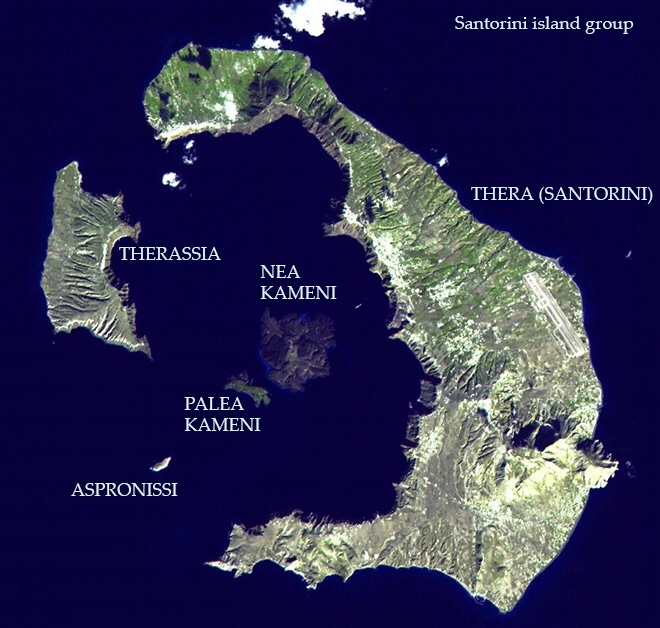
The Santorini group of islands is unique as it is probably the only volcano in the world with its caldera in the sea. All of Santorini’s islands were formed largely due to the volcanic activity and constitute a compound volcano. Twelve huge explosions occurred, one every 20.000 years approximately, during the last period of volcanism. Each violent explosion caused the collapse of the volcano’s central part and the creation of a large crater (caldera). The volcano however managed to recreate itself over and over again.
The last large explosion occurred 3.600 years ago (during the Minoan Age) when the igneous material (mainly ash, pumice and lava stones) covered the three islands (Thera, Thirasia and Aspronisi) together with a thriving prehistoric civilization, evidence of which was found during the excavations of Akrotiri in Thera. The huge amount of new matter did not only create stretches of flat fertile land, but it is also responsible for the formation of the well-known external beaches. The solid material and gases emerging from the volcano’s interior created a big “vacuum” underneath. This caused the collapse of the central part and the creation of an enormous “pot”, the today’s Caldera.
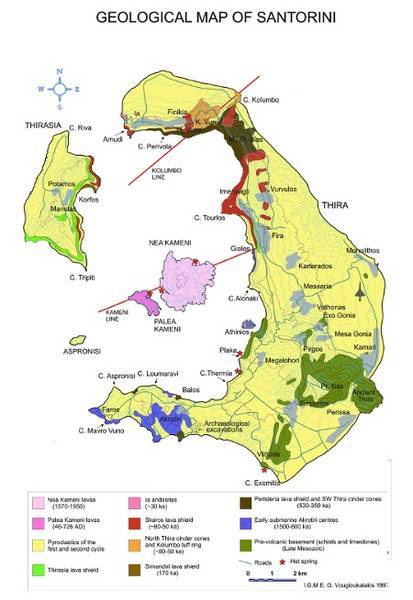
Following this explosion, the volcanic activity continued through time with slower pace, building two islets inside the Caldera, the Palea (Old) and Nea (New) Kameni. The latter is the newest land in the Mediterranean as it was formed by lava between 434 and 57 years ago. The round craters, hot fumaroles, new minerals, and gushing warm multi-coloured water, impress visitors. The collapse of the central part of the volcano created the Caldera’s slopes and cliffs, “gremna” as local called them, and it is possible for visitors to take a tour by sea within the “internal” part-the offspring of the active volcano.
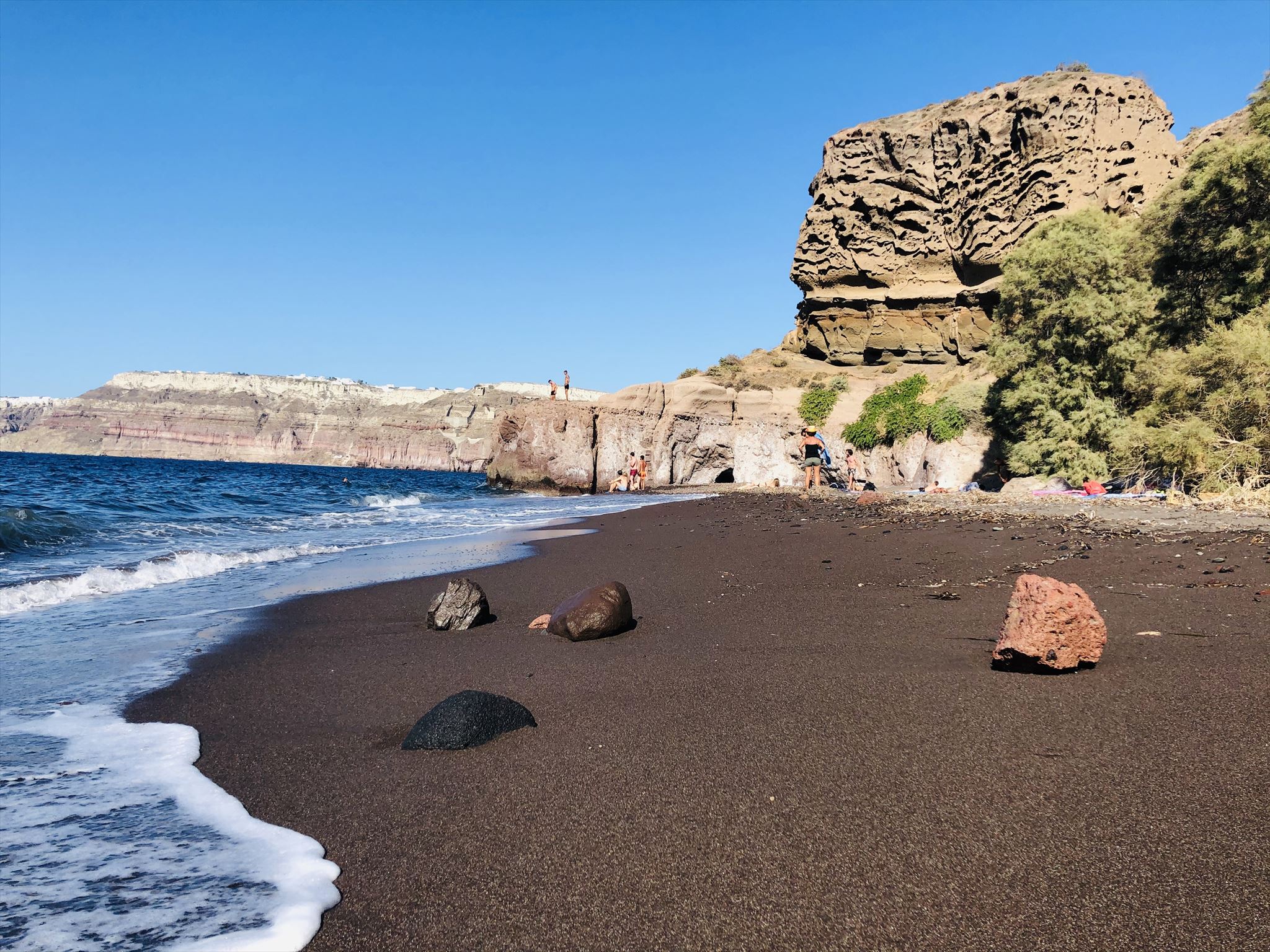
The inner coast around the caldera is a sheer precipice of more than 300 metres (980 ft) drop at its highest, and exhibits the various layers of solidified lava on top of each other, and the main towns perched on the crest. The ground then slopes outwards and downwards towards the outer perimeter, and the outer beaches are smooth and shallow. Beach sand colour depends on which geological layer is exposed; there are beaches with sand or pebbles made of solidified lava of various colours: such as the Red Beach, the Black Beach and the White Beach. The water at the darker coloured beaches is significantly warmer because the lava acts as a heat absorber.
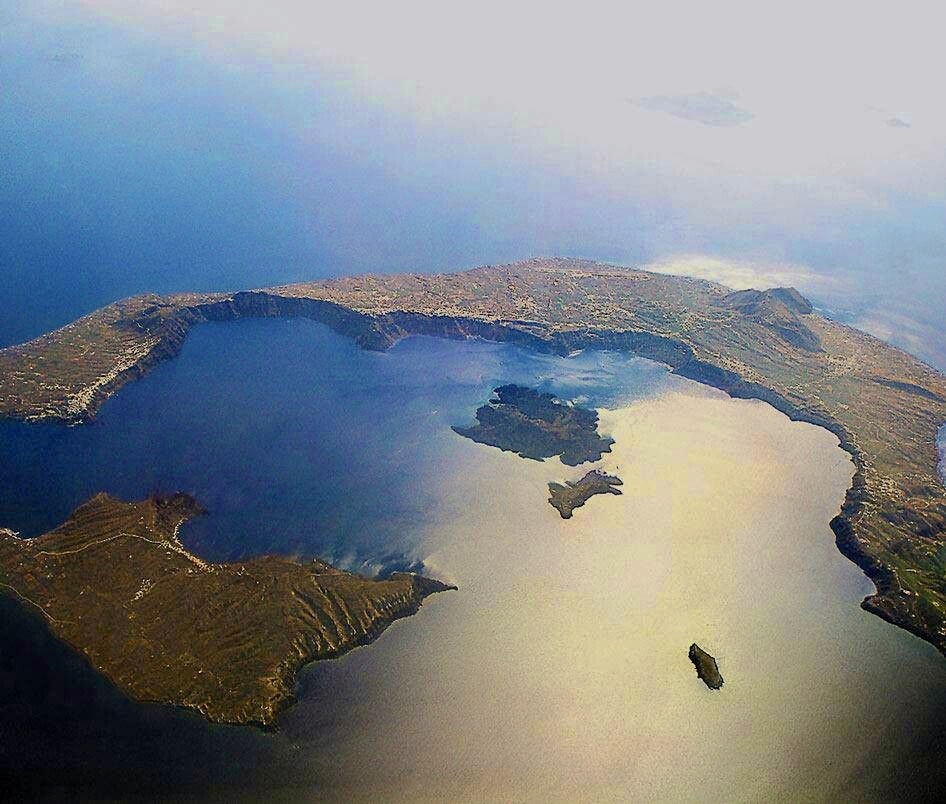
The huge Minoan eruption of Santorini in the 17th century BC may have inspired the legend of Atlantis. It was rated 7, the highest score for a historical eruption, in the Smithsonian Global Volcanism Program's Volcanic Explosivity Index.
The last eruption was in 1950, and now only fumarolic activity, primarily inside the recently active craters, takes place. GPS instruments registered renewed deformation around the caldera in 2011 and 2012.
THE CACHE:
To log the cache please email your answers to the following questions.
You don’t have to wait for a logging permission. You will be contacted if there is anything unclear in the answers.
-
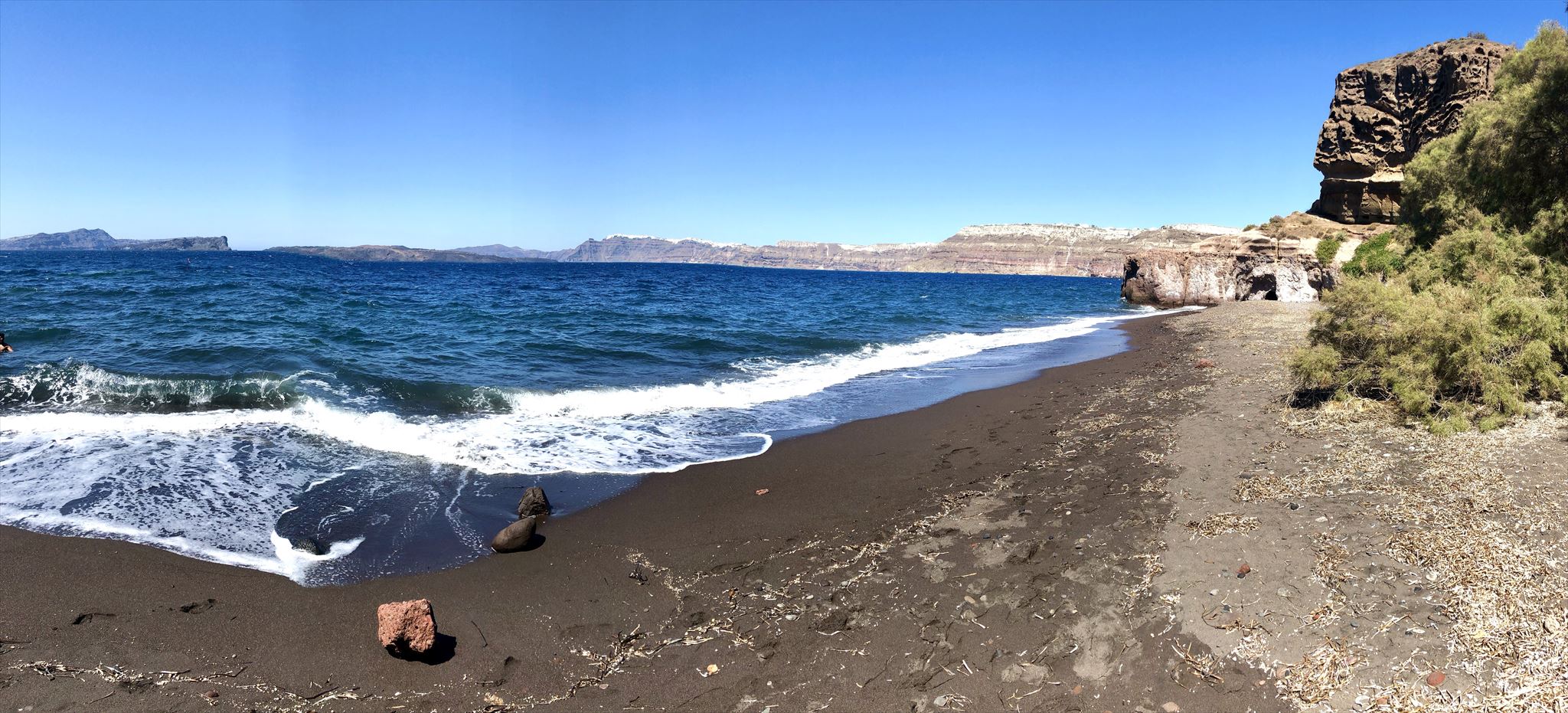
In front of you, you can see the Nea Kameni and Palea Kameni. Which rocks are they made of?
-
See at the right, how many stripes you can count on the rock wall? Which colors are there? What is the source of the stripes and the colors? Are the stripes and colors caused by many different eruptions creating layers of different material?
-
Behind of you there is a big rock, describe it: is it smooth or rough? In your opinion, why it is so?
-
Take a picture of yourself (or if you prefer, your GPS or your GC nickname) where the caldera is visible from Caldera Beach
Sources:
www.wikipedia.org
www.santorini.net