
The Tuia Mātauranga Pōkai Whenua GeoTour follows the footsteps of early explorers of Aotearoa New Zealand taking you to places where leaders of the past searched for food, resources and ways to adapt and survive in this new land.
Use the Pōkai Whenua GeoTour as your classroom to explore the stories of the past, in the present, to preserve what is unique in Aotearoa New Zealand for the future.
Collect the codewords to get the Geocoin puzzle piece.
To be able to complete this GeoTour and receive your special Geocoin collectable, remember to take a note of the codeword placed in the cache. This will need to be recorded in your passport which can be downloaded here.
|
Te Toto Gorge - Māori Gardens
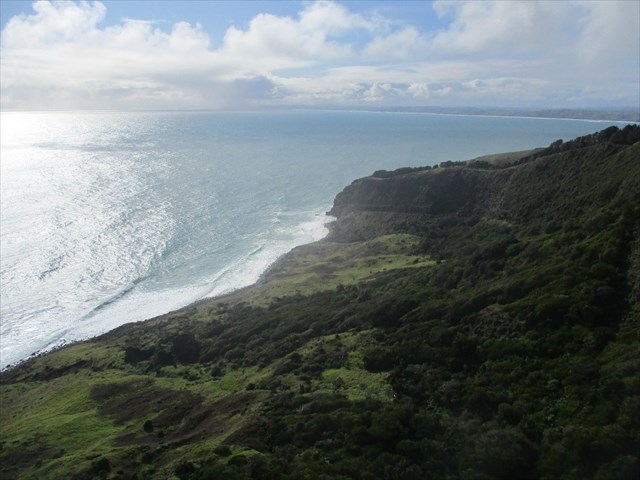
Te Toto Gorge lies along the coast 13 km south of Raglan. While there is little recorded history about this area, there is evidence of early settlements and the rather eroded state of the earthworks suggests it was occupied between about 1700 and 1800.
From the car park it’s a short walk to a viewing platform providing stunning views of the coastline and into the natural amphitheatre which was once the site of extensive Māori gardens. Remnants of stone rows which would have outlined garden plots can still be seen in places, as well two small pā, storage pits and terraces.
When Polynesian ancestors of Māori settled in New Zealand, they brought several plants with them such as kūmara, yam and taro. The climate they encountered here was vastly different to that of their tropical homeland and new techniques were developed to improve the yield of crops.
Such techniques included terracing; complex drainage systems; stone rows and mounds; and the modification of soil to improve warmth and fertility. Many of these techniques have left archaeological remains that can still be seen today. European explorers observed that Māori had neat gardens, about 0.5–5 hectares in size, on sunny, north-facing slopes. These gardens were communally owned and worked.
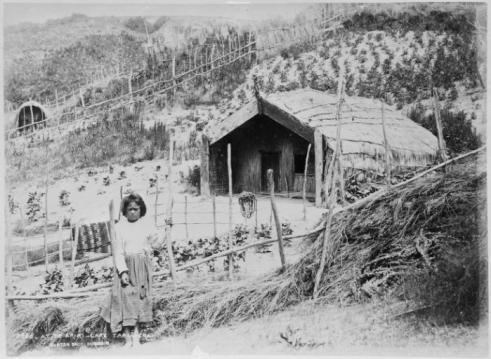
Native crops
A few native plants were cultivated for food, although perhaps not as widely as the Polynesian crops. Some central North Island Māori grew New Zealand cabbage trees for their edible roots and karaka trees were planted near settlements for their fruit.
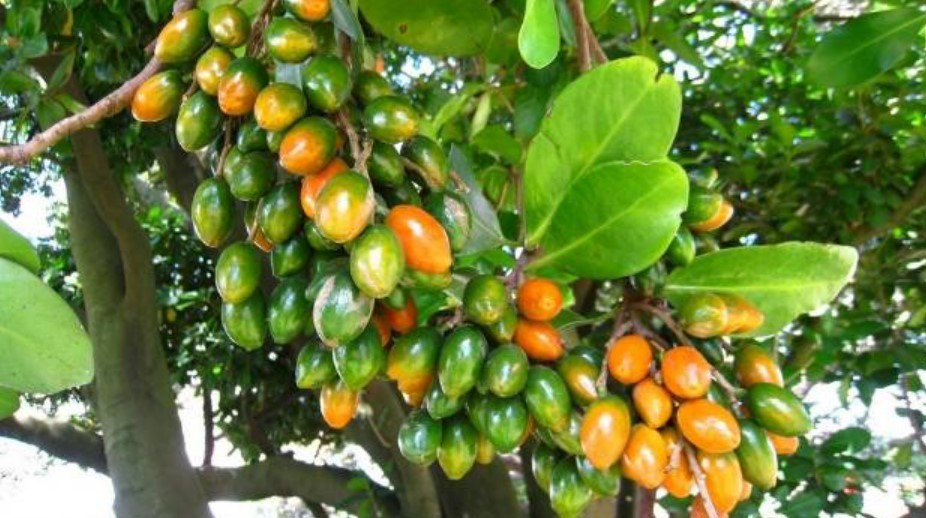 Karaka berries – the fruit from the karaka trees was a very important source of food for Māori and they cared for the trees to ensure a good crop. The orange coloured berries ripen on the trees in December and were processed by soaking and cooking them to remove the toxins from the stone in the centre of the berry. Māori stored and ate the berries over winter when other food sources were not available.
Polynesian crops
Kūmara (sweet potato) - was introduced to New Zealand around 1400AD. The origins of this plant are in South America and it was thought to have been brought to Polynesia by explorers who had ventured there. Pre-European Māori grew several different varieties of 'bush' kūmara but compared to the varieties we eat today they were very small in size, often no bigger than a finger. Kūmara were cultivated from vine cuttings rather than seeds and often grown on slopes or in mounds as they prefer well drained soils
Kūmara crops were once at risk from te hīhue (kūmara moth caterpillar) and could be devastated if the pests were not controlled. This was sometimes done by taming karoro (black-backed seagulls) to sit in the gardens and eat the caterpillars.
Taro - one of the earliest known cultivated plants, was grown for its starchy tuber and was considered a kai rangatira (food for important people). Early Māori created elaborate drainage systems in swampy areas to grow it in ideal conditions as taro prefers moist ground. This drainage practice was abandoned in the late 18th century in favour of growing taro in hollows or flattened areas of dry land gardens.
Uwhi (yam) - although being one of the first crops to arrive in New Zealand, was mostly replaced by kumara. Uwhi is a vine type plant that was also grown on mounds but required longer for the tubers to mature compared to the kūmara that replaced it.
Hue (gourd) - was grown both as a fruit to eat when young and to use as containers when the fruit aged and outer shell hardened. Gourd plants were grown in hollows, as they preferred moist soil, and the vines may have been grown on stakes.
Tī pore (Pacific cabbage tree) - was grown for its tap root, which, after steaming in a hāngī (earth oven), was sweet and edible. Tī pore is now extinct in the wild in New Zealand but grows on several of the offshore islands.
Gardening methods
Before planting, Māori cleared and burned forest and prepared the ground. They spread ash over the garden then added sand and gravel to heavy loam and clay soils. Usually the land was not completely dug over but instead the earth was formed into small mounds for planting kūmara or scooped it into shallow hollows for growing taro or gourd. Reed or mānuka-brush fences protected crops from marauding pūkeko (swamp hens).
Ditches and drains were dug around the gardens and some early sites have long stone rows which may have provided shelter for the crop and defined the garden boundaries. Each garden was used for two to six years and then left to fallow for several years during which time a cover of fast-growing native shrubs developed.
Garden tools
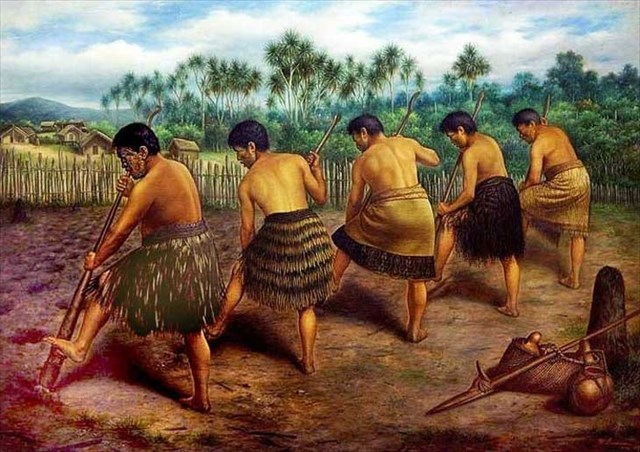
Tools were made primarily from hard woods and were designed to poke and prod the soil rather than turn over clods of earth. Cultivation was labour-intensive, especially in poor and hard soils. The three main tools used by Māori were the kō, kāheru and timo.
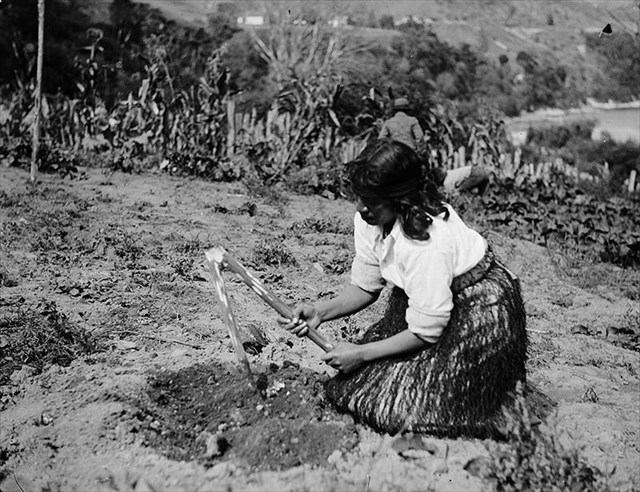 Kō - was a form of long-handled digging tool that was used to loosen soil and was the most widely used of all Māori agricultural tools. It was used either with or without a teka (foot tread) and had various shapes and lengths. It was made from a variety of woods, depending on the nature of the soil and the requirements of the user.
Kāheru - was a form of wooden spade that was used for loosening soil and weeding. Kāheru were made from a variety of woods, including maire, mānuka, mataī, and akeake, though some were also made of bone or stone.
Timo - were grubbing hand tools used for loosening soil while in a sitting or squatting position. They were often made from a forked branch with a flattened blade and a round handle.
Early Māori worked together to cultivate and maintain their gardens. Homage was paid to the god of cultivated food, Rongomātāne, to ensure good crops. There was little idleness. Chiefs and their families set the example of labour - which was followed by all.
When standing on the viewing platform of Te Toto Gorge, have a look down and try to imagine the gardens as they were many years ago. From this awe inspiring view it’s easy to appreciate the early peoples’ hard work and dedication to the land.
-- This cache is made from some old boards we had lying around, tiles left over from a building project, sticks gathered from a nearby reserve, metal pole that once held a playhouse mailbox in the backyard, a few repurposed items from the local op shop, paint test pots we already had and a whole lotta patience. --
The lock code is: 3274
Note:
• If caching with a mobile phone you should note down the details, screen shot the map or use offline mapping before driving to this area as there is little/no mobile coverage here.
• This cache is intended to be found from the Raglan end of the road only (if you do not have a 4WD vehicle and do not wish to travel on a long unpaved windy road). Please take Whaanga Road passed Manu and Whale Bays from Raglan to get to the cache.
• The last section of the road to this cache is gravel, at times narrow and winding - please drive carefully. For your efforts you will be rewarded with fabulous views and a little adventure.
References:
• https://doc.govt.nz/parks-and-recreation/places-to-go/waikato/places/karioi-area/te-toto-gorge
• https://tangatawhenua16.wixsite.com/the-first-ones-blog
• https://teara.govt.nz/en/gardens/page-1
• https://tepapa.govt.nz/discover-collections/read-watch-play/maori/maori-gardening-tools
• https://teara.govt.nz/en/nga-tupu-mai-i-hawaiki-plants-from-polynesia