Mullinmur Constructed Wetlands

The Mullinmur Wetland on the Lower Ovens is a 3.73ha freshwater marsh. The wetland is a billabong (old river channel) which is recharged with water from the Ovens River during periods of flooding. The wetland is owned by, used and managed by the local Catholic schools in partnership with the Wangaratta Sustainability Network (WSN).
The North East Catchment Management Authority (CMA), with the WSN, have established the billabong as a ‘wetland demonstration site’, to show the importance of appropriately managed wetlands in the North East CMA regional landscape. The project also aims to assist schools and the WSN to educate students and the community on the important ecological functions that wetlands provide. Please take the time to enjoy a walk around the billabongs and take note of the many information boards that have been installed which provide further information about the Mullinmur Billabong project.
This Constructed Wetland is essentially what’s known as a Bioretention facility or a ‘rain garden’, one of a variety of urban development practices designed to naturally treat polluted stormwater runoff.
The Mullinmur Billabong site has three connected pools that have been modified to form a chain of Constructed Wetlands. These constructed wetlands are engineered systems that use natural functions (vegetation, soil, and organisms) to treat and remove pollutants from storm water before it enters Mullinmur Billabong and the Ovens River.
Bioretention facilities reduce the flow rate and pollutant load of runoff from urban areas like roads, roofs, driveways, walkways, and compacted lawn areas. They rely on plants and a natural or engineered soil medium to retain stormwater and increase the lag time of infiltration, while remediating and filtering pollutants carried by urban runoff.
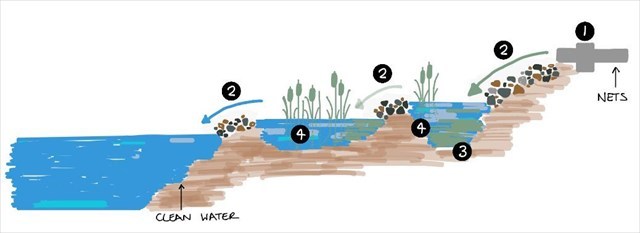
How this works:
- Rubbish is filtered from the storm water inlet.
- Water flows through rocky channels aerating the storm water, which helps break down pollutants.
- The ponding areas provides a temporary storage location for runoff prior to its evaporation or infiltration. Sediment and heavier metals settle in deeper ponds.
- The organic components in the ponds filter pollutants and provide an environment conducive to the growth of microorganisms, which degrade petroleum-based products and other organic material. This component also prevents the erosion and drying of underlying soils. The clay in the planting soil provides adsorption sites for hydrocarbons, heavy metals, nutrients and other pollutants.
To log this earth cache:
Park at the recommended trailhead and take a short walk to the posted coordinates. You will pass several information boards and photo points which you can learn more about the restoration of the billabong site and the management of it to create a healthy ecosystem.
Once you reach GZ you are to being answering the following questions, here you will find the first of the three ponds. The questions will require you to continue to walk the billabong loop trail (approx. 1km). You may log the EC straight away but please send me your answers to the questions within 4 days otherwise your log will be deleted.
Questions
Through observation of the site;
1. What can you see in these constructed wetlands that would remove various pollutants?
2. Describe the differences between the rocky channels in between the ponds. What is the effect of these differences?.
3. Describe the (subtle) differences in characteristics between the three ponds. Why are they different and how does this contribute to the overall function of the system?
4. An accompanying photo of yourself and/or your group visiting the site is also required. This can be attached to your log but please avoid spoilers for the above questions.
